
“Thirteen governments [of the original states] founded on the natural authority of the people alone, without a pretence of miracle or mystery, and which are destined to spread over the northern part of that whole quarter of the globe… gained in favor of the rights of mankind.” — John Adams
American Exceptionalism: A Chimera
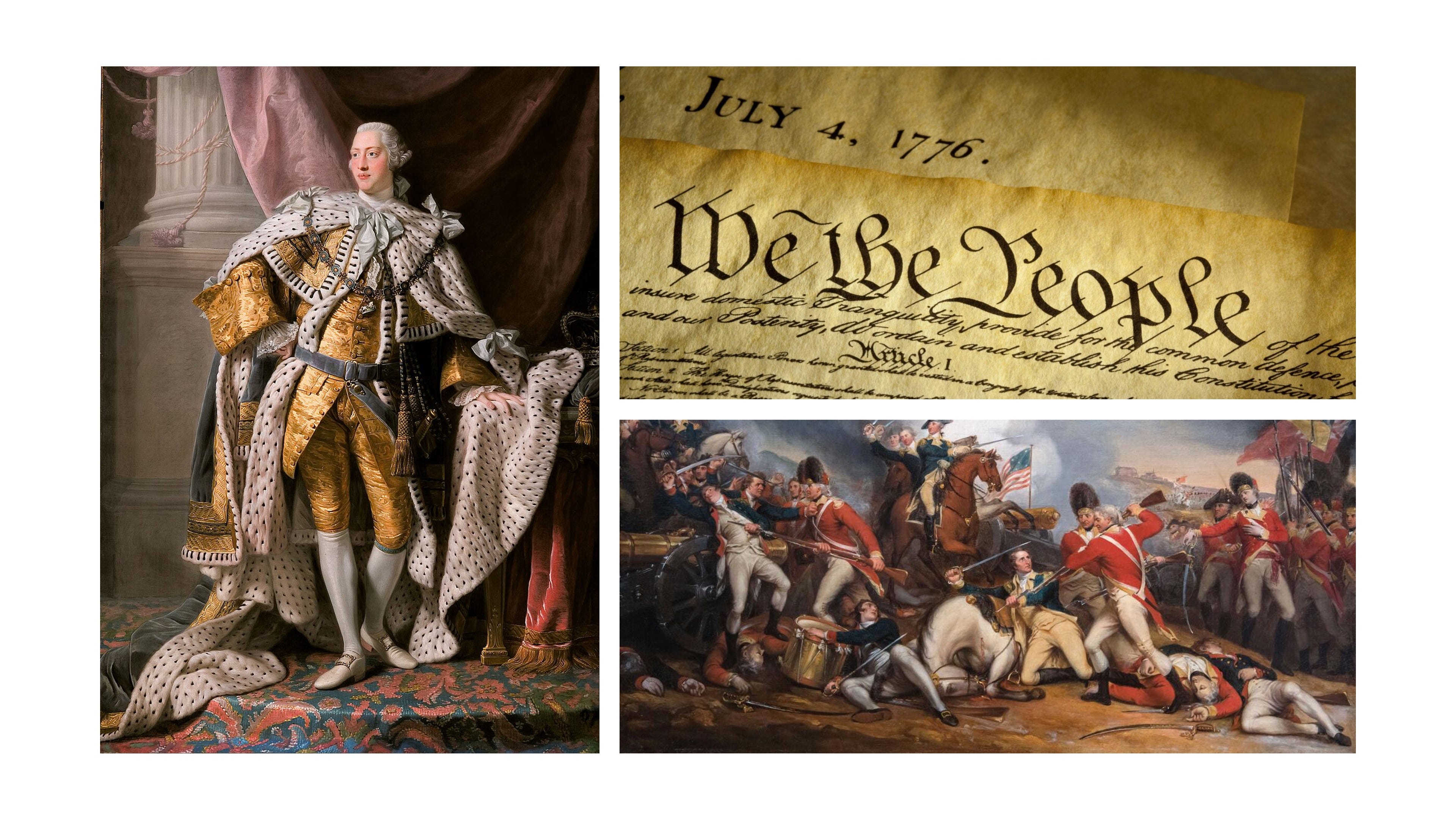
In July our entire country celebrated the 250th anniversary of the American Revolution and the achievement of independence from King George III,1 whose subjects we had been. Leading up to this historic event, the Trump Administration launched an initiative called “Freedom 250.” President Trump’s fundamental reflection was as follows: “With a single sheet of parchment and 56 signatures, America began the greatest political journey in human history.”
This sentiment is thoroughly American. For better or worse — we consistently have argued the latter in our Journal — our country has always viewed itself as unique in its animating spirit, principles, form of government and founding philosophy. This is the vaunted “American Exceptionalism” we hear so much about; a designation in which we would take no issue, were the qualities in question actually exceptional.
While calmly stating this unpopular truth, we must affirm our commitment to and love of our country, heading off the likely objectors. Recall, it is with principles, not passions, that sound judgments are made.
Underlying our love of country, true patriotism,2 are principles independent of the circumstances we find ourselves in today. This patriotism affirms and wants to cultivate the existing good in America while opposing whatever evil is actually present — no more, and no less.
Returning to the claimed American Exceptionalism, perhaps one of the most authoritative witnesses is the celebrated “Father of the Constitution,” James Madison. Writing in Federalist no. 14 in 1787, Madison first entertained the prospect of the Revolution not happening, speculating, “the people of the United States might, at this moment, have been numbered among the melancholy victims of misguided councils, must at best have been laboring under the weight of some of those forms which have crushed the liberties of the rest of mankind.”3 Given the American Revolution did succeed, however, he claimed for the Revolution a status “which has no parallel in the annals of human society”, since it established “fabrics of governments which have no model on the face of the globe.”4 The significance of this remark can hardly be overstated: one of the most influential “Founding Fathers” confirmed that both the American Revolution and the governments it produced were without historical precedent.
This same Madison — defender of the Constitution against the anti-Federalists — was also the architect of a second, no less celebrated exceptionalism: a commitment to separating Church and State rivaled only by Thomas Jefferson. In a letter to Edward Livingston in 1822, consistent with his strict stance for separation maintained throughout his life, Madison affirmed the Masonic ideal5 of all government entirely indifferent to religion:
I observe with particular pleasure the view you have taken of the immunity of Religion from civil jurisdiction… Every new & successful example therefore of a perfect separation between ecclesiastical and civil matters, is of importance. And I have no doubt that every new example, will succeed, as every past one has done, in shewing that religion & Govt. will both exist in greater purity, the less they are mixed together.6
Pleased with Livingston’s commitment to this religious liberalism,7 Madison was untroubled by this novel and radical view, whereas the ancient, medieval and Catholic view always proclaimed the union and cooperation of Church and State — a view even all Protestant sects had shared until the American Revolution. Madison accurately summarized it as holding “the establishment of Religion by law, was right & necessary; that the true religion ought to be established in exclusion of every other; And that the only question to be decided was which was the true religion.”8
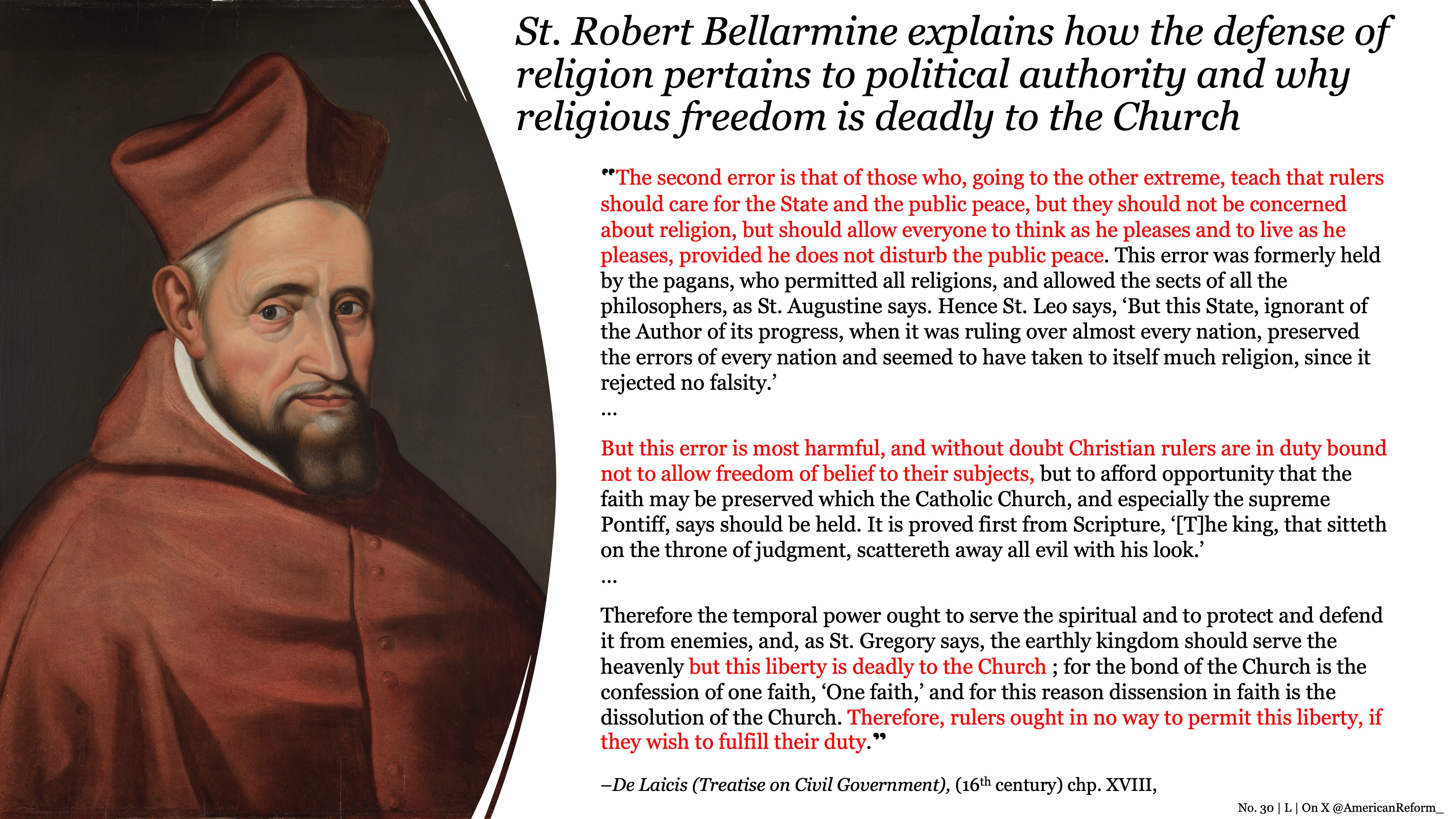
But the American Republic departed, and proudly so, from this natural, timeless and harmonious union of Church and State. This was motivated in no small part by Madison’s activism, preceded by both his and especially Thomas Jefferson de-confessionalizing Virginia. Remember, prior to the introduction of “religious liberty” in Virginia, there was a state-established Anglican church. Jefferson candidly explained what motivated its introduction in his autobiography, emphasizing that the satanic principle of religious freedom — for who would afford Truth and error equal rights as an ideal — applied to members of every religion:
“Where the preamble declares, that coercion is a departure from the plan of the holy author of our religion, an amendment was proposed by inserting “Jesus Christ,” so that it would read “A departure from the plan of Jesus Christ, the holy author of our religion;” the insertion was rejected by the great majority, in proof that they meant to comprehend, within the mantle of its protection, the Jew and the Gentile, the Christian and Mohammedan, the Hindoo and Infidel of every denomination.9
In what may astonish many, forgotten is the approval of George Washington for this act, who relayed to George Mason that a continuing state religion in Virginia would be offensive to a “respectable minority.”10 This is the same Washington who was relieved in 1790 that the American political project confidently overcame the religious toleration of Europe, in favor of “having given to mankind examples of an enlarged and liberal policy: a policy worthy of imitation,” that all men “possess alike liberty of conscience and immunities of citizenship.”11 His revolutionary call for imitation was well-heeded: every European country in the world, beginning with France in 1789, went on to introduce the solvent of “religious freedom” into its political order.
As we argued earlier this year, this American “exceptionalism” and its legacy has come at tremendous cost:
Yes, a godless constitution for a godless republic — harsh to hear, but the history bears it out. Consider that our Constitution has been amended twenty-seven times since it was ratified in 1788, however no amendment has ever declared the government to have any religious belief, much less a Christian one.12 That said, there have been meaningful efforts to rectify the omission of what has been termed a “Christian amendment.” During the nineteenth century, the Protestant-led “National Reform Association” made promising steps to both enshrine the Holy Name of Jesus in the Constitution and derive the authority of government from God. However, both efforts failed, not even making it to a vote in Congress.13
Not content with keeping these principles confined to the eighteenth century, America’s presidents and statesmen wanted to see the intensification of the Liberal revolution. Chief among them, alongside Washington and Jefferson, was John Adams. A free-thinking, unitarian radical who blasphemed the the Cross of Christ and the Church,14 Adams wrote to the prominent Jewish statesman Mordecai M. Noah in 1818 that “This Country has done much,” but he wished “it may do more, and annul every narrow idea in Religion, Government and Commerce” (emphasis added).15 He was moved by the conviction, in his own words, to “please the Providence of the ‘first Cause,’ the Universal Cause [ed. phrases by which Adams’ defined his God], that Abraham should give Religion, not only to the Hebrews but to Christians and Mahomitans, the greatest Part of the Modern civilized World.”16
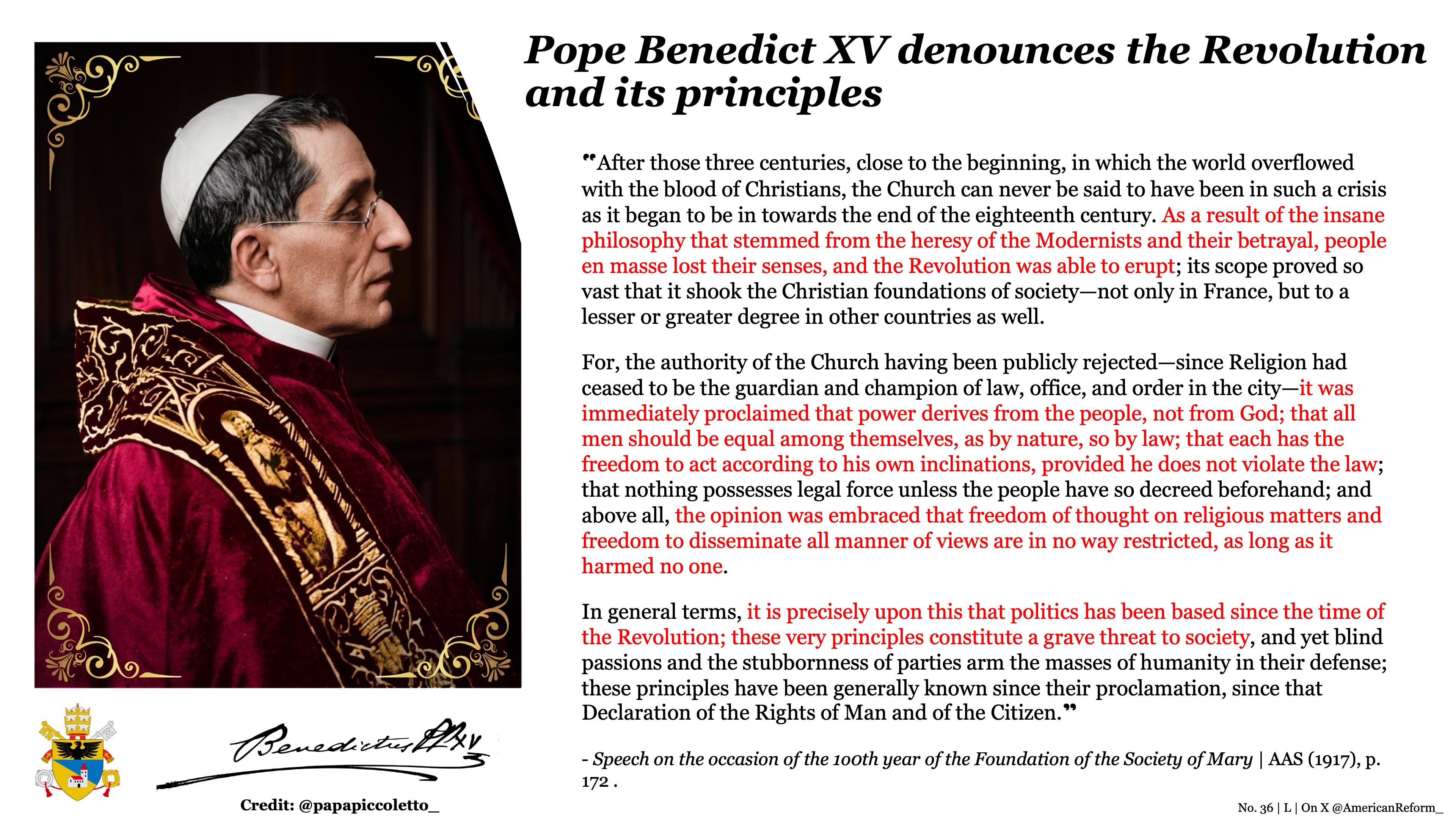
How fitting does all this cohere with what Pope Leo XIII warned in his encyclical Immortale Dei, fittingly “On the “Christian Constitution of States”, where he described the “tenets of unbridled license” culminating in a “new conception of law… at variance on many points with not only the Christian [law], but even the natural law.”17 A new system of government where “The authority of God is passed over in silence, just as if there were no God; or as if He cared nothing for human society.”18
No man then, whatever his rank, should claim “America began the greatest political journey in human history” and not expect to be “likened unto a foolish man, who built his house upon the sand (Matt. VII, 26).”
Leo XIII, President Washington, and the Perils of Prooftexting
Hoping to stave off criticism of the American Revolution and Founding, especially when it is severe, the retort from many Catholics is to energetically repeat the praise of Pope Leo XIII for our Republic’s first President. The source of the praise is, of course, the 1895 encyclical Longinqua Oceani “On Catholicism in the United States.” In the text Pope Leo XIII not only gives recognition for Catholic aid in the American Revolution,19 but issues several significant compliments for George Washington.
Before recalling the relevant remarks, it it is essential to remind ourselves of the two most salient points of the encyclical.20 First, the Church at the end of the nineteenth century was growing rapidly in America, aided by the freedoms granted to it by the new republic, but this was accidental — every false religion had the same exact freedoms and privileges — and is rather to be attributed to the “fecundity with which God has endowed His Church.” Secondly, the Church would do better with privileged support and protection from the government, and that “it would be very erroneous to draw the conclusion that in America is to be sought the type of the most desirable status of the Church.”
Now, turning to the pontifical remarks concerning President George Washington, we will briefly argue what they support and, no less importantly, by what they do not. In Longinqua Oceani, Pope Leo XIII called President Washington not only “great,” but an “illustrious citizen” with “keenness of insight worthy of his genius and statesmanship”21 In other words, this was deserved recognition of Washington’s natural virtues. Recall also that Popes, in addition to being teachers and legislators, are rulers of the universal Church and therefore prudence dictates establishing warm relations — to the extent possible — with all heterodox regimes and certainly not going out of one’s way to offend them. Why would President Washington be an exception?
Lest one think this kind of praise is unique to Washington, Pope Pius XII said similar things to the Indian ambassador to the Holy See in 1949 and even to Mahatma Gandhi, who was recognized as bequeathing his people a “legacy of great price: a staunch faith in the rightful ascendancy of the spiritual over the material.”22 The same Pope did not hesitate use honorifics for an infidel — that is, an unbaptized, pagan ambassador — whom he called “a representative so able and accomplished.”23Again, this was in the context of a newly-formed regime, the founding of modern state of India, so it made sense to secure the rights of the Church and Catholics by way of expressing personal respect for state leaders.
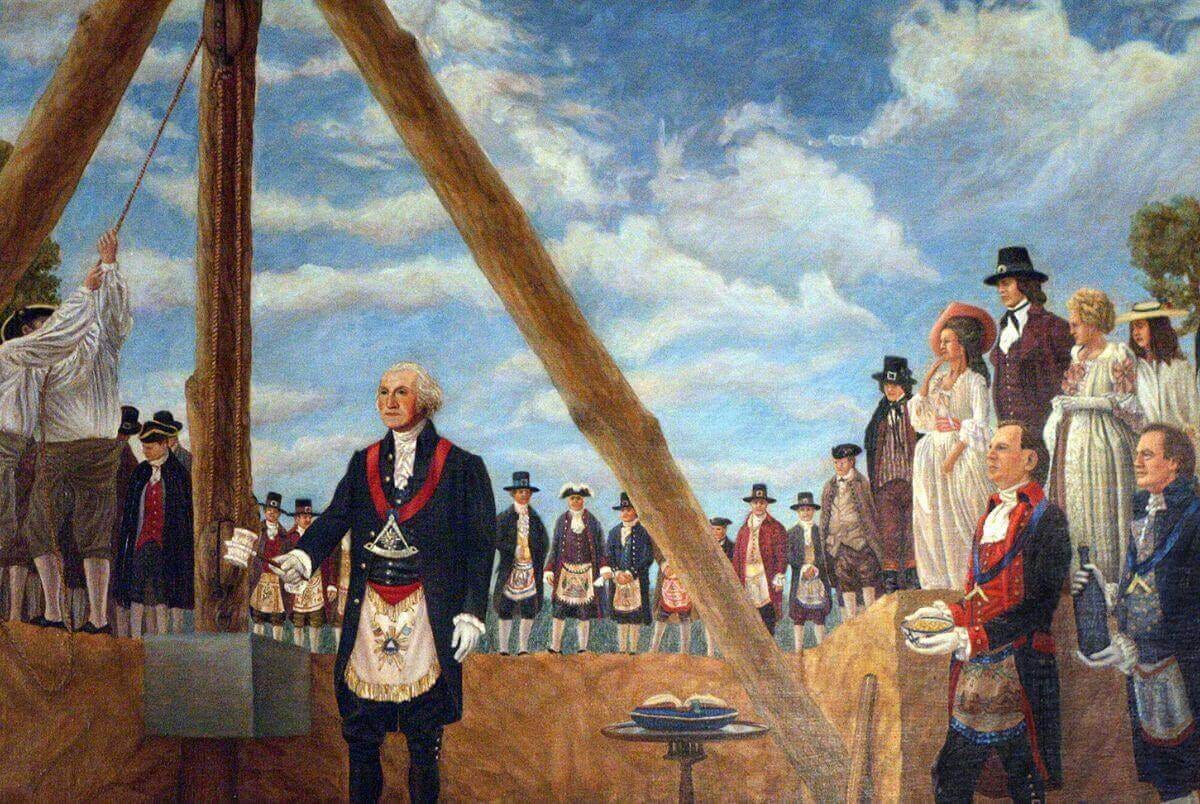
All this said, while it is true Washington had many admirable qualities,24 we know from Saint Paul that “Without faith it is impossible to please God” and that a committed Freemason,25 like himself, would not have faith.26
Washington’s commitment to religious indifferentism emerges clearly from this and other evidence. In a 1789 letter to the Hebrew Congregations of the City of Savannah, he first rejoiced that the “spirit of liberality and philanthropy is much more prevalent than it formerly was among the enlightened nations of the earth” (emphasis added).27 He continued in the letter, equating the “wonder-working Deity” of the Old Testament with that of modern Rabbinical and Talmudic Jews28 and then further with the God of “every denomination.”
In 1792, he told Sir Edward Newenham that “Of all the animosities which have existed among mankind those which are caused by a difference of sentiment in Religion appear to be the most inveterate and distressing and ought most to be deprecated.”29 In this revealing quote, Washington identifies the religious dogma producing strife between Ireland’s Catholics and Protestants as a mere “difference of sentiments”, recommending they cease hostilities since “religious differences” can and should be done away with. Any remaining doubt about his indifferentism vanishes with the next sentence in the letter:
I was in hopes that the enlightened & liberal policy which has marked the present age would at least have reconciled Christians of every denomination so far that we should never again see their religious disputes carried to such a pitch as to endanger the peace of Society (emphasis added).30
How far is this admonition from that of Our Lord Jesus Christ, who is (Jn. XIV, 6) “the way, the truth, and the life” and came (Matt. X, 34) “not to send peace, but a sword.” The false peace of this world is rather destroyed as a consequence of the Truth of the Gospel, not lamented. For is it not better to have temporal strife and eternity with God then temporal peace and eternity with the Devil?
Another interesting indirect detail about Washington and his legacy is to be found in the story of his monument and another Pope, Pius IX. In the late 1840s the Washington National Monument Society began soliciting help for the construction of a monument to President Washington, asking the American states and world leaders to furnish a memorial stone for its construction.31 Pope Pius IX obliged, commissioning a stone which simply stated “Rome to America” as a diplomatic gesture of good-will. However, before the stone could be installed, a radical band of anti-Catholic Know-Nothings raided the monument and destroyed the stone, refusing to allow it to be installed.
From the foregoing, it is clear that Pope Leo XIII simply praised the natural virtue of Washington, which is not a judgment on his whole person, necessarily. Neither is it a judgement on the legitimacy of the American Revolution, the degree to which the Federal Constitution coheres with Catholic doctrine nor a prohibition on analyzing both.
The Rights of Man vs. the Rights of God
On All Saints’ Day in 1900, Pope Leo XIII promulgated the encyclical Tametsi Futura Prospicientibus “On Christ the Redeemer” in which he criticized the endless, modern clamoring for the so-called “rights of man.” In response, the Vicar of Christ suggested, nay demanded, that the people instead “should hear of the rights of God.”32 These precious, inviolable rights of God so often overlooked by modernity, even scorned.
Examining our American tradition, one searches in vain for a single mention of the rights of God by a prominent political figure, let alone in our legislation. Who among us has ever heard a politician, governor or president — living or dead — talk about God’s rights? The revolutionary founders of our republic were no exception, having passed over in silence the grave duty of civil authorities offering public worship, obedience and honor to God who is Jesus Christ.33 This is the case with the Declaration of Independence and the 1788 Constitution. A government by the people, for the people and of the people has its consequences.
It is as the same Pope Leo XIII observed in his encyclical thunderously condemning freemasonry, Humanum Genus, in which he unmasked those who work towards:
[T]he utter overthrow of that whole religious and political order of the world which the Christian teaching has produced, and the substitution of a new state of things in accordance with their ideas, of which the foundations and laws shall be drawn from mere naturalism.34
The American conservative recoils at the thought of this charge being laid at his country — though conceived in revolution and Lockean philosophy, surely our country is an exception, right? Bishop Sheen, and more recently Bishop Barron and Michael Knowles would like to think so, merely following in the footsteps of Edmund Burke, a Protestant Whig who is the father of philosophical and political Conservatism.
Upon scrutiny, however, the American constitution and founding philosophy are the application of the principles of Liberalism and naturalism to government. It is a revolutionary new order for a country, indeed the world. A figure no less authoritative than Thomas Jefferson said as much. If law is to be interpreted according to the legislator,35 who better to relay the meaning of the Declaration of Independence? Here is what he had to say on June 24, 1826, just ten days before he died:
May it be to the world, what I believe it will be, (to some parts sooner, to others later, but finally to all,) the Signal of arousing men to burst the chains, under which monkish ignorance and superstition had persuaded them to bind themselves, and to assume the blessings & security of self-government. that form which we have substituted, restores the free right to the unbounded exercise of reason and freedom of opinion. all eyes are opened, or opening, to the rights of man. the general spread of the light of science has already laid open to every view. the palpable truth, that the mass of mankind has not been born with saddles on their backs, nor a favored few booted and spurred, ready to ride them legitimately, by the grace of god. these are grounds of hope for others. for ourselves, let the annual return of this day forever refresh our recollections of these rights, and an undiminished devotion to them (emphasis added).36
A more explicit confirmation of the significance and intention of the American revolutionaries could hardly be found. Not content with installing the “unbounded exercise of reason and freedom of opinion” in the new republic, Jefferson saw the Declaration to be a signal to the world — indeed it was — to throw off the old order of “monkish ignorance and superstition” while embracing the “rights of man.”
John Adams, whom we have already mentioned, reflected on the America Revolution and its effects in 1818 similarly:
The American Revolution was not a common Event. It’s Effects and Consequences have already been Awful over a great Part of the Globe. And when and Where are they to cease?… The Revolution was in the Minds and Hearts of the People. A Change in their Religious Sentiments of their Duties and Obligations… This radical Change in the Principles, Opinions Sentiments and Affection of the People, was the real American Revolution. By what means, this great and important Alteration in the religious, Moral, political and Social Character of the People of thirteen Colonies, all distinct, unconnected and independent of each other, was begun, pursued and accomplished, it is surely interesting to Humanity to investigate, and perpetuate to Posterity.37
If the Revolution’s own heroes are to be believed — and who is better to characterize it than those who made, supported and completed it — then America’s founding was not merely a political separation from King George III and Britain but a self-conscious “alteration” in the “religious, Moral, political and Social Character” of a people — precisely the “utter overthrow of that whole religious and political order” that Pope Leo XIII would later condemn. Jefferson, as the author of the revolutionary Declaration of Independence and Adams in the former’s words “the pillar of it’s support on the floor of Congress, it’s ablest advocate and defender”38 surely are to be taken at their word.
For us, as Catholics, it marks the first and deliberate departure from the old Christian order; in favor of a new one built, as Adams said at its inception, “Thirteen governments [of the original states] founded on the natural authority of the people alone, without a pretence of miracle or mystery, and which are destined to spread over the northern part of that whole quarter of the globe… gained in favor of the rights of mankind.”3940
May God have mercy on America.
Postscript
In due time at The Journal of American Reform we will delve deeper into the facts of the revolution, as we mostly concerned ourselves with a critique of the founding philosophy in this essay. Charles Carroll, the only Catholic signer of the Declaration, has a peculiar background and his well-known cousin John Carroll of Baltimore became America’s first Bishop. Importantly, the fundamental legitimacy — or lack thereof — of the American Revolution will also be examined in light of the principles of established, Catholic political philosophy.
In anticipation, one must therefore ask himself: what side were good Americans really on?
END.
CONSIDER SUPPORTING THE JOURNAL OF AMERICAN REFORM!
As I intend to devote more and more time to this political project, I want to continue to provide free, educational material, whether visual (graphics) or written (essays, translations and a forthcoming book) content. If you have benefited from my work in any way, kindly consider supporting The Journal financially. On a personal note, I am married and duty-bound to provide for my family, so any help, big or small, is appreciated. Subscribe or make a one-time donation.
Regardless, the production of free material will continue, hopefully with ever-increasing quality, and I will keep all my subscribers notified of my plans.
In addition to Substack, the home of The Journal, my work, graphics and commentary can be found on the following platforms:
X: @AmericanReform_
Telegram: @American_Reform
In 1775, one year before the Declaration of Independence was issued by the American Revolutionaries, King George III decreed a royal proclamation against the rebellion and sedition of his lawful subjects. These subjects, of course, were the American colonists. His decree was a direct response to the outbreak of violence and armed conflict at Lexington and Concord in April earlier that year.
In the proclamation, King George formally declared that the colonies were in a state of “open and avowed Rebellion,” accused colonists of being misled by “dangerous and ill-designing Men,” and ordered all civil and military officers, as well as loyal subjects, to help suppress the rebellion and bring the “Traitors” to justice.
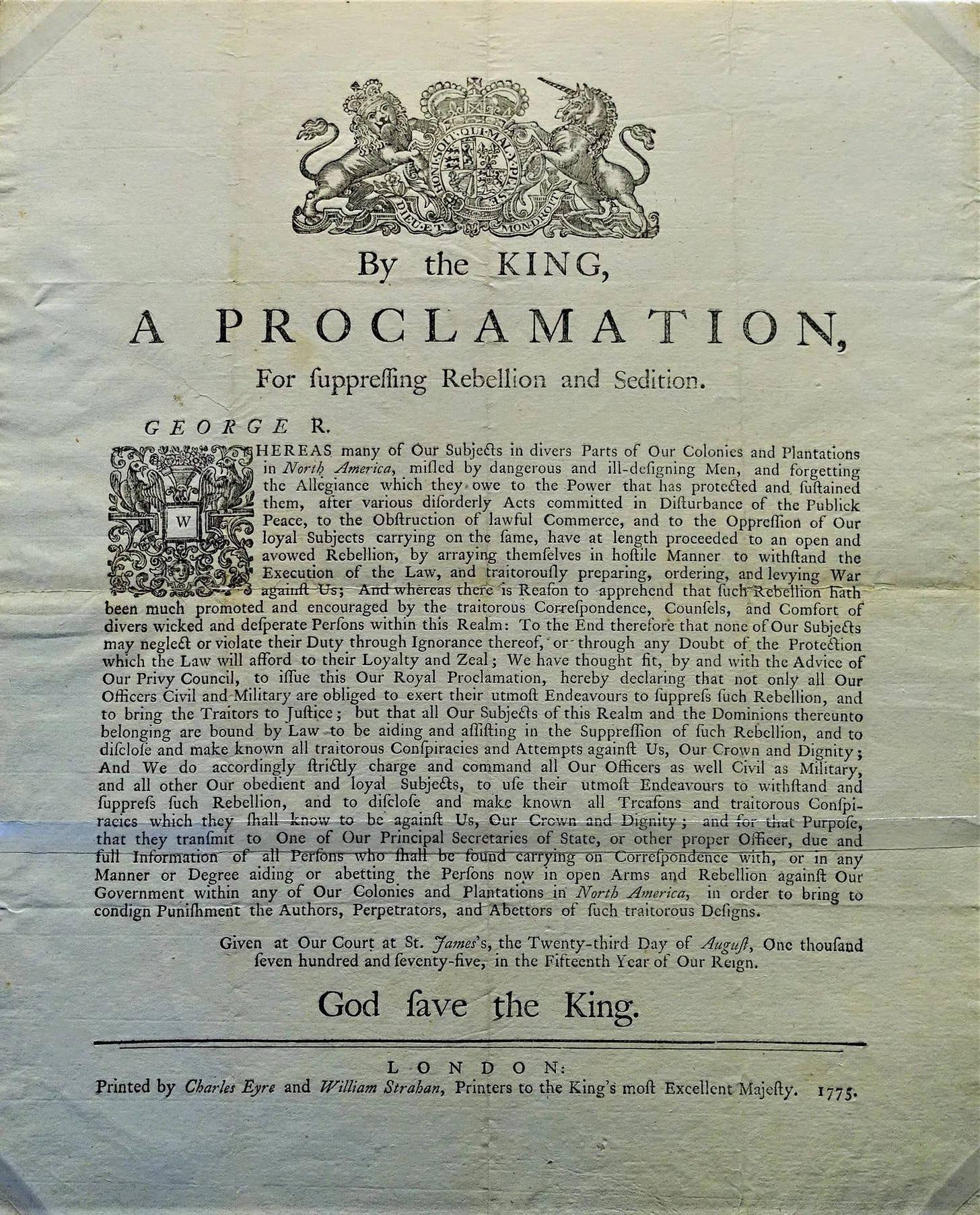
This proclamation marked a major turning point in relations between the King and his subjects — it was the stage at which England officially treated the American rebellion as treason rather than mere political grievance.
Fr. Edward Cahill, S.J., Framework of a Christian State, (1932), pp. 573-99.
James Madison, Federalist no. 14, November 30, 1787.
Ibid.
Pope Leo XIII, Humanum Genus, (1884), nos. 12-4.
James Madison, Letter to Edward Livingston, July 10, 1822.
Cf. Rev. Henri Grenier, Moral Philosophy, (1949), p. 452.
Letter to Edward Livingston, Ibid.
Thomas Jefferson, Autobiography, (1821).
George Washington, Letter to George Mason, (1785).
George Washington, Letter to the Hebrew Congregation in Newport, Rhode Island, (1790).
Christian in the broad sense, with certain qualifications, can refer to various members of Protestant or Photian sects but, strictly speaking, it belongs only to Catholics, the true Christians:
[A]s you are Christians, so are you to be Romans. To be Christian one must be Roman; one must recognize the oneness of Christ’s Church, that is governed by one successor of the Prince of the Apostles, who is the Bishop of Rome, Christ’s Vicar on earth. — Address of His Holiness Pope Pius XII to the National Pilgrimage of Ireland, (1957).
‘As long as it was in the body, it lived; separated, it forfeits its life. So the Christian is a Catholic as long as he lives in the body: cut off from it he becomes a heretic — the life of the spirit follows not the amputated member’ (S. Augustine, Sermon cclxvii., n. 4). — Encyclical of Pope Leo XIII, Satis Cognitum, (1896), para. 5.
Question: Who is to be called a Christian?
Answer: He who confesses the doctrine of Jesus Christ in his Church. Hence, he who is truly a Christian thoroughly detests all cults and sects found outside the doctrine and outside the Church of Christ, everywhere and among all peoples, as for example the Jewish, the Mohammedan, and the heretical cults and sects. — St. Peter Canisius, Sum of Christian Doctrine, (16th cent.), pt. 1, q. 1.
Similar proposals were considered by Congress in 1874, 1895, 1896, 1910, 1947, 1949, 1951, 1953, 1955, 1956, 1957, 1959, 1961, 1963, 1965, 1967, and 1969 but none passed.
Cf. John Adams, Letter to Thomas Jefferson, September 3, 1816 —
Dear Sir — I almost Shudder at the thought of alluding to the most fatal Example of the Abuses of Grief, which the History of Mankind has preserved. The Cross. Consider what Calamities that Engine of Grief has produced.! With the rational Respect that is due do it, knavish Priests have added Prostitutions of it, that fill or might fill the blackest and bloodiest Pages of human History.
John Adams, Letter to Mordecai M. Noah, July 31, 1818.
Ibid.
Pope Leo XIII, Immortale Dei, (1885), no. 23.
Ibid., no. 24.
Cf. Longinqua Oceani, (1895). no. 4 — The recognition of American independence, which Pope Leo XIII simply relays as fait accompli, is often misconstrued to be Papal justification for the same Revolution. In reality, it is a separate question and, to our knowledge, has never been addressed by the Holy See. Moreover, given that the 1783 Treaty of Paris saw English recognition of American Independence it is no surprise that, over one hundred years later, Leo XIII would simply acknowledge this fact, offering both diplomatic overtures and earned compliments to the young Republic.
Ibid., no. 6.
Ibid., no. 4.
Pope Pius XII, Address to the Ambassador of India, (1949).
Ibid.
The theoretical and practical judgement of the Popes on matters of faith and morals, particularly in Encyclicals, is often coupled with other, diplomatic statements and comments about historical facts. Though we do not, perhaps one could argue that Pope Leo XIII simply misjudged the character of Washington, and still not call into question the magisterial authority of Longinqua Oceani and its author.
When President George Washington died on December, 14 1799 at the age of 67, he was buried in his Masonic apron and given Masonic funeral rites. One of the three doctors present during his last days was a Mason, hailing from the Alexandria lodge. Finally, the Bible that was used to preside over his funeral is considered a Masonic artifact and is currently owned by the Federal Lodge No. 1, a Scottish Rite of Freemasonry based in Washington, D.C.
Rather telling is the reply of George Washington to Rev. Samuel Langdon on the eve of the Thanksgiving Proclamation of 1789. Anticipating the speech, Langdon urged Washington to “let all men know that you are not ashamed to be a disciple of the Lord Jesus Christ.” Rather than affirming any Christian doctrines, or the Holy Name, Washington wrote back offering thanks to the generic and impersonal “Author of the Universe.” Unsurprisingly, in the Thanksgiving Proclamation no Christian doctrines were affirmed.
George Washington, Letter to Hebrew Congregations of the City of Savannah, June 14, 1789.
Cf. 1 Jn. II, 22.
George Washington, Letter to Edward Newenham, October 20, 1792.
Ibid.
August Imholtz Jr., The Pope’s Stone: Part One, 2010.
Pope Leo XIII, Tametsi Futura Prospicientibus, (1900), no. 13.
Pope Pius XI, Quas Primas, (1925), no. 32.
Pope Leo XIII, Humanum Genus, (1884), no. 10.
St. Thomas, ST I-II, Q. 96, art. 6, s.c. —
On the contrary, Hilary says (De Trin. iv): “The meaning of what is said is according to the motive for saying it: because things are not subject to speech, but speech to things.” Therefore we should take account of the motive of the lawgiver, rather than of his very words.
Thomas Jefferson, Letter to Roger Weightman, June 24, 1826.
John Adams, Letter to Hezekiah Niles, February 13, 1818.
Thomas Jefferson, Letter to William P. Gardner, February 19, 1813.
John Adams, A Defense of the Constitutions of Government of the United States of America, (1787).
Later in 1788 Adams would declare in the third volume of his work (pp. 505-6) that — in addition to the State constitutions — the Federal Constitution, contained “the principles we have attempted to defend [and which] have been acknowledged.” A few sentences later, he went further and claimed that the 1788 Constitution was “without all partiality or prejudice, if not the greatest exertion of human understanding, the greatest single effort of national deliberation that the world has ever seen.”
This is a great article and a much needed conversation.
Having four direct ancestors who fought in the Revolution, it is time that we call the errors and lead a process to remedy the inherent evils in our current system.
Great work!
I am a subscriber but am not receiving emails to alert me to new posts.