
Commentary on the Errors Concerning Liberalism in Pius IX's Syllabus — Maupied, 1877
Msgr. F.L.M. Maupied provides critical insight for understanding Pope Pius IX's condemnation of modern Liberalism and its application to Church-State relations and the social rights of God

“Since the Catholic religion is the only divine one, it is also the only religion that can lead humanity to its final and divine destiny; therefore, by full natural right, and consequently also by full social right, it must be the religion of every state, of every government that knows its truth. But, above all, it must be the state religion of every nation, the majority of which is Catholic…That this protection of the true religion should be the primary aim and principal duty of every government, the Holy Spirit teaches us first through the Apostle St. Paul, and then through the divine authority of the Church.” - Msgr. F.L.M. Maupied
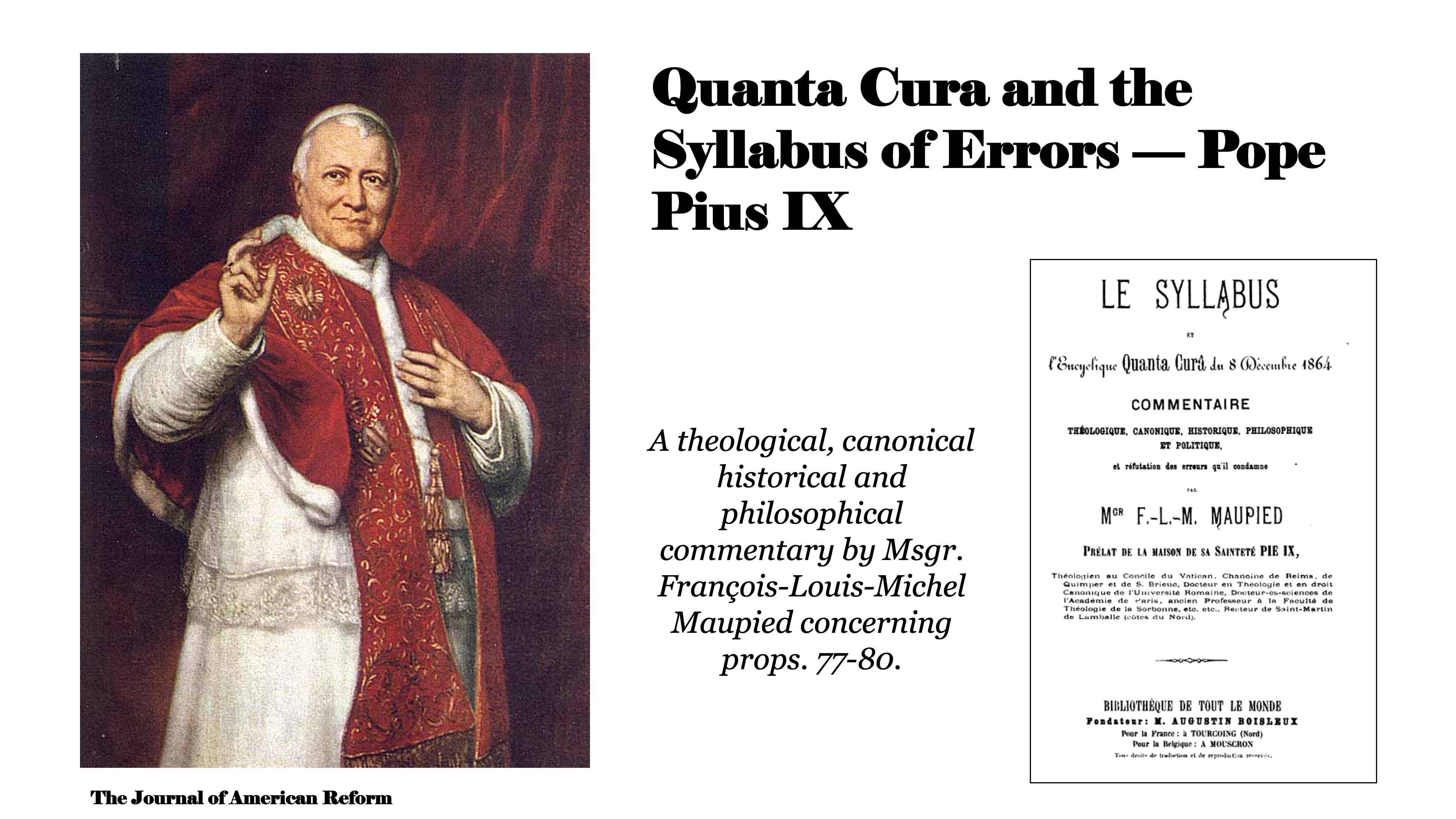
The Syllabus of Pius IX: An Introduction to Maupied's Commentary
Continuing our study of the relations between Church and State at The Journal of American Reform, it is only natural to turn to the Syllabus of Pope Pius IX. In fact, this document ought to serve as the lodestar for Catholic thinking on the matter, coupled with the positive doctrine outlined in Pope Leo XIII’s Immortale Dei “On the Christian Constitution of States”.
Promulgated in 1864, the Syllabus contains a list of eighty condemned propositions the modern, revolutionary paradigm — ushered in by the American and French revolutions — embraced as shining ideals. It was attached to the Quanta Cura “Condemning Current Errors” of the same Pontiff, in which the right to religious freedom was infallibly condemned.
The portion of the Syllabus we will focus on is the tenth chapter, on the errors of modern Liberalism. Our guide will be Monsignor François-Louis-Michel Maupied.
Born in 1848 in La Poterie, France,1 Maupied became a gifted theologian whose commentary on the Syllabus is, in our humble view, invaluable. Maupied draws on Catholic theology, philosophy and canon law, as well as the historical circumstances in which Pius IX’s condemnations were issued. We will examine the doctrinal authority of the Syllabus more fully at a later time; it suffices to say that its errors were and remain condemned.2 While every error proscribed by the authority of Pius IX is not be to considered as heretical, no Catholic may defend any of its theses without endangering his eternal salvation.3
To our knowledge, this commentary is unknown to the English-speaking world, and we are pleased to bring it to light, however modestly.
As a testament to Monsignor Maupied’s fidelity to the Holy See and his zeal in combatting doctrinal error, we reproduce below the translated 1877 letter written in the name of Pope Pius IX by His Excellency Monsignor Charles Nocella:4
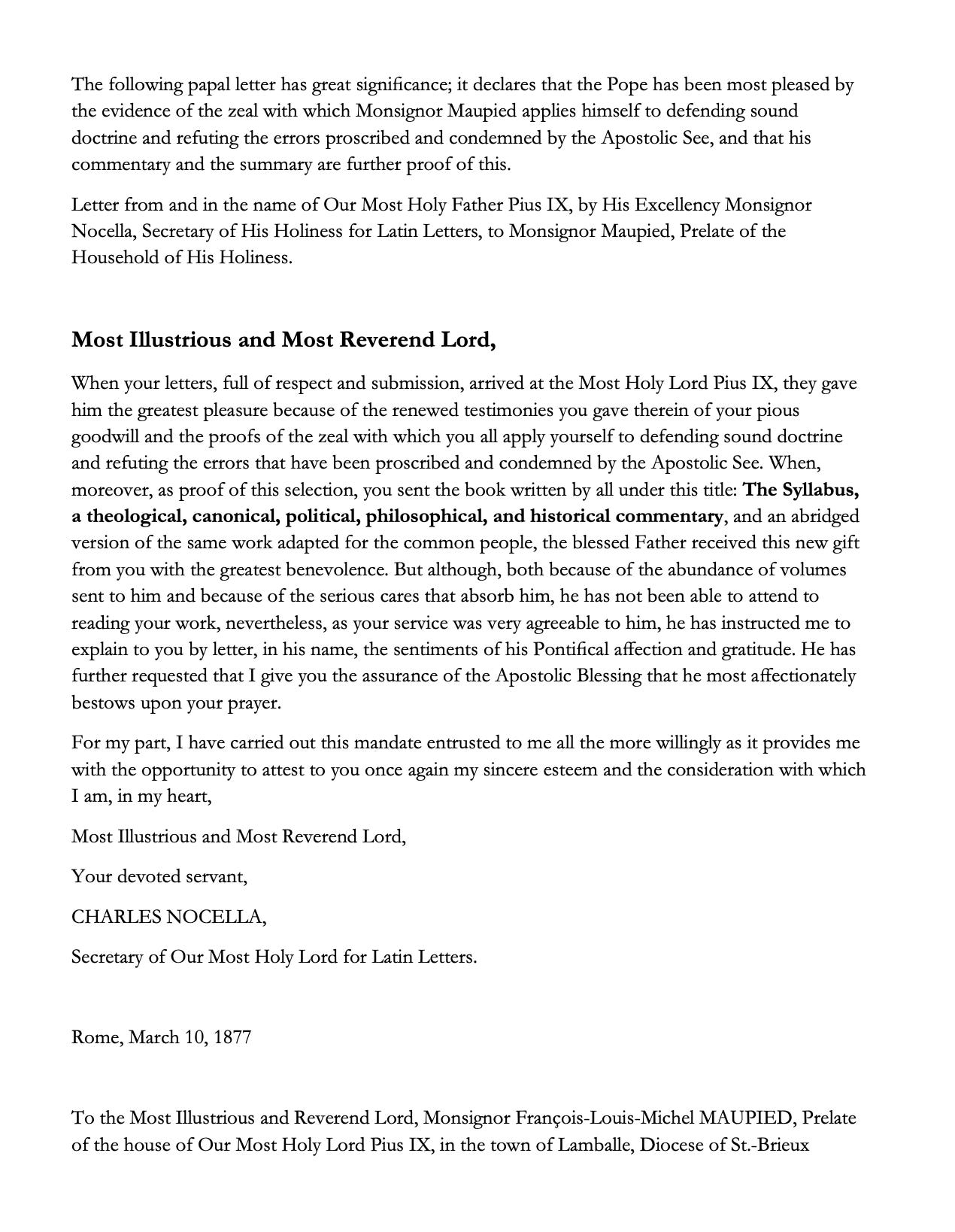
In addition to the above letter, many other documents testify to the orthodoxy and acclaim of Monsignor Maupied.5
Catholic Doctrine on Church-State Relations and True Tolerance
In this commentary from Monsignor Maupied, we will find further confirmation of the perennially valid and unalterable Catholic doctrine concerning relations between the Catholic Church and Catholic State, to which all States are objectively and universally obliged to conform.6
As Monsignor George Shea proved in his 1950 study, drawing principally from the ecclesiastical magisterium, the Catholic State as such, not merely civil society considered distinct from public authority, must:
To satisfy its religious obligations... worship God not only indirectly, virtually, administratively, but also directly and formally. That is to say, not only, for example, by abstaining from whatever is contrary to divine law, not only by positive furtherance of public religion, not only by legislation, ex motivo religionis, against perjury, public blasphemy, writings inimical to public religion and morality, etc., but also by official participation in acts of worship properly so-called—of adoration, thanksgiving, supplication, and the like.
This was the same conclusion reached by Cardinal Alfredo Ottaviani, Father Reginald Garrigou-Lagrange, O.P. and, at risk of repeating ourselves, outlined by Father Anton Straub, S.J.:
The Church per se cannot approve political tolerance, in which false religions are not prevented from spreading by civil power, or are even to some extent encouraged by civil law, or are considered to have the same number of civil rights as the true Church of Jesus Christ, but for its sacred function the Church by itself must absolutely want, corrupters of the only legitimate cult, such as men who are rebellious or certainly enemies both of the ultimate end of humanity and of the temporal peace it is seeking to obtain, to be avoided or justly coerced, but that cult, both accepted by individuals and by entire cities, as far as it is in them, to be retained, defended, and promoted.
Now, further distinct from the political tolerance of above is another concept: civil tolerance.7 With civil tolerance, it is a matter of tolerating erring individuals and only for the sake of the common good;8 this is the only legitimate reason and does not establish correlative rights for heterodox citizens in their commission of error. There is also no “right” to protection — which is sometimes referred to as a “negative right” — from the State in professing public error,9 no matter how sincere its exponent.
Unlike with political tolerance, the Church is not opposed, in principle, to civil tolerance but rather demands her members practice it in imitation of Our Lord. As Monsignor Maupied will explain “Indeed, the Catholic Church, instructed by its divine founder, has always desired civil tolerance for those who are in error, protecting them in all their temporal rights while preventing them from harming the state and religion of the majority of Catholic citizens.”
A good example of this is permitting, in a Catholic State, non-Catholics to practice their religion in private, provided it can be done without scandal and the appearance of indifference.10
With all these principles in mind, we will now turn to a few highlights from the study:
Highlights
This gives us the strict meaning of the condemned proposition, whose true contradiction is this: “In our time, it is still useful that, wherever possible, the Catholic religion be considered the sole religion of the state, to the exclusion of all other cults.”
These ignorant multitudes have an absolute need to be protected by ecclesiastical and civil laws against the seductions of error, against the corruption of perverse doctrines, and against their own concupiscence. Now, the so-called civil liberty of all religions and the full power given to all to openly and publicly manifest all their thoughts and opinions inevitably plunge peoples, as experience proves, into the corruption of morals and spirit, and spread the plague of indifferentism—that is to say, the greatest of misfortunes for time and for eternity.
Here, finally, is the last word of the anti-Christian sect, the long-considered grand goal of the Masonic lodges: the destruction of the Church of Jesus Christ by its own Vicar. It is now common knowledge that Freemasonry dreamed of having a Pope of its own choosing, a Pope who belonged to them, who was their follower and their blind instrument to destroy the reign of God and Christ on earth and establish the sole reign of Satan with its train of errors, iniquities, injustices, and corruptions…
This means that the Roman Pontiff reconcile himself and compromise with all the errors and heresies that the syllabus has condemned; that he admit, with the Freemasons, that all religions are equal and indifferent, and that, consequently, the Church of Jesus Christ have nothing more or superior to all the heretical and diabolical sects, than the idolatry of paganism; that he admit, with liberalism, the best ally of Freemasonry, that the civil liberty of all religions and the full license granted to all to publish their thoughts and opinions, even the most abominable, corrupting, and impious, is a good and a step forward;
Most of our posts are free, however if you are able to support us, please consider upgrading to a paid subscription — it helps enormously.
With a paid subscription, you will get:
Subscriber-only posts and full archive
Post comments and join discussion
Support for the mission of American Reform
Discounts to books and merchandise
Now, without further ado, The Journal of American Reform is pleased to present Monsignor F.M.L. Maupied’s 1877 commentary on the Syllabus of Errors, specifically the propositions associated with modern Liberalism.
Proposition 77.
LXXVII. — “In the present day it is no longer expedient that the Catholic religion should be held as the only religion of the State, to the exclusion of all other forms of worship.”
This proposition summarizes what is refuted by the address of Pius IX, Nemo Vestrum of July 26, 1855, concerning Spain and condemning “all that the secular power then did against the Church, against its freedom and its rights, against the authority of the Holy See, whose solemn convention was violated, against the law of nations; the pontiff deplores that the authority of the bishops in the exercise of their ministry was hindered, that violence was used against these same bishops, and that finally the patrimony of the Church was usurped, against all divine and human rights.”
This gives us the strict meaning of the condemned proposition, whose true contradiction is this: “In our time, it is still useful that, wherever possible, the Catholic religion be considered the sole religion of the state, to the exclusion of all other cults.”
The Pope is declaring by this that wherever the Catholic religion is the religion of the state or of the greater part of the nation, as in Spain, it should always be considered as such so as not to encourage the dangerous progress of error.
It would nevertheless be a grave error to conclude from this that a state religion is that which the state imposes on its subjects solely for political reasons, which it teaches, governs, and administers, as in all Protestant and schismatic countries. Such a religion, which is the enslavement of consciences to the tyrannical will of the state, may be called national; but it is the very opposite of the Catholic religion which recognizes no other law of conscience, no other supreme authority than that of God, represented by his Vicar, to whom Jesus Christ promised his assistance and that of his Holy Spirit to ensure the infallibility of his teachings and judgments.
This is why the Catholic religion cannot recognize the supremacy of kings, emperors, or queens, of presidents of republics, of national, constituent or legislative assemblies, of any parliaments whatsoever, etc. But it submits all men, rulers and ruled, legislators, constituents, as well as the humblest subjects, to the divine authority of the Vicar of Jesus Christ in all that concerns their salvation, that is to say, the truth to be believed, the justice and morality to be practiced. Thus the Catholic religion, the only one that can be the religion of the state and not a national institution, nor a law of a human assembly, of parliament etc., guarantees equality and gives freedom to all consciences, both those of subjects and those of kings and any rulers whatsoever; by submitting the former and the others to the one divine truth, veritas liberabit vos “the Truth will set you free”, it delivers them from all injustice and all human tyranny; it delivers them from the bondage of error and sin. When it is thus professed by governments, which give the example of submission to its dogmas and precepts, and when they protect it out of duty, to the exclusion of all other so-called worship, to which they grant only civil tolerance, it is called the religion of the state.
Such is the strict meaning and primary purpose of the condemnation of this 77th proposition. But there is a broader meaning and other points of focus in this condemnation. Indeed, it targets liberalism, which prides itself on demanding and proclaiming in all things and everywhere the common law for error and truth, for Jesus Christ and Belial, which is nothing but religious indifference invented in Masonic lodges, which received it as Cromwell’s law, of which liberal Catholics are the most useful disciples, without realizing it.
The simplest arguments refute this grave error and justify its condemnation. And first, as there is only one God; there can be only one divine truth, revealed by God. Two contrary revelations would destroy each other and find the revealer in opposition to himself, deceiving and deceiving, and consequently not being the infinitely perfect God, whose existence and supreme perfection human reason alone is sufficient to demonstrate. Just as there can only be one revealed religion, there can only be one that conforms to the true destiny of humankind, that is, to the end for which God created us. This religion is the only one that can lead humanity to this final destiny willed by its Creator, and for this very reason, it is the only religion revealed by God.
Therefore, on God’s side, as on humankind’s side, there can only exist one divine religion, one positively revealed religion, one true religion.
Now, of all possible religions, this one is the truest, containing the greatest number of truths recognized by all others and demonstrable, without accepting their contradictions and errors. But the truest religion is obviously the only true one, and consequently the only divinely revealed one.
No one can deny that the Catholic religion contains all truths, of which the others retain only diverse and isolated fragments within each; that it offers reason only truths demonstrable by human reason, and then by that reason guided by the divine and infallible authority which certainly exists in the Church, and whose divine institution is easy to demonstrate.
The Catholic religion is therefore the only true one, the only divine and positively revealed one.
But besides this simple, irrefutable argument, the truth of the Catholic religion is supported by a multitude of proofs, a single one of which no other religion could produce. This is not the place to enumerate these proofs, the mere enumeration of which would require a large book. We have set them forth in our six-volume work, unpublished due to the difficulties of the times.
Since the Catholic religion is the only divine one, it is also the only religion that can lead humanity to its final and divine destiny; therefore, by full natural right, and consequently also by full social right, it must be the religion of every state, of every government that knows its truth. But, above all, it must be the state religion of every nation, the majority of which is Catholic. This majority, in fact, has the natural right to be governed in accordance with the dogmas and precepts of its religion, to be protected in the practice of this religion, and not to be hindered in it by any regulation, by any so-called law; it has the right not to be confused with, nor assimilated to, a minority that professes error, because that would expose it to falling into error itself and thus incurring the greatest of misfortunes, its eternal damnation. That this protection of the true religion should be the primary aim and principal duty of every government, the Holy Spirit teaches us first through the Apostle St. Paul, and then through the divine authority of the Church.
In his first letter to Timothy, chapter II, St. Paul implores us first of all to pray for all people, but particularly, “For kings, and for all that are in authority; that we may lead a quiet and peaceable life in all godliness and honesty. For this is good and acceptable in the sight of God our Savior; Who will have all men to be saved, and to come unto the knowledge of the truth. For there is one God, and one mediator between God and men, the man Christ Jesus; Who gave himself a ransom for all, this to be a testimony at the proper time.”
The apostle wants us to pray for kings, even pagan ones, since there were no others in his time, and for their ministers; so that these kings may provide the Church and its faithful with a peaceful and tranquil life that allows them to practice all the virtues that religion commands; but also so that all people may be saved and come to the knowledge of the truth, which is Jesus Christ. For since there is only one God and one mediator, one can only be saved through him. Now, all this must be fostered by the peace and tranquility that the governments must provide to the apostles, preachers, and all the faithful.
In his Epistle to the Romans, chapter XIII, the apostle teaches that all legitimate power comes from God, and that the prince is God’s minister for the good of his subjects, to protect those who do good deeds and to execute God’s vengeance against those who do evil. Now, what better actions are there than those commanded by God himself in the Catholic religion? Therefore, all princes and all governments have as their first duty the protection of the Catholic religion, according to the teaching of the Holy Spirit; this is why those who persecute it act tyrannically, and they cannot be obeyed in this matter even if they were legitimate sovereigns. (St. Thomas Aquinas, Summa Theologica I-II, Q. 95, Art. IV, Q. 96, A. IV.)
Catholic tradition is no less explicit; Pope St. Marcellus wrote to the tyrant Maxentius: “It is the duty of a good prince and king to restore ruined churches, to build new ones, to honor and defend God’s priests.” Isidor. Mercat. patrolog. Lat. Migne, vol. 130, p. 222.
Pope St. Leo the Great wrote to Emperor Leo: “Recognize, therefore, august and venerable Emperor, how that you are called by Divine providence to the guardianship of the whole world, and understand what aid you owe to your Mother, the Church, who makes special boast of you.” In another letter, he told him “that for the peace of the world he is the guardian of the Council of Chalcedon.” Epist. 164, etc. ibid., vol. 54, pp. 1117 and 1148.
The Sixth Council of Toledo in the year 680, under King Chintila, gave thanks to God that this king had undertaken to eradicate superstitions and that he did not allow anyone who was not Catholic to reside in his kingdom, ibid. vol. 130, p. 488.
St. Peter Damian, in his third letter to Emperor Henry II, shows him that the first duty of the emperor and king is to defend and protect the Church. ibid. vol. 144, p. 437, etc.
St. Bernard wrote to Conrad, King of the Romans, that it was in Caesar’s twofold interest to protect his own crown and to defend the Church... ibid. vol. 182, p. 442, epistle 244.
Canons 2, 3, and 4 of case 23, question 3 of the decree of Gratian, drawing from St. Augustine, establishes that emperors and kings must come to the aid of the Church against heretics and the powerful.
The dogmatic constitution of Boniface VIII, Unam Sanctam, confirmed by the Fifth Lateran Council, teaches that the two swords are in the power of the Church, the spiritual and the material. They must be exercised: the material for the Church and the spiritual by the Church, extravag. com. 1. I Title. VIII. cap I.
Pope Pius VII, in his encyclical Diu Satis of May 15, 1800, expressed himself thus: “There is no greater benefit or boast for kings and political leaders, as another wise and brave predecessor, St. Felix, wrote to Emperor Zeno, than ‘to allow the Catholic Church to enjoy its own laws and not to let anyone interfere with its liberty….For it is certain that it is beneficial for their own affairs, as God has laid down, for kings to submit their will to the priests of Christ when God’s business is in question, rather than imposing it.’”
Leo XII, in his apostolic letter, Quo Graviora, of March 13, 1826, puts his finger on the problem of the present proposition. 77. “Catholic princes, our dearest sons in Jesus Christ, for whom we have a special affection, we earnestly ask you to come to our aid. We remind you of these words that Leo the Great, our predecessor and whose name we bear, though unworthy to be compared to him, addressed to Emperor Leo: “You must constantly remember that royal power was not only conferred upon you to govern the world, but also and principally to lend a hand to the Church, by courageously suppressing the wicked, by protecting the good laws, by restoring order in all things where it has been disturbed.”
“Current circumstances are such that you must suppress these secret societies not only to defend the Catholic religion but also for your own safety and that of your subjects.”
“The cause of religion is today so closely linked to that of society, that they can no longer be separated; for those who belong to these associations are no less enemies of your power than of religion. They attack both and equally desire to see them overthrown; and if they could, they would allow neither religion nor royal authority to remain.”
Gregory XVI, in his famous encyclical Mirari Vos of August 15, 1832, which condemned the first champions of Catholic liberalism, editors of the newspaper L’Avenir, F. de la Mennais, Ph. Gerbet, C. de Coux, Count Ch. de Montalembert, and H. Lacordaire, expressed himself in these terms: “May Our dear sons in Christ, the princes, support these Our desires for the welfare of Church and State with their resources and authority. May they understand that they received their authority not only for the government of the world, but especially for the defense of the Church. They should diligently consider that whatever work they do for the welfare of the Church accrues to their rule and peace. Indeed let them persuade themselves that they owe more to the cause of the faith than to their kingdom. Let them consider it something very great for themselves as We say with Pope St. Leo, ‘if in addition to their royal diadem the crown of faith may be added.’ Placed as if they were parents and teachers of the people, they will bring them true peace and tranquility, if they take special care that religion and piety remain safe. God, after all, calls Himself ‘King of kings and Lord of lords.’”
Pius IX, finally, in his encyclical Qui Pluribus of November 9, 1846, confirms the teachings of his predecessors: “We love to strengthen ourselves in the hope that our dearest sons in Jesus Christ, the princes, guided by their piety and religion, will remember: ‘That royal power was not only given to them for the government of the world, but that this power was chiefly entrusted to them for the protection of the Church, and we ourselves not forgetting that, in giving all our care to the cause of the Church, we must work effectively for the happiness of their reign, for their own preservation, and in such a way as to procure for these princes a peaceful exercise of their rights over the provinces of their empire; we can trust, we say, in the hope that all princes will, by the support of their authority and the aid of their power, favor the wishes, designs, and cares for the good of all that we share with them. Let them therefore defend the freedom and fullness of life of this Catholic Church, so that ‘Jesus Christ, with his mighty hand, may also uphold their empire.’”
The same Pontiff preaches the same duties to the people as to kings toward the Church. He recalls it in these terms in his address, Quibus Quantisque, of April 20, 1849: “The political revolutions which everyone knows having arrived in Italy and in Europe, We raised again Our apostolic voice on March 30 of this year, and We took care to exhort more earnestly than ever all peoples to respect the freedom of the Catholic Church, to defend order in civil society, to protect all rights, to follow the precepts of Our most holy religion, and above all to exercise Christian charity towards all, since if they neglected to act in this way, they should be assured that God would show that he is the master of the peoples.” — and further on: “In the great and bitter sorrow that overwhelmed Us at the sight of the calamities afflicting the Church and our States, convinced that Our duty compels Us to employ every means to prevent or avert so many misfortunes, We already, as early as December 4th of last year, asked for and solicited the assistance of all princes and all nations…” and further on: “Here We also adjure in the Lord the princes and leaders of peoples and ask them to reflect seriously on all the evils that the impure accumulation of errors and vices produces in society; this will suffice to make them understand the necessity of dedicating all their care, all their study, all their efforts to ensuring everywhere and increasing the dominion of virtue, justice, and religion. Let all peoples, let those who govern them, bear this in mind, let this truth always be present to them: all good lies in the practice of justice, all evils come from iniquity: for ‘justice’ elevates a nation, but sin makes people miserable.”
In his address, Singulari Quadam of December 9, 1854, after noting a return to religion, Pius IX points out and condemns the usurping actions of the so-called Catholic liberals, when they are in power; “There still remain,” he said, “many obstacles that prevent men from fully embracing the truth, or at least delay them. Indeed, among those charged with directing public affairs, there are many who claim to favor and profess religion, who lavish praise upon it, who proclaim it useful and perfectly suited to human society; but who nonetheless wish to regulate its discipline, govern its ministers, interfere in the administration of sacred things; in short, they strive to confine the Church within the limits of the State, to dominate it, even though it is independent, and according to divine order, cannot be contained within the boundaries of any empire, but must extend to the ends of the earth and embrace all peoples and all nations to show them the path to eternal happiness... may those who fight against the freedom of the Catholic religion, finally recognizing how useful this religion is to the public good, since, in the name of the doctrine it received from heaven, it proposes and instills in each citizen the duties he must fulfill; may they finally be persuaded of what our predecessor, Saint Felix, once wrote to the Emperor Zeno, ‘that there is nothing more useful to princes than to allow the Church to follow its laws, for this is beneficial to them,’ in that, in matters of God, they strive to subordinate their royal will to the priests of Christ and not to place it above them.”
From all these teachings of the Roman Pontiffs, infallible instruments of the Holy Spirit, we conclude that civil governments and Christian peoples must protect and defend the Catholic religion and Church, without, however, interfering in the governance of spiritual matters and ministers of religion; they must defend the Catholic religion against all kinds of attacks and protect the divine freedom and independence of the Church. They cannot, therefore, without committing a crime and without injustice towards God and His truth, to place heretical or schismatic sects on the same footing as the Church.
This is why Pius IX, in his address, Nemo Vestrum, of July 26, 1855, concerning the corcordat of Spain, expressed himself in these terms: “We have above all established that this holy religion will continue to be the sole religion of the Spanish nation, to the exclusion of all other cults...”
Must we conclude from this that the Catholic Church calls for the persecution and oppression of all those who do not recognize its faith, its divine authority, its discipline, and its laws—in other words, idolaters, Jews, heretics, schismatics, or the unfortunate souls afflicted with the folly of atheism? Such a conclusion would be an injurious and blasphemous calumny against the Church and against Jesus Christ, its head.
Indeed, the Catholic Church, instructed by its divine founder, has always desired civil tolerance for those who are in error, protecting them in all their temporal rights while preventing them from harming the state and religion of the majority of Catholic citizens. Jesus Christ and his Church could never have wanted error to be protected and encouraged, thus providing it with the means to destroy the truth, overthrow the reign of God, and expose a multitude of weak souls to seduction and their eternal damnation.
That Jesus Christ and his Church preached and desired civil tolerance, as we have just indicated, is undeniable to anyone who has simply read the Gospel and knows a few notions of the history and laws of the Church.
First, God has, throughout history, tolerated pagan, heretical, and schismatic nations; he has enabled them to preach the truth through various means according to the times; he has awaited their repentance and conversion. He only exterminated them when the measure of their iniquities, having reached its peak, no longer left their members with sufficient means to attain truth and salvation.
The Son of God made man, Jesus Christ, teaches and establishes this law of tolerance in chapter XIII of St. Matthew, in the parable of the weeds and the wheat. While the head of the household’s servants were sleeping, his enemy sowed weeds among the wheat. The servants asked to pull up the weeds, but the father of the household forbade them, lest in pulling up the weeds they might uproot the wheat also. But at harvest time he will tell the reapers to gather the weeds first, bind them in bundles, and burn them. The Lord explains this parable: The field is the world. The good seed is the children of the Kingdom of God, the Church. The weeds are the children of the wicked. The enemy who sowed them is the devil. The harvest will be the end of the ages. The reapers will be the angels; by God’s command they will gather from his kingdom all causes of sin and all evildoers, and they will throw them into the fire.
In chapter V of St. Matthew, the Savior gives this law and its reason to his church: v. 44-48: “But I say unto you, Love your enemies, bless them that curse you, do good to them that hate you, and pray for them who despitefully use you, and persecute you; That you may be the children of your Father who is in heaven: for he makes his sun to rise on the evil and on the good, and sends rain on the just and on the unjust. For if you love them who love you, what reward have you? do not even the tax collectors the same? And if you greet your brethren only, what do you more than others? do not even the tax collectors so? Be you therefore perfect, even as your Father who is in heaven is perfect.”
Finally, did not Jesus Christ suffer Judas among his apostles until the very end?
The Church, faithful to the teachings of its divine Master, preaches and practices tolerance toward its enemies. We have just heard the Apostle St. Paul instruct Timothy (1 Ep. II) to pray for the pagan emperors who persecute the Church. The same Apostle (Rom. XIII) and St. Peter (1 Ep. II) command Christians to be subject to human powers, even when they persecute them. Following apostolic precepts, St. Maurice and his Theban Legion preferred death to killing. And Tertullian told the persecuting emperors that at that time the Christians “were not lacking in number or strength, if they had wished to show themselves the enemies of their pagan persecutors” (Apology, ch. 37).
St. Augustine devoted the twenty-two books of his admirable City of God to expounding the history of the tolerance of God and his Church toward the city of the devil, which is that of paganism, falsehood, error, heresy, and schism.
When the Church became civilly dominant, through the conversion of Constantine, this emperor did not persecute the pagans. He no longer supported their worship, but he tolerated it. Julian the Apostate, on the contrary, enriched and funded the worship of paganism, and he plundered and persecuted the Church.
St. Augustine, in several of his sermons, letters, etc., extracts of which are canons of the body of ecclesiastical law (cause 23 q. 4º), teaches how the wicked, the heretics, etc., should be tolerated for the sake of the peace of the Church, and how one should separate oneself from them, while still tolerating them. And he gives this rule, in canon XL, writing against Petilian: “We do not persecute you, except in the same way that truth persecutes falsehood.” “The spiritual man”, says St. Jerome in canon XIII of the same question, “never persecutes the carnal man, but on the contrary, the carnal always persecutes the spiritual.”
Book V of the authentic decretals, title VI, forbids Jews to have Christians as servants, and to keep their doors and windows open on Good Friday; And he excommunicates Christians who serve in the homes of Jews, Saracens, and pagans (chapters 1, 2, 5). But while forbidding them to build new synagogues, he allows them to maintain and repair the old ones without interference (chapters 3 and 7). In chapter 11, Clement III, in the year 1190, forbids baptizing Jews against their will, punishing them without trial, depriving them of their property, harassing them during their festivals, and violating their cemeteries. Chapters 16 and 18 forbid Christian nations to entrust public offices and positions to Jews or pagans, and if royal rights are sold to them, he orders that an unimpeachable Christian be appointed to receive them. Finally, the Church forbids Christians, under severe penalties, to baptize Jewish children without the formal consent of the parents. (Book VII, Decretal Book V, Title I).
Any upright person will recognize the wisdom of these church laws, which, on the one hand, protect Christians from the corruption, oppression, and rapacity of their enemies, whether Jewish or pagan, and on the other hand, prevent Christians from unjustly vexing and dispossessing these same Jews and forcing them to receive baptism. This is the tolerance of justice and equity, which defines the duties of Christian nations and their governments.
But there is a long way to go beyond the blatant injustice that strips and shackles the Catholic Church, subjects it to the oppression of heretics and Jews, and forces Catholics to provide for the existence of heretical and Jewish cults and their ministers. Thus, the Revolution of 1790 stripped the Catholic Church in France, but it took nothing from either the Protestants or the Jews. However, the Organic Articles of the Napoleonic Concordat of 1801 place Protestant ministers and Jewish rabbis not only on the same footing as ministers of the Catholic Church, to whom the confiscated property is owed, but in a much more advantageous position with far superior salaries. Now, it is this iniquity that secret societies want to perpetuate throughout the world, just as they have established and maintained it in France. And this is what is fundamentally condemned in Proposition 77.
Proposition 78.
LXXVIII. — “Hence it has been wisely decided by law, in some Catholic countries, that persons coming to reside therein shall enjoy the public exercise of their own peculiar worship.”
This proposition and its implementation had already been condemned in the Acerbissimum allocution of Pius IX of September 27, 1852, concerning the Masonic laws of New Granada against the Church.
It is refuted in the preceding proposition. But moreover, the practice of this proposition is an outrage against God and His truth, a danger and a scandal for Catholic populations, whom it would inevitably lead to conflating all religions in a single indifference. It is consequently a violation of natural law and an obstacle to the supernatural and eternal ends of these populations. Such a law, far from being a law, is a flagrant injustice.11 — That foreigners are free to practice their particular religion in their homes and without scandalizing the nation that welcomes them falls within the bounds of civil tolerance, which the Church does not condemn.
Proposition 79.
LXXIX. — “Moreover, it is false that the civil liberty of every form of worship, and the full power, given to all, of overtly and publicly manifesting any opinions whatsoever and thoughts, conduce more easily to corrupt the morals and minds of the people, and to propagate the pest of indifferentism.”
In the address of Pius IX, Nunquam Fore, of December 15 1856, concerning the Masonic constitution of Mexico against the Catholic religion, we read: “Among other provisions contained in this new draft constitution,...... to more easily corrupt the morals and minds of the people, to spread the abominable and disastrous plague of indifferentism and to finish destroying our holy religion, the free exercise of all forms of worship is permitted, and everyone is granted the full and complete faculty to manifest openly and publicly every kind of opinion and thought....”
Pius IX, in his address Singulari Quadam of December 9 1854, on the occasion of the proclamation of the dogma of the Immaculate Conception of the Mother of God, gives us the refutation of this proposition. “This class of partisans, or rather of worshippers of human reason (and the license to error), has forgotten what a grave and cruel wound the fault of the first father inflicted upon human nature, since at once the mind was filled with darkness and the will inclined toward evil. This is why the most celebrated philosophers of the most remote era, although they wrote excellently a great many things, nevertheless tainted their doctrines with very grave errors; hence also this continual struggle that we experience within ourselves, and of which the apostle speaks: ‘I feel in my members a law which is contrary to the law of my spirit.’ Now that it is certain that the stain of original sin, propagated to all the descendants of Adam, has weakened the light of reason, and humankind has suffered a most unfortunate fall from its original state of justice and innocence. Who will find sufficient reason to arrive at the truth? Who will deny that, amidst such pressing dangers and such great infirmity that has befallen its strength, in order not to fall and be overthrown, it needs, for its salvation, the help of divine religion and heavenly grace? Now, God, in his great goodness, gives this help to those who ask for it through humble prayer, as it is written: ‘God opposes the proud, but gives grace to the humble.’ This is why Christ Our Lord, addressing His Father one day, declared that the deepest mysteries of truth had not been revealed to the prudent and wise of this age, who pride themselves on their genius and their knowledge and do not admit that the obedience of faith is superior, but on the contrary to humble and simple men who rely and rest on the oracle of divine faith. It is important that you instill this salutary teaching in the minds of those who exaggerate the power of human reason to the point that they dare, with its aid, to scrutinize and explain these mysteries themselves, the most inept and senseless undertaking of all; strive to turn them away from such great perversity of mind, by making them see that providence has given nothing more excellent to men than the authority of divine faith, that it is in it that they will find, like a torch in the darkness, a guide to follow to arrive at life; that it is of absolute necessity for salvation, since ‘without faith it is impossible to please God, and whoever does not believe will be condemned.’”
“We have learned with sorrow that another, no less pernicious error has spread in some parts of the Catholic world and has taken hold of the minds of a great number of Catholics who imagine that eternal salvation can be hoped for by those who are not part of the true Church of Christ. Hence, they frequently ask what will be, after death, the fate and condition of those who have not been at all attached to the Catholic faith, and, after offering the most futile arguments, they expect an answer that will support this erroneous opinion. Far be it from us to dare to place limits on divine mercy, which is infinite; far be it from us to wish to fathom the hidden counsels and judgments of God, an immense abyss into which human thought cannot penetrate. But, according to the duty of our apostolic office, we wish to rouse your episcopal solicitude and vigilance, so that, to the full extent of your powers, you may banish from the minds of men this impious and pernicious opinion that the path to eternal salvation can be found in all religions. Demonstrate, with that skill and knowledge by which you excel, to the people entrusted to your care, that the dogmas of the Catholic faith are in no way contrary to the mercy and justice of God. It must indeed be admitted with faith that outside the Roman Apostolic Church no one can be saved, that it is the only ark of salvation, and that whoever has not entered it will perish in the flood; however, it must also be recognized with certainty that those who are in a state of invincible ignorance regarding the true religion bear no blame in the eyes of the Lord. Now, who would presume to define the limits of this ignorance, according to the character and diversity of peoples, countries, minds, and so many other things? Yes, undoubtedly, when freed from these bodily constraints, we see God as He is, we will understand what a close and beautiful bond unites mercy and justice in God; But as long as we remain in this earthly abode, weighed down by this mortal burden that crushes the soul, let us firmly believe, according to Catholic doctrine, that there is one God, one faith, one baptism; to go further in these inquiries is no longer permissible… these kinds of truths must be engraved very deeply in the minds of the faithful, so that they may not be corrupted by false doctrines that only serve to foster the indifference that we see spreading more and more.”
Faced with these teachings from the infallible authority of the Vicar of Jesus Christ, who would still dare to support the presumptuous errors of this proposition 79. Let us summarize them however in their essential and dogmatic points, and consequently revealed by God.
Through the fall of the first father, the mind of man was filled with darkness, condemned to ignorance; the light of his reason was weakened and became incapable of arriving, by itself, without the aid of the divine authority of faith, at the knowledge of the truths necessary for his salvation. His will was inclined toward evil from childhood, says the Holy Spirit (Gen. VIII, 21); his free will was corrupted, diminished, became infirm, and bowed under the burden of concupiscence, to the point that no man can either believe in God, love Him as he ought, or do good for God, unless he is forewarned and assisted by the grace of divine mercy. (Council of Orange, 529 AD, can. 8, 13, 25. Council of Trent, sess. 5 and 6, ch. 1.)
It follows that there are no other means of salvation than through grace, which leads to the authority of faith, to justification by the divine sacraments and charity. Therefore, it must be admitted by faith that outside the Roman Apostolic Church no one can be saved, while recognizing that invincible ignorance of the true religion cannot be a fault in the eyes of God.
It is therefore necessary that the mind and reason of every person be healed of their darkness, ignorance, and infirmity by the light of faith, and that their will and free will be strengthened and sustained by the power of divine grace, and that this twofold healing of mind and will be effected by the sanctifying grace of the sacraments, which exist only in the Church.
Given the original vices of the mind, reason, will, and free will of all Adam’s descendants, it is a crime to openly and publicly present them with error, perverse opinions, and corrupting doctrines, which are always eagerly embraced by the concupiscence of the flesh. This is to continue the murderous work by which Satan seduced our first parents; and if they succumbed to temptation despite the strength and light of original grace, despite their state of full vigor, how can their descendants, stripped of all these divine privileges, be expected to resist the countless and perpetual temptations that the license of all errors and corruptions casts around their weak and evil-prone souls, given the divine state in which God had created them, free from ignorance and all concupiscence? If privileged souls, protected by rigorous instruction and a more Christian upbringing, manage to triumph in this daily struggle, it can only be a small number. The ignorant multitude quickly abandons not only all Christian education but also despises it and becomes saturated with the errors and corruption of indifference. And thus the paths to eternal salvation are closed to them.
These ignorant multitudes have an absolute need to be protected by ecclesiastical and civil laws against the seductions of error, against the corruption of perverse doctrines, and against their own concupiscence. Now, the so-called civil liberty of all religions and the full power given to all to openly and publicly manifest all their thoughts and opinions inevitably plunge peoples, as experience proves, into the corruption of morals and spirit, and spread the plague of indifferentism—that is to say, the greatest of misfortunes for time and for eternity.
Proposition 80.
Proposition LXXX. — “The Roman Pontiff can, and ought to, reconcile himself, and come to terms with progress, liberalism and modern civilization.”
Here, finally, is the last word of the anti-Christian sect, the long-considered grand goal of the Masonic lodges: the destruction of the Church of Jesus Christ by its own Vicar. It is now common knowledge that Freemasonry dreamed of having a Pope of its own choosing, a Pope who belonged to them, who was their follower and their blind instrument to destroy the reign of God and Christ on earth and establish the sole reign of Satan with its train of errors, iniquities, injustices, and corruptions. If anyone had doubted this Masonic plan, its existence would have been revealed by the death of Pius VI in exile; by the obstacles placed in the way of the election of Pius VII, which only God could thwart; by the long imprisonment and poisoning of Pius VII at Savona and Fantaine-bleau;12 by the pretensions of the greatest persecutor of the Church, Napoleon I, who oppressed these two Pontiffs and who had the ambition to make the Pope his instrument and the Church a mere cog in his absolute domination of the world. If there could still be any doubt about this Masonic plan, it would be brought to light by the impious agitation produced around the Vatican Council by the machinations of Napoleon III and his government in concert with the Bismarcks, the d’Armims, and the traitors they had bought; it would finally be revealed by the pretensions of the Grand Freemason Bismarck and his accomplices to dominate at will the succession of the holy pontiff Pius IX, whom God keeps and will keep for the salvation of his Church, until the enemies of Jesus Christ have become a footstool for his feet. (Ps. CIX).
All this agrees with the purpose of the proposition we are exposing. This document demands, in effect, “that the Roman Pontiff reconcile himself and compromise with progress, liberalism, and modern civilization.” This means that the Roman Pontiff reconcile himself and compromise with all the errors and heresies that the syllabus has condemned; that he admit, with the Freemasons, that all religions are equal and indifferent, and that, consequently, the Church of Jesus Christ have nothing more or superior to all the heretical and diabolical sects, than the idolatry of paganism; that he admit, with liberalism, the best ally of Freemasonry, that the civil liberty of all religions and the full license granted to all to publish their thoughts and opinions, even the most abominable, corrupting, and impious, is a good and a step forward; that he recognize that the Holy See has been stripped of its possessions and its civil sovereignty by a legitimate power and for the greater liberty and happiness of the Church, that the spiritual and divine power of the Church must be subject to the civil power of the governments of each nation, and that, consequently, the abolition of the Catholic Church and of the papacy, which is its necessary foundation, is a worthy advance of modern civilization. And as a consequence, the Roman Pontiff can and should leave the sacraments, their validity and administration, especially with regard to marriage, to the judgment and laws of civil governments, and thereby recognize that the sacraments are not divine, nor instituted by God in His Church alone, but that they are purely human institutions, and of no more value than the regulations of fairs and markets.
To reconcile himself with the progress of modern civilization, the Pope should recognize that perjury, that the violation of eternal law, are holy things when inspired by love of country; He should recognize that there is no moral law other than the satisfaction of even the most shameful and odious passions, those most destructive to society’s existence; he should recognize that not only are those who govern exempt from the jurisdiction of the Church, but that the Church, and consequently Jesus Christ its head and the Holy Spirit, who preside over the Church’s government, are subject to secular powers. This is the height of folly: to subject God to men, the Creator to his creatures. Only Satan could have invented such an absurdity and made the state, of which he is the master, the origin and source of all rights. The Pope must, therefore, agree that the Catholic Church, of which he is the head, and he himself, have no rights, no authority, and are useless; and that governments can do better by establishing national churches.
The Pope must compromise and acknowledge that all religions are indifferent and that, consequently, Jesus Christ and his Holy Spirit were mistaken when they taught and defined that outside the Church there is no salvation. The Pope must recognize the rights of reason as equal to, and even superior to, the divine authority of faith. To compromise with the philosophy of progress and modern civilization, the Pope must declare that the prophecies and miracles of Holy Scripture are poetic fiction, that the mysteries of the Christian faith are the result of philosophical investigations, that the Old and New Testaments contain only fables, and that Jesus Christ himself is a myth—it must finally be admitted that there is no God, no creator, but that everything is God, that the world is eternal, and that only matter exists. Such, in short, is the series of absurdities, errors, and blasphemies that the Roman Pontiff, the infallible Vicar of God, is asked to admit in order to reconcile himself and compromise with progress, liberalism, and modern civilization, of which all these are inseparable prerogatives.
We wonder with astonishment where the unprecedented madness of demanding such a reconciliation, such a transaction, from the Roman pontiff could have come from, if not from the one who said, from the beginning, I shall be like the Most High, from the one who had himself worshipped in place of God by all the centuries of paganism, and who is the only God of the lodges; indeed this madness surpasses the scope of human reason, it is equaled only by the pride and insatiable hatred of Satan, the father of the modern world as he was of the world whose flood purged the earth.
Let us now listen to the words of the Vicar of Jesus Christ, confirming our deductions in his address, Jandundum, of March 18, 1861: “For a long time now we have witnessed the turmoil into which civil society is thrown, especially in our unfortunate era, by the violent struggle between opposing principles: truth and error, virtue and vice, light and darkness. For some men, on the one hand, favor what they call modern civilization; others, on the contrary, defend the rights of justice and of our holy religion. The former demand that the Roman Pontiff reconcile himself and come to terms with Progress, with Liberalism (these are their expressions), in short, with modern civilization. But the latter rightly demand that the immutable and unshakeable principles of eternal justice be preserved without alteration; they demand that the saving power of our divine religion, which alone can extend the glory of God, bring salutary remedies to the ills that afflict humanity, and which is the only and the true rule by which the children of men may, in this mortal life, acquire all virtue and journey toward the harbor of blessed eternity. But the defenders of modern civilization do not understand this opposition, although they call themselves the true and sincere friends of religion. We would like to believe their words, if the sad events that unfold daily before everyone’s eyes did not clearly prove the contrary. Indeed, there is on earth only one true and holy religion, founded and established by Our Lord Jesus Christ himself. This religion, which is the fruitful mother and nurturer of all virtues, the enemy of vices, the liberator of souls, and the mistress of true happiness, is called Catholic, Roman Apostolic. What we must think of those who live outside this ark of salvation, we already declared in our consistorial address of December 9, 1854, and we confirm this same doctrine here. Now, to those who, for the good of religion, invite us to extend a hand to present-day civilization, we will ask whether the facts are such that the Vicar of Christ, divinely established by Him to maintain the purity of His heavenly doctrine, can, without a very grave danger of conscience and a very great scandal for all, associate himself with contemporary civilization, through which so many evils occur, which can never be sufficiently deplored, and so many pernicious opinions, so many errors and principles are proclaimed that are extremely opposed to the Catholic religion and its doctrine. No one is unaware, among other things, of how the solemn concordats, regularly concluded between the Apostolic See and sovereigns, are completely abolished, as recently happened in Naples. This is what we complain about again in this august assembly, venerable brothers, and we loudly protest, in the same way that, on other occasions, we have protested against similar and audacious violations.”
“While this modern civilization favors all non-Catholic cults, while it opens access to public office to infidels themselves, and Catholic schools to their children, it grows resentful of religious congregations and of the institutes founded to run Catholic schools, against a great number of ecclesiastical persons of every rank, even those holding the highest dignities, many of whom drag out their lives miserably in exile or prisons, and even against distinguished laymen who, devoted to us and to this Holy See, have courageously defended the cause of religion and justice. While it grants subsidies to non-Catholic institutions and individuals, this civilization deprives the Catholic Church of its most legitimate possessions and employs all its efforts to diminish the saving authority of this Church. Finally, while it grants complete freedom to all speeches and writings that attack the Church and all those devoted to it wholeheartedly, while it incites, nourishes, and fosters license, at the same time it shows itself reserved and unwilling to repress the attacks, sometimes violent, leveled against those who publish excellent works, and it punishes, even with the utmost severity, the authors of these works when they appear in the least to overstep the bounds of moderation.”
“Could the Sovereign Pontiff then extend a friendly hand to such a civilization and sincerely form an alliance with it? Let things be called by their true names, and the Holy See will always appear consistent with itself. Indeed, it was perpetually the protector and initiator of true civilization; the monuments of history eloquently attest to this throughout the ages: it was the Holy See that brought true humanity, true discipline, and true wisdom to the most distant and barbaric regions of the world. But if, by the name of civilization, we are to understand a system invented precisely to weaken and perhaps even overthrow the Church, then no, the Holy See and the Roman Pontiff can never ally themselves with such a civilization. ‘What fellowship,’ the Apostle wisely asks, ‘what fellowship can righteousness have with lawlessness? What association can light have with darkness? What agreement can exist between Jesus Christ and Belial?’ (2 Corinthians VI, 14-15).”
END.
CONSIDER SUPPORTING THE JOURNAL OF AMERICAN REFORM!
As I intend to devote more and more time to this political project, I want to continue to provide free, educational material, whether visual (graphics) or written (essays, translations and a forthcoming book) content. If you have benefited from my work in any way, kindly consider supporting The Journal financially. On a personal note, I am married and duty-bound to provide for my family, so any help, big or small, is appreciated. Subscribe or make a one-time donation.
Regardless, the production of free material will continue, hopefully with ever-increasing quality, and I will keep all my subscribers notified of my plans.
In addition to Substack, the home of The Journal, my work, graphics and commentary can be found on the following platforms:
X: @AmericanReform_
Telegram: @American_Reform
Br. Arsène Pelmoine, Monsignor François MAUPIED, (2022), p. 1.
For the 1864 Syllabus, its errors were condemned in globo (as a whole) as opposed to each proposition being assigned a specific theological censure. This is not uncommon for a pontifical document of this form.
Pope Pius IX, Dei Filius, (1870), cap. 4.
But since it is not enough to avoid the contamination of heresy unless those errors are carefully shunned which approach it in greater or less degree, we warn all of their duty to observe the constitutions and decrees in which such wrong opinions, though not expressly mentioned in this document, have been banned and forbidden by this holy see (emphasis added).
Pope Pius XI, Casti Connubi, (1930), nos. 103-4.
Wherefore, let the faithful also be on their guard against the overrated independence of private judgment and that false autonomy of human reason. For it is quite foreign to everyone bearing the name of a Christian to trust his own mental powers with such pride as to agree only with those things which he can examine from their inner nature, and to imagine that the Church, sent by God to teach and guide all nations, is not conversant with present affairs and circumstances; or even that they must obey only in those matters which she has decreed by solemn definition as though her other decisions might be presumed to be false or putting forward insufficient motive for truth and honesty. Quite to the contrary, a characteristic of all true followers of Christ, lettered or unlettered, is to suffer themselves to be guided and led in all things that touch upon faith or morals by the Holy Church of God through its Supreme Pastor the Roman Pontiff, who is himself guided by Jesus Christ Our Lord (emphasis added).
Pope Pius XII, Humani Generis, (1950), no. 18.
And although this sacred Office of Teacher in matters of faith and morals must be the proximate and universal criterion of truth for all theologians, since to it has been entrusted by Christ Our Lord the whole deposit of faith — Sacred Scripture and divine Tradition — to be preserved, guarded and interpreted, still the duty that is incumbent on the faithful to flee also those errors which more or less approach heresy, and accordingly “to keep also the constitutions and decrees by which such evil opinions are proscribed and forbidden by the Holy See,” is sometimes as little known as if it did not exist (emphasis added).
Ibid. pp. 12-8.
Father John Courtney Murray, S.J. was censored in 1954 for denying this, forced to correct his theological errors and the Holy Office identified four erroneous propositions associated with his activism (Cf. Rev. Joseph Komonchak, Catholic Principle and the American Experiment: The Silencing of John Courtney Murray, 1999, p. 12):
a) The Catholic confessional State, professing itself as such, is not an ideal to which organized political society is universally obliged.
b) Full religious liberty can be considered as a valid political ideal in a truly democratic State.
c) The State organized on a genuinely democratic basis must be considered to have done its duty when it has guaranteed the freedom of the Church by a general guarantee of liberty of religion.
d) It is true that Leo XIII has said: “States...are bound absolutely to worship God in that way which He has shown to be His will” (Enc. Immortale Dei). Words such as these can be understood as referring to the State considered as organized on a basis other than that of the perfectly democratic State but to this latter strictly speaking are not applicable.
Rev. Artur Vermeersch, Tolerance, (1913), pp. 260-8.
Pope Leo XIII, Libertas, (1888), no. 33.
But if, in such circumstances, for the sake of the common good (and this is the only legitimate reason), human law may or even should tolerate evil, it may not and should not approve or desire evil for its own sake; for evil of itself, being a privation of good, is opposed to the common welfare which every legislator is bound to desire and defend to the best of his ability (emphasis added).
Ibid., no. 23.
For right is a moral power which — as We have before said and must again and again repeat — it is absurd to suppose that nature has accorded indifferently to truth and falsehood, to justice and injustice. Men have a right freely and prudently to propagate throughout the State what things soever are true and honorable, so that as many as possible may possess them; but lying opinions, than which no mental plague is greater, and vices which corrupt the heart and moral life should be diligently repressed by public authority, lest they insidiously work the ruin of the State.
Ibid., no. 33.
Editors’ Note: we cannot help but be reminded of the memorable speech given by John Paul II on the World Day of Peace in 1988 when he proclaimed a vision which includes, nearly word for word, the very condemned proposition found in the Syllabus:
Even in cases where the State grants a special juridical position to a particular religion, there is a duty to ensure that the right to freedom of conscience is legally recognized and effectively respected for all citizens, and also for foreigners living in the country even temporarily for reasons of employment and the like (emphasis added).
As Msgr. Maupied noted, reason alone — unaided by the superior light of faith — is able to recognize the absurdity of this position.
See l’église Romaine et le premier empire, by M. le comte d’Haussonville.
Thank you for putting this together and the time it took to do so. I only wish that those it would benefit from it and learn the truth would read it.
We know the Novus Ordo/Modernist/Synodal church rejected the teaching on the Church condemning religious liberty so would any in that church care to read any of your article with its citations by so many popes with their logical conclusion that it will (and definitely has) lead to indifferentism about the truth?