

“These leaders are those called ‘blue Masons,’ whilst so-called ‘red masonry’ is reserved to a very small number of people, mostly Jews, who, fully aware of the goals, direct all the great mass of those who are more or less ‘enlightened’ in the things of the Masonic organization. These leaders stay in the shadows and they always act secretly, making opposition impossible. They are the ones who plan the advance of the work. Out of their ‘workshops’ came the French Revolution, the whole series of revolutions from 1789 to 1815, and also… the World War.”

Introduction
This marks the final installment of our series here at The Journal of American Reform, in which we are bringing to light the forgotten, dare we say purposely buried, writings of Fr. Maximillian Kolbe1 on a subject the modern, liberal world finds uncomfortable. That is, certainly, putting it too mildly, when the right word is horrifying. The subject, of course, is the Judeo-Masonic conspiracy and its well-documented program of destroying the supernatural character of Christian societies, sending them headlong into godlessness, immorality and ruin.
As is usual in our introductions, we would like to turn the attention of the reader to preliminary materials, if he is so inclined. The previous installments offer important historical and biographical information about Fr. Kolbe, and for that reason, alone, they can be of great benefit. Not only that, but they provide invaluable insight into the Jewish Question:
By far, they have been the most popular posts we have made at our little journal. Though, it is quickly growing, thanks to you.
A Challenge to the Right Men
For too long, there has been a climate of fear in Catholic circles in discussing the Jewish Question, its implications and the ethical countermeasures to combat Jewish power. Simply talking about “the Jews”, as a corporate entity, i.e. leaders and followers of the Jewish race and those in solidarity with them, without equivocation is something that is carefully avoided, even among some traditional Catholics. Unfortunately, many are still breathlessly reassuring others they are not “anti-Semites”, perhaps out of naiveté, but eager to avoid offending the enemies of Christ and His Church. As a remedy, may the words of the saintly Kolbe, dripping with charity, provide the needed inspiration and courage to tackle this problem.
These are big problems for a variety of reasons. First, and most obvious, it is succumbing to the pressure of the Jews and their cultural influence in not wanting to identify them as a organized group, much less one hostile to Christian and European societies. Perhaps we should all recall that the disciples were once in this very position, only to be comforted by the words of Our Lord (Jn. XX, 19) “Then the same day at evening, being the first day of the week, when the doors were shut where the disciples were assembled for fear of the Jews, came Jesus and stood in the midst, and said unto them, Peace be unto you.” The enmity which exists between the Church and Synagogue is not new. It will not go away, that is not until the happy conversion of the Jews, en masse, at the end of the world, finally embracing the Catholic faith and baptism. To this hopeful end, we all must pray.
Secondly, it means that when confronted with the well-documented and subversive designs of organized Jewry, only the voices of non-Catholics, kooks and radicals (in a pejorative sense) will be sought out. After all, no Catholic voices are being raised to talk about the issue, much less courageously and with the requisite intensity. Even if members of the above groups mean well, which is true in many cases, errors will invariably be made, excesses embraced and the credibility of Catholics will suffer.
Finally, and most important, given that society consists of those who lead and those who follow, those who rule and those who serve,2 it is of no use that a few, relatively unknown and powerless men appreciate the Jewish Question and how to address it. How will the institutions, which are the key to exercising power and shaping society, be fundamentally changed. Respectfully, and with a true spirit of encouragement, the clergy need to make their voices heard. The Catholic Church is the most powerful institution in the world. As the saying goes, “As goes the Church, so does the world.”
An Important Qualifier
It goes without saying that the reticence to speak publicly about this issue is understandable. While the situation has improved somewhat in recent times, there still are tremendous financial, social and relational costs associated with making one’s views known on the Jewish Question. Retribution looms large for those who dare to challenge this taboo. Prudence may dictate that a simple laymen not speak out. That said, only the Truth will set us free and it is incumbent on each of us, to the extent possible to discuss the modern Jewish Question, after which, proposing a program to restore Christian order.
But that is why the call to action, if you will, is primarily for those who have the means to insulate themselves—to a greater or lesser extent—from the aforementioned costs. That, or the capacity to change the conversation, from the top down, or to select the right personnel to fill their organizations.
Confirming Authorship
Returning to the writings of Fr. Maximillian Kolbe, in anticipating any objections to the trustworthiness of these writings, it is not only wise, but our journalistic duty, to establish their being authentic. This applies not only to the first two installments, highlighted above, but the final installment, which is actually comprised of three separate articles, listed as “parts 1-3” for easy navigation. For all articles, we have provided a citation, both to a physical book and their online source, if it can be found as well.
The first proof of authorship comes from the Italian book entitled Gli Scritti di Massimiliano Kolbe,Eroe di Osiecim e Beato della Chiesa, which translates into “The Writings of Maximilian Kolbe, Hero of Osijek and Blessed of the Church”. It is a three volume work, published in Florence, Italy between the years 1975-1978, and we have personally verified each of the writings is contained in the series. However, only the third volume was accessed and it looks like this:

Additionally, to confirm that that these are—in fact—the writings of Fr. Maximillian Kolbe, the testimony of the The New York Review of Books will be mentioned. In a 1983 article we find that Gli Scritti di Massimiliano Kolbe,Eroe di Osiecim e Beato della Chiesa (3 vols; Florence: Edizioni Citta diVita, 1975-1978) is identified as the “complete collection of Kolbe’s writings and sermons”.3
Lastly, to remove any and all remaining doubt, additional research was made into our published writings. In an academic-historical study of the early days of Rycerz Niepokalanej “Knight of the Immaculate”, the publishing house established by Fr. Maximillian Kolbe, Fr. Józef Makarczyk, O.F.M., explains it organization:
The Publishing House was governed by the Father Provincial, who served as the higher religious superior. The local superior, the Guardian, ensured that the brothers of the Publishing House adhered to the daily program. The Publishing House’s organization—financial matters, publication of publications, and inclusion of articles—was the responsibility of Father Maximilian Kolbe, the editor. The editor-in-chief, Father Maximillian, was responsible for the publications and their finances. Father Melchior Fordon provided advice on “questionable” matters.
The first editorial team in Grodno consisted of: Father Maximilian Kolbe as editor, Brother Albert Olszakowski as typesetter, and Joachim Gawel (aspirant candidate for the order) as bookbinder. During the five-year period of the Knight of the Immaculate’s publishing house’s operation, 33 people were involved.4
In a table appearing right after, which will be reproduced in English below, Fr. Maximillian Kolbe is listed the editor of The Knight of the Immaculate from October 20, 1922 - September 09, 1926 and April 16, 1927 - November 20, 1927.
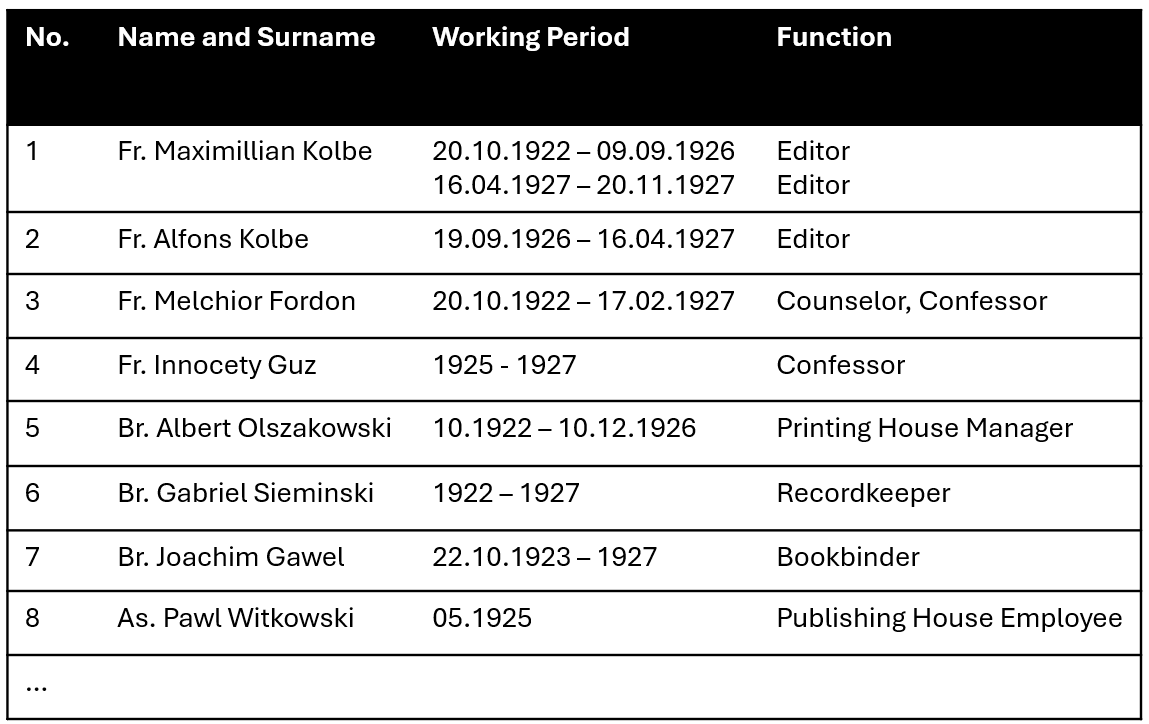
This coincides neatly with the years of each writing, in which Fr. Kolbe assumed editorial responsibilities for the Knight of the Immaculate and its worldview, so to speak. After this investigation, we are confidant the writings presented are authentic, but we would not discourage any skeptical reader from investigating them for himself. Should any evidence against their authorship arise, please contact The Journal using our newly-updated “About” page.
Now, without further ado, The Journal of American Reform is pleased to present the third and final installment of Fr. Maximillian’s writings, this time focused on the Judeo-Masonic peril.
Entry No. 1
Text: Gli scritti di Massimiliano Kolbe eroe di Oswiecim e beato della Chiesa, vol. III, pgs. 51-4
Knight of the Immaculate
Issue No. 1 | January, 1923, pgs. 2-4
Imminent Danger
Looking at the latest events, we realize it is clear that things are going badly here [in Poland]: the cost of living is rising day by day, the country is approaching economic collapse, the government is weak and incompetent; we have the feeling that a mysterious hand is constantly placing obstacles and luring us to ruin.
Throughout the earth, a struggle against the Church and the happiness of souls rages, on some sides more feebly, on others more fiercely. The enemy manifests itself in various guises and under various names. Everyone knows how socialism, taking advantage of the miserable conditions of the worker, has inoculated him with the poison of unbelief. We see how the Bolsheviks persecute religion. We listen to the teachings of the materialists, who wish to restrict the universe only to what we immediately know through the senses, in order to convince themselves and others that neither God nor the soul exists. Theosophy inculcates religious indifference, while “scholars of Holy Scripture” and other Protestants buy the sympathy of believers with large sums of dollars. All these blocs, they form a united battlefront against the Church.
What unites them?
Furthermore, it is well known to all that it is the Jews who lead Bolshevik rule. They are not lacking even among the ranks of the materialist leaders of socialism and those currently governing Russia. The “scholars of the Holy Scriptures,” then, as Mr. Pawlak demonstrated in a lecture to the Men’s Circle of the Mission Immaculata (MI), are nothing but a disguised Bolshevism with all the premises of the Talmudists.
Even in theosophy, Jews make an abundant appearance, so much so that, for example, in Vienna the directors of the theosophical lodges are Jews: Hans Schiff, Dr. Hans Robiczek, Gerstl, Schleisinger, Hirsch, and even the female directors are Jewish: Paola Schiff, Singer-Schiffowa, Miss Berta Mendelssohn, Miss Stella Abramowicz, Miss Anna Wertheimers.
Furthermore, even the name itself: “lodge”, similar to Masonic organizations, gives rise to much thought. Finally, the directors of the entire Theosophical movement in Vienna are exclusively Freemasons, such as Dr. Brother Francis Hartmann, Karl von Kellner, Arturo Pfungst, Paul Stoss and so on.
The influence of the Freemasons on the government is eloquently demonstrated. That the Freemasons exercise a great influence here is demonstrated by the fact that, ten days before the dissolution of Ponikowski’s government, the news had spread in Rome that a change of government would take place in Poland, because... that’s what Freemasonry had ordered (?!) to Piłsudski!!! And that’s exactly what happened. In recent days, then, Professor St[anislao] Grabski writes in Słowo Polskie [The Polish Word]: “There is a nefarious force that does not allow Poles to reach an agreement among themselves; that systematically ruins every attempt to form a Polish majority in parliament and from time to time, on very important issues—such as the problem of the president in the previous parliament and in the current one the election of the president—with the help of national minorities, hinders the majority of Polish votes; which prevented rapprochement between the Piast dynasty and the national camp, which exploits social radicalism and personal ambitions, old prejudices and reluctance of individual members of centrist groups, in order to break them up rather than allow them to cooperate with the right wing...”
“Gazeta Warszawska,” commenting on these words, adds: “The force that has ceased to even hide is the Jewish-Masonic conspiracy. As for the present, it is too visible to all of us to require a lengthy characterization.”
Faced with these facts, can we still doubt the leadership under which our enemies are fighting, consciously or unconsciously? This is the mysterious hand pushing our country to ruin.
In the face of such harsh attacks from the enemies of God’s Church, is it permissible for us to remain inactive? Is it permissible for us to merely complain and shed tears? Not at all! Let us remember that at God’s judgment we will be held accountable not only for the actions we have performed, but God will also include in the balance all the good deeds we could have done, but in reality neglected. Each of us has the sacred duty to take up arms and repel the enemy’s attacks with our hearts.
One can often hear phrases like this: “What can I do?”, “It’s such a strong organization,” “They have a lot of capital,” and so on. These people have surely forgotten what St. Paul says: “I can do all things through Christ who strengthens me” [Phil 4:13].
How should we fight, especially we members of the Militia of the Immaculate? Can we perhaps proceed with the strength of our fists, giving back in kind? No, that is not our task! The stated goal of the Militia of the Immaculate is to win hearts for Her, and She will do the rest. Let only those unfortunate souls who, in their stupidity and anger, raise their hands against the Great Father to satisfy their lusts and gain a semblance of happiness, let only they do something for Her, even the smallest, or suffer the breach already made, She already has some right to sweetly conquer that heart over time, place it in the burning Heart of Jesus, and make it happy. Out of love for the evil, let us persecute all their evil deeds with all our energy , as much as possible, let us turn these hearts to the Immaculate through prayer and suffering, let us win souls for Her at our own expense , and they, already here on earth, will be infinitely grateful to us. I have experienced this many times, and anyone who makes such a soul happy can see how grateful it will be to him.
Let us be careful, however, not to suffer, work, and endure sacrifices merely for the sake of such recognition. That would be too petty an incentive. To live, suffer, work, and die solely for God, for God through the Immaculate Conception and as instruments in her hand: this is the ideal worthy of a Knight of the Immaculate Conception.
Knight of the Immaculate
END.
Entry No. 2
Text: Gli scritti di Massimiliano Kolbe eroe di Oswiecim e beato della Chiesa, vol. III, pgs. 117-120
Knight of the Immaculate
Issue No. 4 | April, 1924, pgs. 55-7
Does the Truth Change?
It was March 13th [1924]. I was on my way to Warsaw. Opposite me sat a decent Jewish woman, next to her a man also of Jewish faith, and on the other side, an intelligent woman whose origins were revealed only by her immersion in a jargon-laden newspaper. I finished my breviary, looked through the newspaper, and, sighing to the Immaculate One, searched for—an incitement: I finally turn to the young man.
— Are you an Israelite? Yes, sir.
— And from what political faction?
— I am a Zionist.
— So could you explain to me the goals of Zionism?
— You must know this by now.
— Certainly, I have heard a lot about Zionism, but I would like to learn about it from the mouth of a Zionist himself.
This intelligent person, who clearly shared the young man’s views, also intervened in the conversation, arguing that the goal of the Zionists was to regain a homeland for the dispersed Jews.
— But you won’t fit in Palestine, I noticed, so Zionism probably has a more extensive plan?
They proved that it was not5, then distinguished the Zionists as “progressive” in contrast to the “pious” “clerical” Orthodox.
— And which of them are right, I asked?
“Truth cannot be determined because it changes over time,” the woman claimed. “For example, before, it was true that the sun revolves around the earth, but now, after Copernicus, it is true that the earth revolves around the sun, and we don't know what will happen next. So, truth is changeable.”
— Ma’am, what is two and two?
— Four.
— How much was it 100 years ago?
— Four, too.
— And how much will it be in 1000 years?
— ...Yes, but this only applies to mathematical truths.
— Is the whole greater or smaller than the parts?
“Of course, it will always be greater, but that’s already a mathematical truth. But let’s take this: we say this paper is white, but color is the impression our eye gets.”
“Madam, it’s one thing to explain what the color white is, and quite another to say whether this paper is white. In the former case, we point to the causes of this thing, and of course we can’t immediately make a statement without sufficient research. It’s also important to distinguish between certain things, very probable things, probable things, and doubtful things. For example, the current theory or hypothesis about the vibrations of the aether, refraction, reflection, etc., is indeed very probable, although no scientist yet dares to declare it a scientific certainty. The fact that this paper is white is a different matter. Here we have complete certainty, without going into the matter of explaining what its whiteness consists of and how it is that we see this paper as white. Your example about the earth’s rotation around the sun also refers to this.” And today, no one will be surprised when an astronomer, studying the starry sky all night, looks at the blazing horizon and says in the morning: “What a beautiful sunrise.” Indeed, it would seem much more bizarre if, without expressing a direct observation, one spoke of how beautifully the earth turned toward the sun. The saying: “the sun rises” is probably and will always be the same, although explanations for the causes of this phenomenon may vary until we reach complete certainty.
— And what other truths are there?
— For example, that we’re sitting here, talking. That’s true and will remain so forever.
— But then we’ll go away; so this truth will change.
“Not at all, because it will always remain true that we were sitting here and talking at that time. And even if everyone claimed and swore, and if anyone wanted to, sang in 4 or 10 voices, that it wasn’t so, everyone would still tell a lie, and this event would remain true.”
M.K.
END.
Entry No. 3
Text: Gli scritti di Massimiliano Kolbe eroe di Oswiecim e beato della Chiesa, vol. III, pgs. 599-606
The Actual Nemesis of the Church
Krakow, Spring of 19 X 19226
In this short lecture I do not intend to speak about the internal enemies of the Church, but I would only like to turn my attention to the external enemies.
We are witnessing a feverish activity directed against the Church of God, an activity which, unfortunately, is not without fruit and which has at its disposal countless propagators.
In the lists of the Ministry of Religious Confessions and Public Education, fifteen groups of such people are registered: the scholars of the Holy Scriptures, the Baptists, the followers of the doctrine of the first Christians, the Adventists, the Seventh-Adventists, the Jehovah’s Witnesses, the Methodists, the evangelicals, the Church of God, the free evangelical Church, the Pentecostals, the Stundist Karaites, and the Doukhobors, the old ritualists (old believers and old Catholics) and the Church of the Bohemian brothers. They do not limit themselves only to preaching lies with words, but also and very abundantly, they flood our cities and villages with printed matter of the most diverse kinds: magazines, pamphlets, flyers and even books. The various magazines: America-Echo, The Watchtower, New Ways, Gospel of Thought, Evangelical Unions, Polish Revival7, etc., pass from hand to hand and poison the hearts of the faithful.
All this work, however, is only a premise. Only after these advance guards comes the bulk of the enemy’s army. And who is he? At first glance it might seem exaggerated to affirm that the principal, the greatest and most powerful enemy of the Church is Freemasonry.
That the flood of the Protestant sects is really the advance guard of Freemasonry is expressly recognized by the Masonic magazine Free Thought8. In it is affirmed: “Reserving for ourselves full independence of judgment on the internal validity of the doctrine of the national church, we can nevertheless support its struggle, as well as that of any other Protestant sect, against the supremacy of the Roman Church”.
Who are the Freemasons?
Even the Popes, by now, have expressed judgments about them, first of all Pope Clement XII, who in the bull “In Eminenti”, of April 27, 1738, accuses them of acting “under a fictitious appearance of natural honesty and under a rigorous and secret pact”. Furthermore, he condemns Freemasonry and prohibits contact with Freemasons under penalty of excommunication “ipso facto”9 reserved to the Pope.
Thirteen years later Benedict XIV with the bull “Providas Romanorum Pontificum”, of March 18 [1751], renews the condemnations of Clement XII and among other motives, he adds the fact that to Freemasonry “are admitted men of all religions and of all sects and that, according to the opinion of wise and honest persons, this sect is wicked and corrupt”.
Pope Pius VII issues two bulls, in 1813 (August 13) and in 1821 Ecclesiam a Jesu (September 13), in which he affirms: “It is known to all how numerous are the persons full of perfidy who have gathered in these difficult times against God and his Vicar, and who aim in a particular way to weaken and to overthrow, even with an ineffective effort, the Church itself, hiding under the cloak of philosophy, seducing the faithful with vain illusions and tearing them from the teaching of the Church. To achieve more easily such a purpose, they have formed secret associations and hidden sects, with the help of which they hope to attract more easily many persons into their societies of conspiracy and wickedness”. And they aim at this “for the purpose of granting to each one ample liberty, according to their own idea and fantasy, to judge the religion that one professes, after having introduced indifference in matters of religion, of which there is nothing more fatal; for the purpose of profaning and outraging with unworthy rites the passion of Jesus Christ; for the purpose of despising the sacraments of the Church and the very mysteries of the Catholic religion and of overthrowing this holy Apostolic See, against which they nourish a particular and complete hatred and which they plot against in an insidious way for its ruin, for the fact that it always maintains the primacy of the apostolic chair. The principles of their morality are wicked. Freemasonry favors the pleasures of sensuality, permits killing anyone who has not kept the secret, teaches that it is lawful to provoke rebellion, to dethrone kings and all governments, whom they vulgarly call tyrants with great outrage”.
All this, however, does not prevent them from gaining the favor of governments. And therefore Pope Leo XII in the bull “Quo Graviora” of March 13, 1825, renewing previous papal condemnations, he adds words consists in the fact that while they appear committed to warning the rulers: “Their most cunning treachery is to increase your power, at that very moment they tend more than ever to overthrow it. They try very hard to convince the rulers to limit the power of the other bishops, they weaken it and little by little they appropriate the papal and episcopal rights. They do this not only out of hatred towards the Pope, but also to ensure that, once the ecclesiastical power has been overthrown, they can achieve a change and an overthrow of the political form of government”.
Freemasonry was condemned in the same terms by Pope Pius VIII with the bull “Traditi Humilitati” (24 May 1829), Gregory XVI with the bull “Mirari Vos” (15 August 1832) and Pius IX on several occasions (9 November 1846, 20 April 1849, 9 December 1854, 8 December 1864, 25 September 1865 and November 21, 1873).
And finally Pope Leo XIII deals extensively with the problem of Freemasonry and condemns it with the bull “Humanum Genus” of 20 April 1884. In it the Pope states that “for a century and a half Freemasonry has grown immeasurably and, making use of arrogance and cunning, has conquered all the levels of the social hierarchy and has taken, within modern states, a power almost equal to that of the monarchy”.
And the Pontiffs were not exaggerating at all!
Freemasonry, organized by English freethinkers in London in 1717, had already set itself a clear goal six years later in its General Constitutions, which no one is permitted to change. “Each of the grand lodges—affirmed therein—has the right to improve upon previous prescriptions and establish new ones, but not to modify the fundamental points, which must remain fixed forever and be implemented promptly”. What are these fundamental points? Behold: the total liquidation of the supernatural world. It’s clear that at this point there’s no longer any talk of religion or morality.
The tendency towards this goal is evident at every step. Art, literature and the periodical press, theaters, cinemas, the education of youth and legislation are moving rapidly toward the elimination of the supernatural world. The tendency toward this goal is evident in every way and the satisfaction of the pleasures of the flesh.
No wonder, since Freemasonry has also branched out considerably; according to statistics from 1907, the state of Freemasonry in that year was as follows: [...]10.
***
In the year 1810 in Poland there were already 12 known lodges:
the grand mother lodge, the “Eastern Star” to the east of Warsaw,
the lodge of the “Temple of Iris” in the east of Warsaw,
the lodge of the “Goddess Eleusis” in the east of Warsaw,
the lodge of the “Northern Shield” in the east of Warsaw,
the lodge of the “Temple of Constancy” in the east of Warsaw,
the lodge of the “United Polish Brethren” in the east of Warsaw,
the lodge of the “Defeated Superstition” in the east of Krakow,
the lodge of the “United French and Polish Brothers” in the east of Poznań,
the “Hesperus” lodge to the east of Płock,
the lodge “I will recover my freedom” to the east of Lublin,
the lodge of the “Knightly Cross” to the east of Bydgoszcz,
the lodge of the “Eastern Aurora” to the east of Radom.
The list of members includes ministers, generals and other dignitaries of the nation, both military and civilian.
Taking into consideration our region, here are the names of some people from these parts: and here in the years 1820-1821 they were part of the Freemasonry among others: [...]11.
All these people really belong to Freemasonry and do a lot of harm, but they are not its true leaders. These leaders are those called ‘blue Masons,’ whilst so-called ‘red masonry’ is reserved to a very small number of people, mostly Jews, who, fully aware of the goals, direct all the great mass of those who are more or less ‘enlightened’ in the things of the Masonic organization. These leaders stay in the shadows and they always act secretly, making opposition impossible. They are the ones who plan the advance of the work. Out of their ‘workshops’ came the French Revolution, the whole series of revolutions from 1789 to 1815, and also… the World War.
According to their instructions, Voltaire, D’Alembert, Rousseau, Diderot, Choiseul, Pombal, Aranda, Tanucci, Hangwitz, Byron, Mazzini, Palmerston, Garibaldi, and others. We don’t know the names of the current members, but it’s certain that Piłsudski belongs to the Freemasonry here. Here’s proof: ten days before Ponikowski’s government was overthrown, rumors spread in Rome that the government would fall, because Freemasonry had told Piłsudski to do so. I heard this from trustworthy people, specifically Father Bogdanowicz, secretary to Bishop Teodorowicz, who (as far as I remember) was in Rome at that very time.
Freemasonry puts people on a pedestal and knocks them down when they feel like acting on their own. Napoleon himself experienced this very clearly.
How can we oppose this plague, this army of the Antichrist?
The Immaculate Conception, Mediatrix of all graces, can and wants to help us. Indeed, what purpose will the apparitions of Lourdes, the manifestation of the miraculous medal, through which so many people have already converted, be opposed by a love for her? A soul filled with love for Her will certainly resist the work of depravity, the weapon in the hands of Freemasonry. “We will not conquer the Church with reasoning”, the Masons decided at one of their gatherings, “but by corrupting morals”.
Also worthy of reflection are the predictions of Wanda Malczewska, collected by Father Gregory Augustynik12, who knew her personally; these predictions have in part truly come true. In them, Jesus recommends: “Let associations be formed of women and, separately, of men, from various social classes, but with one spirit, under the protection of my Mother, conceived without sin, for the purpose of eradicating debauchery and sowing and defending the virtue of chastity. I urge those who love God and their country, by my cruel scourging and crowning with thorns, to join this association, to guard the virtue of chastity themselves, to eradicate debauchery, and to exhort others to do the same”.
In the December issue, dedicated to the Immaculate Conception, Fr. Urban13 expresses his conviction that the only means of salvation against the dominion of Satan, which is expanding in the world today, is ardent devotion to and imitation of the Immaculate Conception.
END.
CONSIDER SUPPORTING THE JOURNAL OF AMERICAN REFORM!
As I intend to devote more and more time to this political project, I want to continue to provide free, educational material, whether visual (edits) or written (essays, translations and a forthcoming book) content. If you have benefited from my work in any way, kindly consider supporting The Journal financially. On a personal note, I am married and duty-bound to provide for my family, so any help, big or small, is appreciated. Subscribe or make a one-time donation.
Regardless, the production of free material will continue, hopefully with ever-increasing quality, and I will keep all my subscribers notified of my plans.
In addition to Substack, the home of The Journal, my work, graphics and commentary can be found on the following platforms:
X: @AmericanReform_
Telegram: @American_Reform
Owing to our theological position on the present status of Authority in the Catholic Church, The Cassiaciacum Thesis, we do not regard Fr. Maximillian Kolbe to be a Saint, publicly. This is not to be viewed as a “knock” against him or an “insult” to his legacy. That said, in private, we consider him to be a Saint and believe his life worthy of imitation—by all available evidence. When God wills it, i.e. pontifical Authority being restored in the Catholic Church, we hope a declaration of canonization for Fr. Maximillian Kolbe will be made, which will formally and infallibly recognize him as such.
St. Thomas, Summa contra gentiles, CHAPTER LXXXI — Of the Subordination of Men one to another: “And similar is the order between man and man. Men pre-eminent in understanding naturally take the command; while men poor in understanding, but of great bodily strength, seem by nature designate for servants, as Aristotle says in his Politics, with whom Solomon is of one mind, saying: The fool shall serve the wise (Prov. xi, 29).”
Schlafly, Daniel, and Warren Green. “Kolbe & Anti-Semitism.” The New York Review of Books, April 14, 1983.
Makarczyk, Józef, (2008), “Wydawnictwo Rycerza Niepokalanej w Grodnie 1922–1927”, Saeculum Christianum: pismo historyczno-społeczne 15, no. 1: 109–117, pg. 3.
Not even all Jews know that the founders of Zionism were interested in world domination. Serious evidence of this is provided by “The Protocols of the Elders of Zion” (Perzynski Bookstore — Nowy Świat 21 - Warsaw). And Masonic work is reduced to this.
Conference written most likely before the transfer of the editorial management of the RN from Krakow to Grodno, that is, before 19-20 X 1922.
Echo of America, The Vedettes, New Ways, Evangelical Thoughts, Annunciators of the Gospel, Reborn Poland.
Free Thought.
Ecclesiastical penalty incurred by virtue of legislative prescription without the need for judicial intervention.
The statistics, probably drawn up on a separate sheet of paper, have been lost.
The list of names has also been lost.
DON GREGORIO AUGUSTYNIK, Love of God and country shown in deeds, or the life of the saintly Polish lady Wanda Justyna Nepomucena Malczewska. Her revelations and prophecies concerning the Church and Poland, Częstochowa 1922.
It was not possible to trace the magazine that published and the article by Fr. John Urban, S.J.