

“For, if on the one hand, all men are equal, in the sense that they have the same nature, the same origin, the same end; on the other hand, they are extremely unequal in strength, in enlightenment, in virtue; and it is clear that the metaphysical equality that results from the identity of nature will soon disappear in the face of the real inequality that necessarily produces the difference in physical, intellectual, and moral qualities.”
Introduction
“We hold these truths to be self-evident, that all men are created equal…” reads the second paragraph of the Declaration of Independence, penned in 1776 by the revolutionary, liberal ideologue and prominent Founding Father, Thomas Jefferson. If you were to survey the American public today, likely, not one man in a hundred would be willing to challenge this foundational American dogma, that is the equality doctrine or egalitarianism. A sad situation, yes, but nonetheless true.
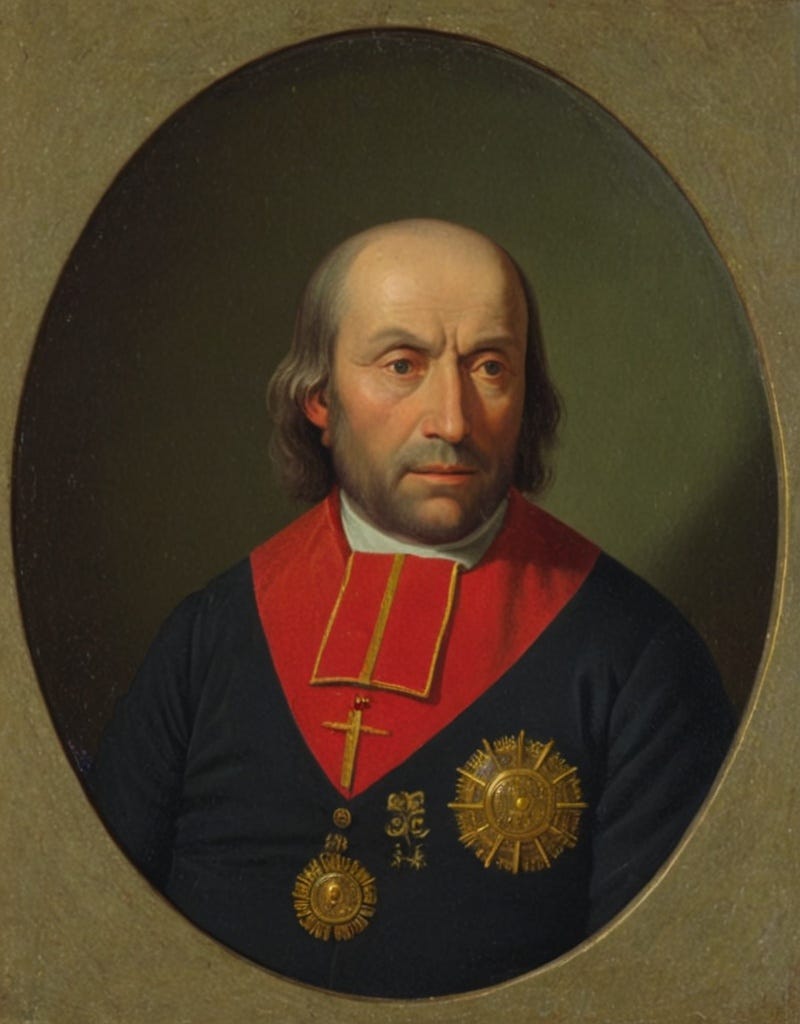
This concept of equality, in which no distinction is made between the abstract and concrete, between what is intrinsic to men and what is extrinsic, along with the effects of sin remains one of the primary engines of disorder in our beloved country. Unsurprisingly, the antidote to this equivocal usage of “equality” will be a 19th century French Catholic prelate, Bishop Jean-Baptiste Duvoisin. Bishop Duvoisin, whose biography will be seen below, had the following to say about the French Revolutionaries, who were also keen on egalitarianism:
Is it man living in society, is it man considered in the state of nature, that the authors of the declaration [of the Rights of Man] meant to speak when they said that men are born and remain equal in law? Or rather, did they not affect this vague and indeterminate expression, so unworthy, I do not say of an assembly of legislators, but of a philosopher, in order to leave to the populace, which they wanted to make the instrument of the revolution, the right to give this equivocal maxim all the scope that their destructive projects demanded?
One would be hard pressed to say this would not apply, retrospectively, to the American revolution. While American liberalism was [and continues to be] more subtle than its vicious, anticlerical French cousin, it can be more dangerous and it is built on the same false principles. Principles that originated in Protestantism, notably radical individualism and the skepticism of Authority, which the enlightenment was happy to apply to the State and political order. Masonic thinking, denounced countless times by the Popes, only added to this deadly package of errors which became the foundation of the American experiment.
For this reason, a counterrevolutionary text from the former Bishop of Nantes will be presented at The Journal of American Reform, hopefully to awaken the senses of many Americans, particularly Catholics, on why our vague understanding of equality in the country (which has been present since the founding) is woefully insufficient, leading to moral, social and political turmoil. As always, without proper distinctions, a legitimate concept like the equality of men, considered in the abstract, will be lost. The result, false notions of equality which are nothing less than anarchy.
Biography of Bishop Duvoisin
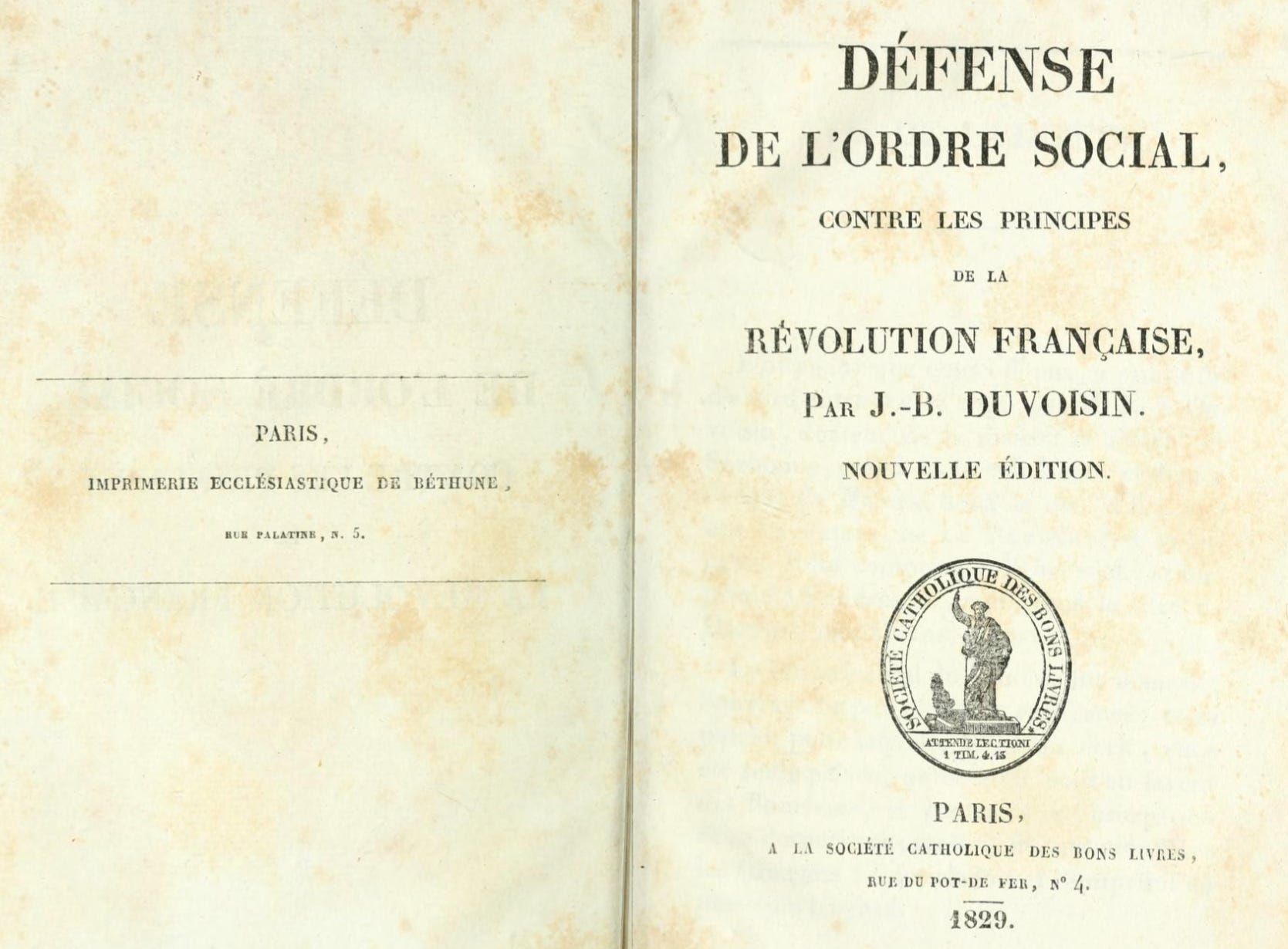
Bishop Jean-Baptiste Duvoisin (b. 1744) was a distinguished priest, theologian and writer.1 He was born in Langres (Haute-Marne) and quickly demonstrated exceptional talent in philosophy, theology and the sciences. At the age of fourteen, Duvoisin had already completed a year of philosophy and defended theses at the Jesuit college he was enrolled in. His bishop, Montmorin, recognized his capabilities and began supporting his ecclesiastical career. By the age of twenty-three, Duvoisin earned a chair at the Sorbonne. He successively became promoter of the officiality of Paris, royal censor, canon of Auxerre, grand vicar and canon of Laon.
At the beginning of the revolution, Duvoisin along with nearly all of the other French ecclesiastics were deported and were exiled in England. During Napoleonic wars, he was one of four bishops appointed to reside near Pope Pius VII during his captivity at Savona and Fontainbleau. As a testament of his fidelity to the Pontiff, Duvoisin is recorded as saying “I beg the emperor to grant freedom to the Holy Father the Pope; his captivity still troubles the last moments of my life. I have had the honor of telling him several times how much this captivity afflicted all of Christendom, and how inconvenient it was to prolong it.” Death took him suddenly, having just received honors, to the dismay of a large number of fellow clergy and friends. He died of chest inflammation, after only sixty hours of illness, on July 9, 1813.
CHAPTER III. — On Equality.
Towards the end of the 14th century, a certain John Ball, a disciple of Wycliffe, stirred up the peasants in England against the clergy, the nobility, and the magistrates. He preached equality, and took as the text of his seditious declamations the English proverb: when Adam dug and Eve spun, where were the nobles? With the same doctrine, the Anabaptists, in the sixteenth century, set a part of Germany ablaze. In the time of Cromwell, the fanaticism of equality gave birth to the sect of the Levellers. Such were the preludes, and as it were, the first attempts, of the French Revolution.
According to the first article of the Declaration of the Rights of Man and of the Citizen, “men are born and remain equal in rights; social distinctions can only be based on common utility.” And in art. 6. “The law must be the same for all, whether it protects or punishes. All citizens, being equal in its eyes, are equally admissible to all public dignities, positions, and employments, according to their capacity, and without any other distinction than that of their virtues and talents.”
Is it man living in society, is it man considered in the state of nature, that the authors of the declaration meant to speak when they said that men are born and remain equal in law? Or rather, did they not affect this vague and indeterminate expression, so unworthy, I do not say of an assembly of legislators, but of a philosopher, in order to leave to the populace, which they wanted to make the instrument of the revolution, the right to give this equivocal maxim all the scope that their destructive projects demanded? For us who, seeking only the truth, need to bring order and precision to our ideas, we will distinguish, as we did when speaking of liberty, natural equality, civil equality, and political equality.
Natural equality supposes that all men, in the state of nature, would have and could exercise the same rights
Civil equality requires that all members of the same state be equally subject to the common law.
Political equality consists in all members of the state having an equal right to the administration of public affairs, without distinction other than that of virtues and talents.
Now I say first, that if natural equality exists in law, it cannot subsist in fact.
Second, that political equality is not compatible with the social order, especially in a large empire.
Third, that civil equality is the only one that the citizen has the right to demand.
The state of nature is essentially a state of liberty and equality; and it is because the human race cannot preserve itself with this liberty and this perfect equality that the state of nature has given way to the social state.
In the state of nature, equality exists by right, but everything conspires to destroy it. For, if on the one hand, all men are equal, in the sense that they have the same nature, the same origin, the same end; on the other hand, they are extremely unequal in strength, in enlightenment, in virtue; and it is clear that the metaphysical equality that results from the identity of nature will soon disappear in the face of the real inequality that necessarily produces the difference in physical, intellectual, and moral qualities. “In nature,” said an unsuspecting writer to the friends of the revolution, “there is only equality of right, and never equality of fact. Even savages are not equal as soon as they are gathered in hordes: they are only equal when they wander in the woods, and even then, the one who allows himself to be hunted is not equal to the one who wins.”2
Since the state of nature admits neither positive law nor common judge, rights are measured by needs and faculties. More numerous needs, more perfect faculties, give more extensive rights. I admit that the superiority of bodily strength and mental qualities does not constitute the right to command; but it establishes an empire of fact, and prepares the way for an empire of law, by making the weakest feel that it is in their interest to submit. Among free beings, whose passions constantly intersect and clash, physical inequality would produce only violence and oppression, if it did not convert into moral and conventional inequality. Hence the institution of political societies, formed by the voluntary abandonment that each has made of a part of their natural rights to ensure the peaceful enjoyment of what they reserved for themselves.
But, before families and peoples were united under a common government, there existed express or tacit conventions which fixed the rights of each, not according to the principle of an equality that nature denied, but according to the ascendancy that force and genius necessarily give, when their action is not repressed by the authority of the laws.
I said that, in the state of nature, equality existed by right; but I did not mean to say that there was equality of rights among all individuals. In the state of nature itself, and prior to any convention, there exists a true society, domestic society, which can only be maintained by the diversity and inequality of rights. It is nature itself that subjects woman to man, children to parents, the imprudence of youth to the experience of old age. All men are born in a state of dependence. Obedience is the need even more than the duty of early life. Families, like political societies, essentially presuppose authority and submission.
In short, the state of nature does not admit equality in fact, and it only admits equality in law between the heads of different families. Equality in law also exists between sovereigns, or the heads of different nations, because they are among themselves in the state of nature. But it is absurd to make it the basis of civil society, which unites an entire people, like a single family, under the paternal authority of the sovereign.
Political societies were instituted only to correct and cushion this prodigious inequality which results from the difference in personal qualities. In the state of nature, isolated men, abandoned to their own strength, had rights without the means to assert them. In the state of society, the rights of each are assured by the guarantee of all. The establishment of laws and governments has, in a way, caused natural inequality to disappear by introducing political inequality, less troublesome, more favorable to the freedom of all, and tending to establish, among such unequal beings, all the equality of which they are capable.
I am speaking of civil equality, which is established and maintained by political inequality.
In everything relating to personal safety, the right of property, and the innocent and legitimate use of natural faculties, all members of society are equal in rights. They are not equal in what relates to the organization and government of society. They are equal in the civil order, unequal in the political order. Equal protection for all persons and for all property—this is the right that, in a constituted state, belongs to every citizen. This right, by virtue of the social pact, is supported by public force, and in this respect, the weakest man becomes the equal of the strongest.
Such is the civil equality founded on the universality and impartiality of the law, which assures everyone a equal right, to what they hold either from nature, or from their ancestors, or from their industry; that is to say, an equal right to unequal goods.
The state of society requires nothing more, unless, destroying every principle of justice, and every idea of property, to achieve absolute equality, one wishes to introduce the community of goods; but this system, which one has seen realized in small corporations, whose members, sustained by a supernatural virtue, renounced all human affections, it would be insane to want to transport them into political society, where the common interest is born from the clash and combination of all particular interests, where one would only succeed in establishing it by violence and brigandage; where passions, industry, fortune would continually tend to overthrow it.
Inequality of conditions is a consequence of inequality of property, and inequality of property derives from natural justice. For each person acquires according to their strength, their talents, and their application. Labor, industry, happiness are sources and titles of property recognized by natural law, and which civil law protects with all public force.
Not only does the law give and guarantee to every citizen the ability to acquire and preserve property: it also requires that the right of property may be exercised after the death of the owner. Hence the right of will, more or less restricted by the laws; hence the right of inheritance admitted among all civilized nations, although it visibly tends to increase more and more the inequality of fortunes and conditions.
The inequality of fortunes and conditions provides society with men prepared by their needs, by their education, by their feelings to fill all the jobs, to take on all the tasks required by public service. While the citizen born in comfort, or with qualities that supplement fortune, prepares himself, through long studies, for the honorable but difficult functions of religious, civil, or military administration, a small number are called by natural taste, or by talent, to the cultivation of the sciences and the fine arts; and the crowd of men born without patrimony, found a means of subsisting in easy, but obscure and often perilous tasks, to which no one would devote himself unless condemned to them by necessity. This inequality, without which Society could not maintain itself, is not a social institution: it has its source in nature, or, to speak in more religious and philosophical language, in the order established by divine providence She was born with freedom, she is the inevitable effect of strength and weakness, of virtue and vice, of intelligence and stupidity, of work and laziness.
The equal submission of all to general laws common to all constitutes civil equality. The independence of any particular will constitutes civil liberty. Civil liberty and civil equality are inseparable. By the former, the citizen obeys only the law; by the latter, the law extends its empire over all citizens. It is in this sense that it is true to say that the law must be the same for all, whether it protects or punishes, and that all citizens are equal in its eyes.3
But does it follow from this that “all citizens are equally admissible to all dignities, places, and public employments, according to their capacity and without any other distinction than that of their virtues and their talents?”
Nothing is more specious than this maxim from the Declaration of Rights. But as much as it appears appropriate to serve as a rule in the administration of an ideal republic, it is equally false and dangerous when applied to governments and men as they are.
First, taken in the exclusive sense that it presents, it is false or at least incompletely true, if one can express it thus. Sound reason and the general good of a State require that offices and jobs be entrusted only to those who both deserve them and are best suited to them. But this merit, this suitability, is not composed solely of virtues and talents We must include other considerations taken from age, services rendered to the fatherland, even birth. It was Pascal, I believe, who said that a great name was thirty years gained for virtue, by the consideration with which it invests it, and by the empire it gives it. We know well that nobility is only a prejudice; but it is one of those prejudices which have their roots in the nature of man, since we find it established, in one form or another, among all civilized peoples. It is a useful prejudice, because it offers the State a means of purchasing the greatest services, with the least possible expense.
Another essential defect of this maxim is that it is stated in a manner too vague, and likely to mislead the ignorant multitude, who too easily mistake wit for talent, and in whose eyes an exalted or simulated civic-mindedness often takes the place of virtue. Under a popular Government, in the system of equality, it would be up to the populace to judge virtues and talents. But one must have no knowledge of men, one must be ignorant of everything that happened in the primary and electoral assemblies of France, not to see that all choices would be decided by cabal, by corruption, or by fear. To recognize no other principles in the distribution of public employment than this presumptive preference based on talents and virtues, is to resemble those savages of whom Montaigne speaks, who, admitted to the audience of Charles IX barely an adolescent, could not conceive why the crown had not been placed on the head of one of those handsome and vigorous Swiss who composed his guard.
Undoubtedly, it would be desirable that public offices were never entrusted except to the most enlightened and virtuous men. This is the goal to which all governments must strive; but, as enlightenment and probity are not shown by characters that cannot be mistaken, the peace and stability of the social order demand that in appointments to positions, deference be paid to certain external advantages which, without being sure guarantees of talent and virtue, are at least their ordinary indications.
Justice does not forbid, and politics demands, that, in monarchical states, nobility is a title of preference for certain jobs when it is combined with talents and virtue. All that can, what must be demanded of this Government, is that a birth defect is not a title of exclusion, that the obscure man who has ennobled himself, a Fabert, a Jean Bart, a Chevert, an Amyot, a D'Ossat, a Massillon, share with the nobility the right to serve and illustrate their country. Now, says an ancient writer quoted by President Hénaut, “the constitution of the kingdom of France is so excellent that it has never excluded and will never exclude citizens born in the lowest ranks from the highest dignities.”4
We saw in the previous chapter that political liberty is not essential to a constituted state. I will prove that political equality is incompatible with a wise constitution.
I agree with the Constituent Assembly that “social distinctions can only be based on common utility”; but I maintain that common utility requires that there be permanent, and even hereditary, social distinctions.
First, the Constituent Assembly itself even paid homage to this truth, since it had declared that France was a hereditary monarchy. There is no distinction in the social order more marked than that which calls a family to the crown to the exclusion of all others. The philosophers of the day will declaim against a prerogative which closes access to the throne to merit and leaves it to the chance of birth. But the wise man, who has trained himself in the school of History, is not unaware that hereditary monarchies have enjoyed more constant internal peace and have defended themselves better against external enemies than elective monarchies. He knows that hereditary monarchy is more favorable to the liberty of peoples, because it is less favorable to the power of the great. He sees that all States would be torn apart by revolts and seditions, if the people did not recognize their sovereign by a characteristic and striking sign; and that there is none more certain and more striking than that of birth.
“It is not for the interest of the reigning family that the right of succession is established, but because it is in the interest of the State that there be a family reigning.”5 Under the first race of our Kings, the kingdom was divided between brothers. It seems that then heredity was established in favor of the reigning family: it was the infancy of our public law.
Here then is the first of all social distinctions which is hereditary, at the same time as it is founded on common utility.
Secondly, society could only be formed, and can only be maintained by authority and subordination. There therefore exists for some a right to command, and for others a duty to obey: the first source of political inequality
I say a right to command, and a duty to obey, but a permanent right and duty. If all the leaders, all the magistrates of a nation are removable at the whim of those who appointed them, I see neither a right nor a duty, properly speaking. Such leaders will have little respected authority; too weak against license, if they received it from the people; too weak against tyranny, if they hold it from the monarch.
It is not that, in a republic, the people cannot set a term to the authority of some of their magistrates. They must even do so, if they wish to preserve their liberty. But any republic that does not admit some perpetual power, like that of the Kings in Sparta and the Doge in Venice, or of the Areopagus and the Senate in Athens and Rome, would sooner or later degenerate into Ochlocracy, a type of government or, to put it better, anarchy where all affairs are conducted tumultously and by sedition.
One might object to me the democratic cantons of Switzerland, where the magistracies and councils were neither perpetual nor attached to a certain order of persons. I do not examine whether, in these small republics, tranquility, and political liberty itself, would not have gained from the establishment of an irremovable power. I limit myself to observing that the vice of the constitution was corrected by their own weakness and by union with the other members of the Helvetic body.
One of the things that distinguishes monarchy from despotism is that, in the latter, all officers of the State are immediately under the sovereign’s control, and that there are no offices, only commissions; whereas, in monarchy, although the sovereign is the source of all powers, there are some that he can neither exercise by himself, nor arbitrarily withdraw or suspend; and what results from this difference is that political inequality is less under despotism; but also civil inequality is extreme.
In general, political equality cannot be preserved only at the expense of civil equality. For civil equality requires that the government have the necessary strength to enforce the law; and political equality divides and weakens the action of the government. This is noticeable for republican states. With regard to despotic states, one cannot say that there is a true government. The despot reproduces himself in the agents he employs, and who are all, like him, scourges to civil liberty. Political equality, which is one of the essential principles of despotism, limits the duration of their power to an uncertain time, usually quite short; restricts it to their person, to the exclusion of their family, and invites them to take advantage of the moment to enrich themselves through injustices and vexations.
Third, in all civilized states, citizens are divided into various classes which have particular functions and prerogatives: another source of inequality between members of the same society.
If one wanted to go back to the first origin of this political hierarchy, it would be easy to find it in the difference in strength, talents, and properties, in the progressive action of social institutions, in conventions dictated by need or by recognition. But, whatever the primordial title, whether once established by law or affirmed by time, these class distinctions and the privileges that flow from them are properties, all the more sacred because they are linked to public order, and cannot be attacked without shaking the foundations of the Constitution.
In an orderly state, the prerogatives of the first ranks defend and guarantee the rights of the lower classes. A blow struck at the first orders threatens all citizens. Once the sacred principle of property is undermined, there is no telling where the brigandage will stop. The decree that abolished the hereditary nobility in France prepared the bourgeoisie for the forced requisitions of money, food, and soldiers.
The difference in ranks forms in the State a sort of natural magistracy, independent of authority, the exercise of which it makes easier for the sovereign and more gentle for the subjects. All conditions receive from the superior conditions the example of obedience: all learn to temper the rigor of command with regard to the inferior conditions. From this are born those habits of respect and protection, of consideration and benevolence, those mutual regards, that politeness which binds all estates, which forms social mores, develops the feeling of honor, and commands respect for public opinion.
Political inequality does not harm civil equality, if the most favored classes can never rise above the law, if privileges and distinctions do not affect the safety of persons and property, which must be the same for all citizens.
A Tribune of the Roman people, whose speech is reported by Dionysius of Halicarnassus, distinguished very clearly between civil equality and political equality. “We do not claim,” he said to the Patricians, “to take away from you the offices, precedence, and distinctions that you owe to the virtue of your ancestors or to fortune; but we regard it as a common right of every citizen not to suffer injuries and to draw just satisfaction from those who have offended us.”
The barbaric laws of our ancestors, which redeemed all crimes by pecuniary settlement, and which placed a higher price on the life of a Frank or a nobleman than that of a Roman or a commoner, evidently sinned against civil equality. It is not the same with modern laws which, pronouncing the death penalty against all those guilty of certain crimes, awarded different punishments according to the difference in conditions. The vice of this inequality, although of little importance at bottom, is compensated by the advantage which results for the State from the preservation of a useful prejudice.
Political equality can only take place in pure democracy, where every individual is part of the sovereign, and under strict despotism, where all, except the master, are slaves.
In moderate governments, order and liberty are preserved by the gradation of powers and conditions. Intermediate orders fill the gap that separates the people from the sovereign; they temper the force of the government, preventing it from falling from its full height upon the people; they repress or moderate the seditious movements into which the ever-anxious, discontented, and credulous people so easily get carried away or allow themselves to be carried away. They are anchors that hold the ship of state between two equally formidable reefs, despotism and anarchy. If they fall under the blows of the government, the prince becomes despot; if it is the people who annihilate them, the state is dissolved. In the latter case, natural inequality takes the place of political inequality; for nature is still stronger than the people.
In no other constitution, perhaps, were these intermediate powers more wisely managed than in the French monarchy. The three great objects of all political association—religion and morals, the defense of the state, labor, and industry—indicated the natural division of the three orders. The clergy aspired to trust and consideration through virtue and enlightenment; the nobility was paid with its blood through honor and distinctions that cost the state nothing. The careers of the arts, commerce, and wealth were open to the Third Estate.
The weakest of these orders, the Clergy, enjoyed first place: it was a tribute paid to Religion; and sound policy demanded that this prerogative be left to the one of the three orders that could least abuse it, and which drew its members from the other two. The Clergy had retained the right to tax itself. Far from being jealous of this privilege, the other two orders must have seen in it a precious remnant of the ancient law of the nation, which constantly reminded our kings of the origin and destination of subsidies.
The nobles were personally exempt from certain taxes; but their property was subject to them. They paid through their tenant farmers. The clergy had redeemed the poll tax, and replaced the twentieth with the gratuitous gift. All indirect taxes fell on the clergy and the nobility, as on the Third Estate. The inequality, which was rightly complained of in the distribution of public responsibilities, arose much less from the privileges of the nobility and the clergy, than from the abuse of credit and wealth.
The three orders did not form separate castes. Brilliant actions, military service, the magistracy, and too often wealth opened the way for the Third Estate to enter the nobility. This kind of adoption repaired the losses of an order devoted to a murderous profession, and nourished in the other classes an ambition useful to the fatherland.
The great places in the Church were, ordinarily, reserved for the ancient races, because it was important to honor nobility and religion through one another, and it was just to grant some preference to the posterity of the founders. But the greater part of the members of the Clergy were taken from plebeian families; the goods of the Church spread over all classes of society, and one could then truly say that they were a national property, since by the institution, and even speaking in general, by the fact, they were the reward of study and good conduct, and in the hands of the holders they became an abundant resource for the State and for the poor.
The judiciary, without being an order within the State, formed a distinguished class, whose functions were not limited to dispensing justice. An ancient custom, consecrated by the tacit acquiescence of the nation, gave the sovereign courts the right to represent, in a way, the States-General. The esteem enjoyed by these illustrious companies gave them political influence, both over the government, whose undertakings they prevented or repressed, and over the people, whom they kept within bounds of submission. The venality of the offices, which at first glance seems a revolting abuse, did not prevent most judicial positions from being filled by upright and enlightened men; and perhaps to this we owe this hereditary attachment to ancient maxims and this esprit de corps which constituted the principal strength of the judiciary.
Thus, in our ancient constitution, the various orders of the State, each animated by a particular spirit, contributed to the general good. Thus, the privileges of the first two orders, and the political rights possessed by the parliaments, formed a barrier against despotism, and civil equality was strengthened by political inequality.
Narrow minds only saw this inequality as an inexhaustible source of jealousies and debates, either between citizens or with the sovereign. They saw only the vices of men, without perceiving the wisdom of institutions. They did not understand that it is through rivalry and the opposition of interests between the different orders of the State, that public liberty is sustained. Perfect harmony, absolute equality among all citizens would infallibly be the effect and proof of general oppression, for it would be foolish to expect it from virtue.
Other reformers have claimed that esprit de corps (a feeling of pride, fellowship, and common loyalty shared by the members of a particular group) harmed public spirit, and that, in order to attach all citizens equally to the fatherland, it was necessary to extinguish these particular societies, these corporations, which shared the affections that general society alone has the right to claim.
It was a sign of a very poor understanding of human nature in general, and of the French nation in particular, to propose to twenty-eight million men, as the sole object of their worship and all their affections, this metaphysical idea called the fatherland. Lycurgus had performed this miracle in a small, poor, and virtuous town. But in a vast empire, in our modern times, with our morals, our arts, our commerce, and our vices, most men hold more dear their family and the small society in which they have a marked rank and a tangible and immediate interest than they do to society at large, in the immensity of which they are as if lost. The art of the legislator consists, not in stifling the feelings that nature inspires in us for everything that approaches us, but in directing them toward a common goal, so that no one can love their family, their profession, their city, their province, without loving the State, and so that public prosperity becomes the infallible, though often unnoticed, effect of everything undertaken by particular affections.
It is impossible to evaluate all the advantages procured for France by this multitude of ecclesiastical and civil bodies, whose glory and interest kindled in souls an emulation that a more general, and therefore weaker, interest would not have excited. These admirable institutions are no more. The revolutionary level has flattened everything. There remain in all of France only two classes: those who govern and those who are governed.
Finally, a final source of inequality that is due to the nature of all government is property.
In all constitutions, even in democracies, proletarians, or those who owned nothing, were never allowed to take part in the administration of public affairs. A law of Solon excluded from any magistracy citizens who did not collect at least two hundred measures of wheat, oil, or wine. King Servius, popular as he was, deprived the common people of any significant influence in affairs. He distributed to the Roman people, according to the gradation of property, in 192 centuries, each of which had one vote in the assembly of the Comitia. But he rejected the crowd of those who possessed nothing in the last century, who always found the decision formed before being admitted to vote. It was still established among the Romans that to be a soldier, one had to have homes to defend. It was only, says Montesquieu, after Aristotle, in the corruption of some democracies, that artisans came to be citizens.
Democracy, Aristotle also says, turns into tyranny wherever the poor have too much influence in public deliberations. Speaking of Carthage, he predicted that this republic, then so flourishing, would perish through the natural increase of the claims and power that the constitution granted to the people. At the time of the Second Punic War, about a hundred years after Aristotle, Polybius observed that Carthage was leaning toward ruin, and he attributed its decline to the authority that the people had usurped.
It is true that, if the constitution of empires were to be treated like an arithmetic problem, nothing would be more unreasonable than to subject the many to the few. It is with the help of this crude sophism, and by forgetting that the State is composed of men and their property, it is by applying to an Empire formed over thirteen to fourteen centuries notions borrowed from the state of nature that the metaphysician S..... had no difficulty in demonstrating that in France the Third Estate constituted the nation.
According to this way of reasoning, it would not be to the bourgeois property owners, who alone composed the Third Estate, but to the populace, to the innumerable class of Proletarians, who nowhere form a political order, that the name and rights of the nation would have to be transferred.
Such was, in fact, the conclusion that the Jacobins drew from the principle provided to them by the Constitutionalists. It was from the school of S..... that Marat emerged.
The excess of consequences alone would suffice to demonstrate the falsity of the principle; but the favor that all legislation grants to property, moreover, is in no way contrary to reason and natural justice.
Political administration presupposes feelings and enlightenment which, ordinarily, are the fruit of an education which the poor classes cannot attain.
The State cannot trust those who have no interest in its preservation. The man who owns nothing has no homeland, and it is difficult for him to feel affection and interest in a government that keeps him in a state of humiliation and need.
If property in those who administer is not always a guarantee of their probity, it is at least a pledge of responsibility.
It is just that every citizen enjoys the advantages of society, in proportion to the contribution he makes to it. Now, the property owner gives more to society than the one who has nothing. It is just that the former has the right to protect those who have something to defend. Property owners have no less interest than proletarians in laws that preserve individual security, and consequently the latter can rely on the former for the care of their life and liberty. But with regard to property, the former have the right and interest to preserve, the latter the interest and desire to invade. How can balance and peace be established among such opposing interests, unless the advantage of numbers and natural strength is counterbalanced by political advantages?
“There are always in a State,” says the author of The Spirit of the Laws, “people distinguished by birth, wealth, or honors. But if they were merged among the people, and if they had only one voice like the others, the common freedom would be their slavery, and they would have no interest in defending it, because most resolutions would be against them. The part they have in legislation must therefore be proportionate to the other advantages they have in the State, which will happen if they form a body that has the right to stop the people’s undertakings, as the people have the right to stop theirs.” Thus, in our constitution, when the three orders were assembled in the States-General, one of the three was not bound by the wishes of the other two.
From the contempt of these maxims, consecrated by the conduct of all legislators and by the suffrage of all public figures, all the misfortunes of France were born.
Let us follow the course of the Revolution in its different periods: we will see the progressive development of the anarchic principles of liberty and equality. A faction composed of philosophers, great minds, Freemasons, practitioners, and courtiers had long been meditating the subversion of religion and the monarchy. The disorder of the finances, the all-too-well-known weakness of the government, the audacious incompetence of Mistress Brienne, the faults of the parliaments, the imprudent convocation of the States-General, the perfidious views and hypocritical popularity of Necker had brought the moment when the faction could break out. The conspirators knew how to take advantage of the anxiety and agitation of the minds; they raised the people with the cry of liberty, and, to sow division between the orders of the State, they presented the chimera of equality to those who, enjoying in the midst of abundance the sweetness of a peaceful life, believed themselves humiliated by the prerogatives of the superior conditions, and did not see that a universal leveling would elevate them less than it would depress them. The Third Estate took advantage of the increase in its wealth, to attribute to itself a greater preponderance in the Constitution, and this increase in wealth was the most tangible proof of the wisdom of our Constitution and its conformity with the true interest of the Third Estate.
This is the beginning, and as it were, the first act of the Revolution. Soon, demanding equality in its turn, the common people disconcert the ambition of the factious and the foolish vanity of the Bourgeois, crush everything with its mass, and wage open war on the Landlords. It arms itself against them with their maxims and their examples. For if one could, by virtue of equality, strip the Clergy and the Nobility of the rank and privileges they had possessed from the origin of the monarchy; if, in defiance of the most authentic titles and the most legitimate, it was permitted to take away their patrimony, why should the people not turn against the unequal division of property? Do family assets belong less to the nation than those of the clergy? And what makes up the nation, if not this numerous class, so long devoted to work and poverty, which finally returns to its natural rights, by putting equality in place of the tyrannical institutions of society?
Thus would the populace reason, if to justify its excesses, the populace needed to invoke a right other than that of the strongest. And yet, victims of their immoral principles, these cowardly and greedy property owners, who in theory divided up the rich spoils of the nobility and the clergy, have lost everything, even the right to complain. Such is the second act of the Revolution.
In this bloody tragedy, the turmoil and horror continue to grow. After having meted out justice to the first kidnappers, the people punish themselves with their own hands. They know neither how to preserve, distribute, nor administer the wealth they had seized: it becomes the prey of their agitators, the price of audacity and crime, the instrument of tyranny. A small number of scoundrels, more skillful than the others, have divided up the lands, the castles, the gold, the precious belongings, and have left nothing to the people only a vile paper imprinted with the seal of revolt and sacrilege. The true sources of wealth, industry, work, commerce, have disappeared; only remorse, misery, and endless dissension remain.
This is how Providence justifies itself and, in the disorders of popular revolutions, we see the immutable order of eternal justice burst forth. Peace, prosperity, glory, are for nations the price of civil and moral virtues; discord, misery, and opprobrium march in the wake of revolt, license, and immorality.
To briefly summarize the result of all that I have said in this chapter, I will borrow the words of a writer who can be called the precursor of the Revolution. “The chimera of equality is the most dangerous of all in a civilized society. To preach this system to the people is not to remind them of their rights, it is to invite them to murder and pillage: it is to unchain domestic animals and change them into wild beasts.”6
END.
CONSIDER SUPPORTING THE JOURNAL OF AMERICAN REFORM!
As I intend to devote more and more time to this political project, I want to continue to provide free, educational material, whether visual (edits) or written (essays, translations and a forthcoming book) content. If you have benefited from my work in any way, kindly consider supporting the journal financially. On a personal note, I am married and duty-bound to provide for my family, so any help, big or small, is appreciated. Subscribe or make a one-time donation.
Regardless, the production of free material will continue, hopefully with ever-increasing quality, and I will keep all my subscribers notified of my plans.
In addition to Substack, the home of The Journal, my work, graphics and commentary can be found on the following platforms:
X: @AmericanReform_
Telegram: @American_Reform
The biographical information was summarized from the official collection of the writings of Bishop Jean-Baptiste Duvoisin, Oeuvres complètes de Du Voisin, (1856), pg. 1.
Raynal, histoire politique et philosophique des deux Indes, bk. 18.
The French are equal before the law, whatever their titles and ranks. (Art. 1 of the Charter.)
They are all eligible for civil and military employment. (Art. 3 of the Charter.)
Montesquieu.
Raynal, bk. 18.
Great article! Would love to see more like this in the future, the widespread praise of the American Revolution in Catholic circles needs to end.