

“There is no teaching of the Church in opposition to the idea of a State composed of a number of national or racial groups maintained in their separate and distinct identity by the State of which they form a part… The Church considers immoral any policy aimed at equating such ethnic groups into a uniform cosmopolitan mass.” — Abp. W.P. Whelan
Preliminary Reading
As a suggestion to our readers, it will be helpful to familiarize oneself with the general principles—as outlined by approved, Catholic authors—to employ when thinking about the subject of “race”, with its many aspects and implications. The question of apartheid, which is merely separate racial development within a State, aided by public authority, is deeply connected. To avoid racial errors and common misconceptions, along with eschewing the sentimentalism of modern culture, which some Catholics are regrettably mired in, the following short posts are a good antidote:
In time, these ideas will be further developed and refined in dedicated essays, in addition to outlining and responding to common objections. Thus far, the reception of the arguments has been very positive, though many people still refuse to engage with their substance, opting for a “conspiracy of silence.”
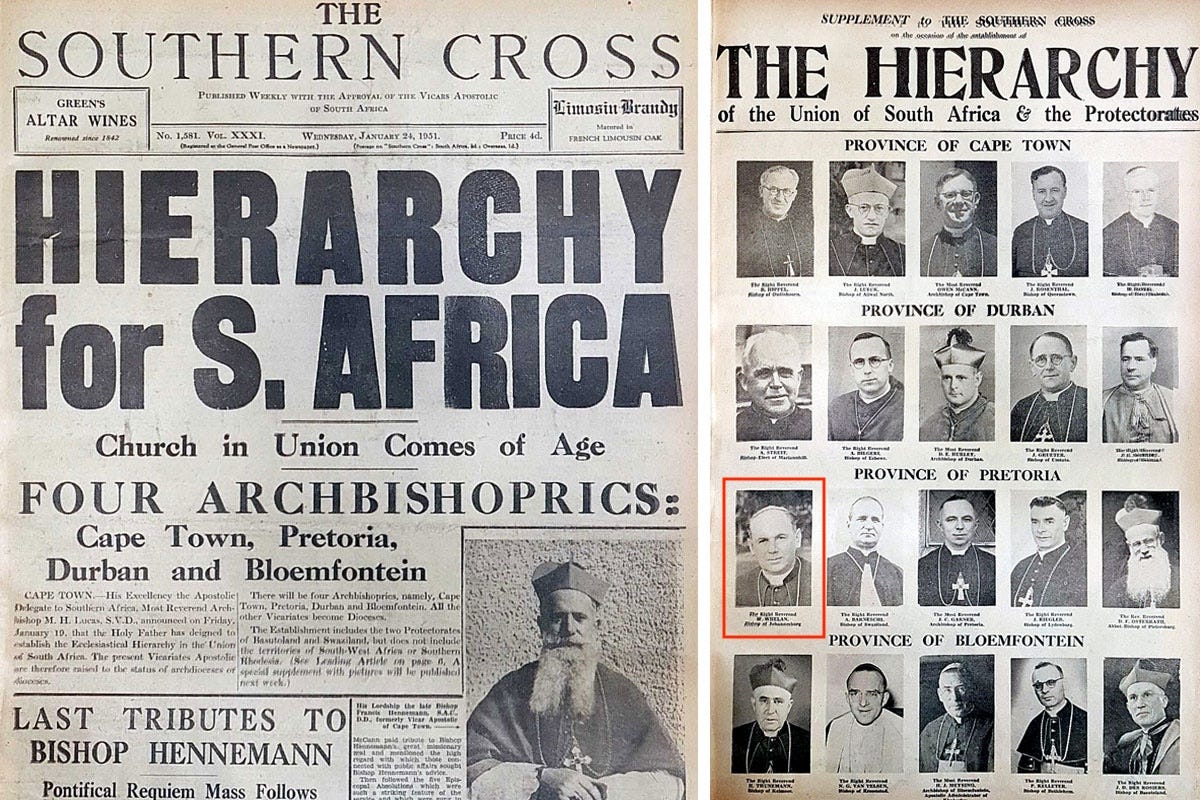
Archbishop Whelan’s Biography
In preparation for this translation and our commentary on the 1964 address of Archbishop William Patrick Whelan, we have relied on a study from Rev. Stuart Bate O.M.I., doctor of theology and professor at the University of KwaZulu-Natal. His work, coupled with historical press coverage, provides valuable insight into the context of the speech, revealing how the South African hierarchy was not neatly unified in its approach towards the apartheid regime. As for Archbishop Whelan’s background, there is no comprehensive biography to draw from, at least that we can tell. For that reason, this short biography from a larger work, “The Catholic Church and Apartheid”, by Mr. Garth Abraham will suffice. In the sixth appendix of his master’s thesis we read:
W.P. Whelan was born in Wakkerstroom in the Transvaal in 1907. He received his primary education from Loreto Convent in Pretoria, and his secondary schooling at St Aidan’s College, Grahamstown. In 1924 he joined the Oblate novitiate in Ireland, continued his studies at the National University of Ireland in Dublin and the Oblate Scholasticate. He was ordained a priest in June 1937. For fifteen years he was on the staff of the Johannesburg Pro-Cathedral, and for the last three of these years he was parish priest. During this time he was editor of the Catholic News. In May 1948 he was consecrated titular bishop of Legia and appointed coadjutor to Bishop O'Leary, whom he succeeded as the fourth vicar apostolic of the Johannesburg vicariate in December 1950. The following year he became first bishop of Johannesburg. On the resignation of Archbishop Herman Meysing, OM, he was appointed archbishop and metropolitan of Bloemfontein in July 1954. He died in February 1966 and was succeeded by Archbishop Joseph Patrick Fitzgerald, OMI.1
Context of the 1964 Speech
The controversy among the South African hierarchy over apartheid unfolded gradually from the 1950s through the 1980s. At first, the bishops adopted a cautious approach. Their first collective “Statement on Race Relations” in 1952 emphasized principles of justice and charity without naming apartheid directly. By 1957, however, under the influence of Archbishop Denis Hurley, who was “the most progressive of the bishops”2 according to Stuart, the Southern African Catholic Bishops’ Conference (SACBC) issued a landmark pastoral letter condemning apartheid as “intrinsically evil” and even a “blasphemy” when justified as God’s will. Witnessing further to Hurley’s progressivist tendencies is his comment at the conclusion of the Second Vatican Council. He remarked, approvingly:
Vatican II was a watershed in the history of the Catholic Church. We leave on the far side of the watershed a church gazing heavenwards, wrapped in her isolation and identified with her bishops, priests and religions. On this side of the watershed we are swept along in a somewhat turbulent church, still gazing heavenwards but taking in as well the terrestrial scene, shedding her isolation and recognizing that the bulk of herself is made up of the laity.3
The 1957 SACBC statement on apartheid was a major turning point, though it did not mean full consensus, as some bishops and Vatican officials would have preferred more general, less confrontational language.
The divisions became public in 1964, when Archbishop Whelan of Bloemfontein made a statement that gave qualified approval to South African apartheid, arguing, in our view sensibly, that it can be compatible with Catholic teaching. His remarks sparked controversy within the Catholic Church and abroad. Archbishop Owen McCann of Cape Town tried to downplay the significance of Whelan’s comments, while Archbishop Hurley publicly rejected them, stressing that apartheid violated Catholic principles of human dignity. While disagreeing, the tactful approach from McCann was captured in 1964 by an American Catholic paper, The Catholic Transcript. In the issue of February 27 we find the following characterization, “[McCann] said that Archbishop Whelan was entitled to his own views as head of the Bloemfontein archdiocese, but that those views were not those of the Bishops’ Conference. But, he added, insofar as Archbishop Whelan quoted the joint statements of the South African bishops, he was setting forth the official attitude of the Church.”4 Many Catholic newspapers5 and other churchmen quickly clarified that Whelan was speaking personally, and not for the Catholic Church as a whole. This clash was one of the most visible moments of discord among the bishops and highlighted how deeply the hierarchy was split in its response to apartheid.
Archbishop Whelan, for his part, emphasized that his statement was not made on behalf of the Bishops’ conference, but it was recorded that:
[T]he statement was not a purely private expression of his views as Archbishop of Bloemfontein. He said it was released taking into account his responsibility to the Church as Director of the Press, Cinema and Radio Department of the Bishops’ Conference. He said it was based on the encyclicals of Pope John XXIII and on statements made over the years by the Bishops’ Conference. He singled out a 1952 Bishops’ statement which said that “the great majority of non-Europeans and particularly Africans, have not yet reached a state of development justifying integration”.6
It is interesting that Archbishop Whelan invoked Pope John XXIII’s first encyclical letter, Pacem in Terris (Peace on Earth), because after the Second Vatican Council the climate decidedly changed. Exaggerated and misunderstood notions of human dignity took hold, which were no longer connected in any way to sin. Losing moral dignity, which happens by committing serious sin, in a way, makes men worse and more harmful than beasts.7 Tragically, moral dignity was conflated with ontological dignity, which belongs to man in virtue of his unique, rational will and intellect. The latter, ontological dignity, is truly permanent—even in the sinner—but it importantly comes from God, not man.
After the 1960s, racial egalitarianism was quickly dogmatized. This new dogma was proclaimed by cosmopolitan and communist movements, aimed at racial “leveling”. It was truly a global phenomenon, not limited to South Africa, but present in other White countries, like the United States, France, Britain and Australia.
Over time, the South African hierarchy moved towards greater and greater unity in their position. In 1966, they issued A Call to Conscience by the Bishops, and in 1977, the Declaration of Commitment on Social Justice and Race Relations within the Church, both of which articulated stronger opposition to apartheid and emphasized the need for what they saw as justice and reconciliation. By the late 1970s and early 1980s, South Africa became increasingly influenced by Soviet-backed Black terrorism through the African National Congress (ANC). Over time, the ANC’s revolutionary program was legitimized by propaganda and Western betrayal. Sharing many of the same sympathies, the SACBC predictably became more outspoken in its condemnation of the apartheid regime.
Arguments and Their Merits
Perhaps for some readers, this will be the first time you are hearing anything positive about the White South African apartheid regime, much less a moral defense of the same—with certain reservations. If that is your position, please keep an open mind, making sure to weigh the presented arguments on their merits. A dispassionate, careful analysis from Archbishop Whelan should be examined by an equally dispassionate reader. Insofar as his analysis is sound, which we believe as mentioned above, the same underlying principles can easily be applied to our present situation in America, along with other White countries. Naturally, the same principles would be admitted for Asian or Black countries, trying to keep their respective racial and national characters intact. However, the dispossession, i.e. losing our homeland, and present racial suicide of the White race in America is, obviously, our biggest concern.
Now, without further ado, The Journal of American Reform is pleased to present the 1964 speech of Archbishop Whelan on South African apartheid.
Text: Die Burger, (19 February, 1964), pgs. 1 & 13
HEADLINE — Favorable Roman Judgement for South Africa
ARCHBISHOP’S VIEWS ON SEPARATE DEVELOPMENT
THE present situation in South Africa, despite its defects, is stable, secure and full of prospects for future development, said the Archbishop of Bloemfontein, Archbishop W. P. Whelan, O.M.I., in a statement issued last night.
He said he was disturbed by the present situation in South Africa only in so far as South Africa had been made the object of criticism that was largely prejudiced or, to say the least, uninformed.
The Archbishop is director of press, radio and cinema of the administrative board of the South African Catholic Bishops’ Conference and his statement contains his answers on behalf of his Church to a number of questions about the Church’s attitude towards the racial discourse in South Africa. The questions were put to him from time to time.
The Archbishop issued the statement in the belief that the time is now ripe to explain the position of the Roman Catholic Church at this stage.
Editor’s Note: the following is the text of the statement in question-answer form.
Are you disturbed by the present situation in South Africa?
Yes, and no. Yes, insofar as South Africa has been made the object of criticism that is largely prejudiced or, to say the least, uninformed. Also because all the fair promises concerning other parts in Africa have proved to be such a grievous disappointment.
No, because it is clear that the South African situation, despite its defects, is stable, secure, and full of prospects for future development. I believe that when one considers a country’s socio-political future it must always be against the background of its economic possibilities.
In this respect South Africa offers unrivalled possibilities, unequalled anywhere in Africa.
For this reason I foresee a happy issue out of our current social and political difficulties, including those arising from the multi-racial character of our society.
Will this necessarily involve the abandoning of the apartheid policy?
Not necessarily.
But is apartheid not an injustice which must go?
It all depends on what you mean by apartheid. It is crucial in any discussion on this subject to distinguish clearly between the idea of apartheid, or separate development, or whatever else it may be called, on the one hand and, on the other, the actual laws and regulations which the public authorities may make to implement the theory.
Is not the theory of apartheid or separate development evil in itself?
There is no teaching of the Church in opposition to the idea of a State composed of a number of national or racial groups maintained in their separate and distinct identity by the State of which they form a part.
This is clear from the Church’s attitude concerning the rights of national minorities, so hotly debated during the first 50 years of this century. This was reiterated recently in Pope John’s encyclical Peace on Earth. The Church has often declared that public authorities have an obligation to assist the cultural and racial groups in a pluralistic State in their distinctive development.
Editor’s note: one can find this same principle outlined in a standard pre-conciliar work of Thomistic moral philosophy. Rev. Henri Grenier explains it thusly, “Every nation, or every considerable part of a nation, has a right to self-preservation within the civil society of which it forms a part… 1° Therefore the political authority should see to it that its institutions and laws are such as will give assurance that the nations subject to it will work together in peace and harmony for the common good… 3°The civil authority may, for a grave reason, take prudent steps to gradually remove national or racial differences which are an impediment to the attainment of the common good.”8
Can it be said that the Church is not indifferent to the destruction of such groups?
This is correct. The Church considers immoral any policy aimed at equating such ethnic groups into a uniform cosmopolitan mass. The bishops of the United States have even gone so far as to say that these heterogeneous racial and cultural groups have an inherent right to exist. This is also the position adopted by the United Nations in 1948-49, when it condemned genocide, the meaning of which was expanded to include their physical destruction or forced integration, not only of racial groups, but also of national and religious groups.
Has South African apartheid been officially condemned by the Church?
In 1958, Catholics were informed by the chairman of the Administrative Board of the South African Catholic Bishops Conference that they were perfectly free to vote for any of the parties contesting the general election.
This response could not have been given if any party had been judged to be advocating a policy which, considered as a whole, was immoral.
Why do you say “considered as a whole”? Are there items in the present Government’s policy which could be considered immoral?
It is common knowledge that the application of several provisions of our racial legislation involve hardship and injustice: conditions of Bantu urban employment; unreasonable job reservation; restriction on the freedom of the Bantu worker to improve his economic and social position, restriction on the freedom of the Bantu worker to choose his employer, to alternate employment, or to offer his services to the highest bidder; restriction on the place of abode which separates members of the same family.
All these matters have been dealt with at length, and the attitude is clear from the statements issued by the bishops of Southern Africa in 1952, 1957, 1960 and 1962.
How can a Catholic vote for a party that pursues a policy that involves the violation of such human rights as those you just mentioned?
In no society can every man have the full exercise of the rights which are theoretically due to him as a human person. By the very fact of being a person, man is essentially a social being, and by living in any society, of whatever nature, a limitation is imposed on his freedom of action as an individual. This was clearly stated by the bishops in their declaration of 1952.
On the other hand, this limitation (even when considerable) does not outweigh the advantages enjoyed by living together with others. It cannot be said that this limitation of the individual’s rights necessarily constitutes an injustice.
In this regard, it must always be remembered that, when we use the words “law” and “justice”, we are not using them in their original legal context. A legal right is a provision of the laws that is favorable to the individual, that is clearly stated and that can be proven in court from documentary evidence. Legal justice is the precise interpretation of a written document and the fair application thereof to a particular case.
When we speak of “human rights”, however, we are dealing with general norms by means of which people can develop and take their place in society. It is always a case of more or less, according to the person’s constitution and the circumstances of the society in which he lives. “Justice” in this regard is a weighing of the needs of the individual against the general needs and possibilities of the society in which he lives. It always leaves room for legitimate difference when it comes to practical measures, as Pope Leo XIII clearly stated in his encyclical on Christian Democracy.
Likewise, specific questions about human rights often cannot be decided with a simple yes or no, as Pope Pius XII told the congress of Catholic jurists in 1953.
In their 1952 declaration, our bishops applied it to the South African scene, in these words: “The race question is not susceptible of an easy solution. The choice of the right course of action in the solution of the race question can never be easy... Love and justice must provide the driving force, prudence must be the guide. What has been said remains on the ground of principle. It is the task of men trained and specialized in various branches of study and technique to apply these principles to difficult and complicated situations. This will be no easy task.”
In a political community composed of different types and cultures, there will always be pressure groups and sections of the population with special interests which influence the policies of the different political parties to a greater or lesser extent. The Christian, however, may cast his vote in favor of any of these parties, provided only that, viewed generally, he accepts that policy as one which will achieve the general stability of the community as a whole.
But does the policy of separate development, which involves extensive government interference in the lives of so many individuals, not necessarily entail an excessive curtailment of human rights?
It is difficult to know for sure. The highly complex structure of modern society has forced governments everywhere to interfere more and more in the lives of their citizens. This is especially the case with the welfare state, where virtually every aspect of life is controlled by public authorities of various kinds.
Exactly where the dividing line lies which the governing body may not legitimately cross is impossible to determine in general. It must be judged in each particular case. Thus we read in Pope John’s encyclical Peace on Earth: “Indeed, the whole reason for the existence of civil authorities is the realization of the common good. It is clearly necessary that in the pursuit of this end they should honor its essential elements and at the same time adapt their laws to the needs of a given historical situation.”
But apartheid, which denies the democratic principle of “one man, one vote” by excluding 80 percent of the population from the electorate, surely cannot be reconciled with Christianity?
The first point that must be made clear is that the Church has never considered democracy to be the only form of government compatible with Christianity. In Peace on Earth, Pope John wrote: “It is impossible to determine once and for all what is the most suitable form of government, or how the civil authorities can most effectively exercise their various functions... In determining the structure and operation of the government that a state should have, great weight must be attached to the historical background and the circumstances of given political communities, circumstances which will vary at different times and in different places.”
Editor’s note: worth noting is what Pope Pius IX said about universal suffrage in 1874, “I bless all those who cooperate in the resurrection of France. I bless them with the aim (let me tell you) of seeing them take care of a very difficult but very necessary task, that of eliminating or diminishing a horrible plague that afflicts contemporary society, and which is called universal suffrage. To entrust the decision of the most serious questions to necessarily unintelligent and impassioned crowds, is that not abandoning oneself to chance and willingly running into the abyss? Yes, universal suffrage would rather deserve the name of universal madness, and, when secret societies seize it, as happens too often, that of universal lie.”9
Even in a State of democratic structure, the principle of “one man, one vote” is not always desirable. Thus the Pope further said: “It is in accordance with their dignity as persons that human beings will take an active part in the governance of the State, although the way in which they participate in it will depend on the level of political development of the community to which they belong.”
We know, for example, how limited the electorate was in ancient Athens—the birthplace of democracy: and even today it is not considered a serious injustice that women in Switzerland do not have the right to vote.
In recent times we have seen too many cases where the cry of “one man, one vote” has been used by demagogues as a pretext to seize power and then exploit it for their own ends. A democracy based on a broad body of citizens seems to ensure the common good only in highly developed and homogeneous societies. This is freely acknowledged in Africa.
This was also in the minds of the bishops of South Africa in 1952 when they declared that “the great majority of non-whites, and especially the Bantu, had not yet reached the stage of development which would justify their integration into a homogeneous community with the whites... The coming together of people in communities gives rise to other rights which may be called secondary, derived or conditional. Such rights vary greatly according to the type of community which has developed, the recognition which is granted, and the powers which are necessary to possess them. Among these must be included the right to vote in the election of legislative bodies”.
In South Africa there is a growing tendency to give non-whites an active participation in the affairs of the country. That this participation varies according to the group has been stated in accordance with Pope John’s statement quoted above. In the Cape the Coloureds have elected representatives in Parliament. The recent establishment of the Transkei Parliament, with its considerable powers of local government, and the formation of the National Indian Council, are further new starting points.
So far you have it in terms speaking of justice. The Christian law of love does not bring a new element to the whole discussion?
From that point of view the individual and his motivation: yes. From a public policy perspective: no.
Love is a gift from God to man, by which man receives a share in the life of God, so that his whole being and his actions contain something of the divine. However, it does not bring any new norm or measure of action in the world and its affairs, but rather a new driving force. Thus Pope John writes in his Peace on Earth of the perfect human community which he sees as “an order founded on truth, built according to justice, animated and integrated by love”. For this reason, the expression “justice and love” is a very unfortunate one in that it opens the way to possible confusion of thought. Our bishops especially tried to guard against this confusion when they wrote in their declaration in 1952: “Of course, love does not oblige us to ignore differences in circumstances and culture. There will always be inequalities in society that will inevitably affect human relationships.”
What would be your advice to someone who is truly eager to do something that will improve things in this country?
No better advice can be found than the warning and encouragement of Pope John at the end of his Peace on Earth: “There are some souls who are particularly blessed with generosity, and who, when they encounter situations in which the demands of justice are not met, or are not fully met, feel fired by the desire to change the state of affairs, as if they wished to have recourse to something like a revolution. It must be borne in mind that, to proceed gradually, is the law of life in all its ultimatums. Therefore, even in human institutions it is not possible to renew for the better except by gradually working within those institutions.”
END.10
CONSIDER SUPPORTING THE JOURNAL OF AMERICAN REFORM!
As I intend to devote more and more time to this political project, I want to continue to provide free, educational material, whether visual (edits) or written (essays, translations and a forthcoming book) content. If you have benefited from my work in any way, kindly consider supporting The Journal financially. On a personal note, I am married and duty-bound to provide for my family, so any help, big or small, is appreciated. Subscribe or make a one-time donation.
Regardless, the production of free material will continue, hopefully with ever-increasing quality, and I will keep all my subscribers notified of my plans.
In addition to Substack, the home of The Journal, my work, graphics and commentary can be found on the following platforms:
X: @AmericanReform_
Telegram: @American_Reform
Abraham, Garth, The Catholic Church and Apartheid, (1984), pg. 192
Bate, Stuart, The Church under Apartheid, (1999), pg. 3.
Garth, pg. 20.
The Catholic Transcript, vol. LXVI, no. 44, pg. 2, Feb. 27, 1964.
The Catholic Advocate, vol. XIII, no. 10, pg. 1, Feb. 27, 1964; The Southern Cross, pg. 3, Mar. 5, 1964; The Catholic Commentator, vol. II, no. 6, pg. 8, Mar 13, 1964.
The Georgia Bulletin, pg. 2, Feb 27, 1964.
St. Thomas, ST II-II, Q. 64, a. 2, r. 3: “By sinning man departs from the order of reason, and consequently falls away from the dignity of his manhood, in so far as he is naturally free, and exists for himself, and he falls into the slavish state of the beasts, by being disposed of according as he is useful to others. This is expressed in Ps. 48:21: ‘Man, when he was in honor, did not understand; he hath been compared to senseless beasts, and made like to them,’ and Prov. 11:29: ‘The fool shall serve the wise.’ Hence, although it be evil in itself to kill a man so long as he preserve his dignity, yet it may be good to kill a man who has sinned, even as it is to kill a beast. For a bad man is worse than a beast, and is more harmful, as the Philosopher states (Polit. i, 1 and Ethic. vii, 6).”
Rev. Henri Grenier, Thomistic Philosophy, vol. III, no. 1110, pg. 394-5.
Jules-Paul Tardivel, Vie du pape Pie-IX, (1878), pg. 73.
The transcript for this speech was located in a local South African newspaper, Die Burger, and then a copy was obtained at the Library of Congress. Upon request, we would be happy to make it available to any of our readers. Simply navigate to the “About” page where the administrator email can be seen and ask for a copy.