

“Accordingly, the oath of allegiance to the state does not properly create a new obligation, but rather recalls and confirms the natural obligation that already existed previously, according to which a person is bound to obey the state and support it […] A nation does not need these, for the national connection of men, being more intimate, unites them more firmly to one another, and appears more clearly to their minds.”
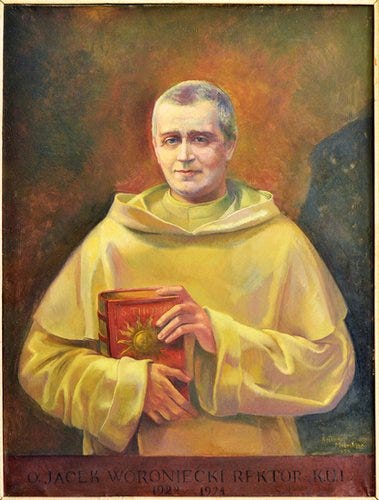
Author’s Biography
Fr. Jacek Woroniecki O.P. (b. 1878),1 born Adam Marian Tomasz Pius Leon Woroniecki in Lublin, Poland, was one of the most significant Polish Thomists and moral theologians of the 20th century. Born into a noble family steeped in Catholic tradition and patriotism, he received an early education at a Russian gymnasium in Warsaw, graduating in 1898. Following a brief stint in a hussar regiment, he pursued higher education at the University of Fribourg, where he earned licentiates in both natural sciences (1902) and theology (1905). After which, he entered the diocesan seminary in Lublin and was ordained a priest in 1906.
Woroniecki’s academic ability soon led him back to Fribourg, where he completed a doctorate in theology in 1909 with a dissertation on the social doctrine of St. Thomas. That same year, he entered the Dominican Order in Fiesole, Italy, taking the religious name “Jacek” in honor of St. Hyacinth. After professing his final vows in 1911, he served as a chaplain and educator in Kraków and Switzerland, distinguishing himself as a gifted teacher of philosophy and theology. In 1919, Fr. Woroniecki became a central figure in the newly founded Catholic University of Lublin (KUL), where he taught moral theology, ethics, pedagogy, and catechetical methodology. He served as rector of KUL from 1922 to 1924 and again as vice-rector (1928–1929), where he helped shape the intellectual and spiritual formation of the future Catholic hierarchy. His influence extended beyond academic halls; he actively promoted a revival of the liturgy and a return to classical Thomism, emphasizing the integration of reason, virtue, and spiritual formation.
From 1929 to 1933, Fr. Woroniecki lectured at the Pontifical University of Saint Thomas Aquinas (Angelicum) in Rome, where he was granted the title of Master of Sacred Theology—a rare distinction within the Dominican Order. Upon returning to Poland, he helped restructure Dominican seminary formation in Lviv, and from 1937 onward directed the Dominican studium generale in Warsaw. During World War II, owing to declining health, he remained in Kraków, devoting himself primarily to writing. Fr. Woroniecki’s enduring legacy lies in his synthesis of Thomistic theology, Catholic ethics, and pedagogy. His major works, such as Katolicka etyka wychowawcza (Catholic Ethics of Education) and Katolickość tomizmu (The Catholicity of Thomism), continue to influence scholars and educators. He was instrumental in restoring the Dominican intellectual tradition in interwar Poland and is remembered for his moral clarity, pedagogical insight, and fidelity to St. Thomas. Fr. Woroniecki died in Kraków on May 18, 1949.
Now, without further ado, The Journal of American Reform is pleased to present “The Disputed Question about Nation and Civil Status”.
THE DISPUTED QUESTION ABOUT NATION AND CIVIL STATUS
“What are laws without morals?” (Tacitus)
PREFACE
After many disputes and debates which have been conducted in recent times concerning the nature of nations and civil status through letters, having carefully read through them,2 it seemed to me that it would not be useless to reduce this arduous question, in the manner of the ancients, to the terms of the school. Am I about to discover immediately a definitive solution to the national problem? I do not dare to presume to do so. However, it is certainly in my mind that, based on the principles of St. Thomas, I will pose the aforementioned problem with greater precision, and thus make the way to its solution easier. I deliberately did not want to delay the reader by insisting on the attack on naturalistic nationalism, which, while it rejects the principles of Christian morality, is to be rejected by us a priori. Rather, I had in mind to inquire what role Divine Providence assigned to fulfill in our moral life the national element, especially if compared with the more obvious element of civil life in the state. I submit the probable solution of the questions, which seem so difficult, the more so because they are so easily moved by the political passions of our age, to the judgment of the more prudent.
There are seven considerations regarding nationality and civil status:
Whether nation and state are formally different.
Whether the end of the nation and the state are the same.
Whether the nation and the state arise by natural inclination.
Whether the nation and the state are freed from the laws of morality, by which the acts of individuals are governed.
Whether the nation should prevail over the state.
Whether a man is bound to love his fellow nationals more out of charity than his fellow citizens.
Whether the state to be defended in the thesis is that of one nation i.e. the so-called nation-state.
Article I.
Whether nation and state are formally different.
The first point is as follows: 1. It seems that there is no distinction between the nation and the civil state. For those things, which are composed of the same elements, cannot be distinguished from one another except numerically. Now, however, both the nation and the state are composed of men who join together to carry out social life. Therefore, a specific distinction between the nation and the civil state is not to be admitted.
2. Further, given that they are not entirely the same, yet they cannot be contrasted except in so far as a part is contrasted with the whole. For the nation is only a certain part of the state, or its material element, and is reduced to unity by civil power, which is, as it were, a formal element of social life. Therefore, the nation and the state cannot be completely opposed.
But contrary to experience it is clear that a state and a nation are not entirely the same. For they are not the same, which neither arise nor perish together. But when civil states arise and perish, nations neither arise nor perish, and vice versa. Therefore they are not entirely the same.
I answer that nation and state are not entirely the same, but rather specifically distinguished from each other. To make this truth evident, it must be considered that unity, which constitutes the formal element in the multitude of civil life, is not something simple or uniform, but can be resolved into several elements. The first of which, to begin with the more obvious, is civil power, which reduces the multitude to unity and governs it by civil laws. Then a certain common territory in which the multitude lives and which must be exclusively subject to this power, even if it is more or less united or divided in itself. Then manners and customs, which, while they attribute a certain habitual uniformity in the way of acting to each individual and to the whole community, somehow unite the multitude from within and reduce it to one. Here are added the bonds of kinship, which transform a multitude that has long resided in one territory into a wider family by attributing to it a new, modest unity. Then comes not infrequently a common language, in which the multitude communicates with one another and through which laws and customs are spread and the unity of society is confirmed. Finally, religion very often comes, which is of no small importance in founding the internal unity of civil society.
But since each of these elements is not necessarily connected to each other, so that the same people are reduced to the same unity by the same element, it follows that individual people can belong to one gathering under one respect, but to another under another.
Therefore, the unity which is constituted by civil power and civil laws founds a civil society, which is called a state; to this element is added another element, namely a territory exclusively subject to this power.
But unity, which is established through customs and traditions, is the constitutive foundation of a nation; closely related to this element are: unity of blood, for not infrequently a nation is nothing but the extension of one family or tribe and marriages are often contracted between co-nationals; in addition, unity of common language and unity of religion.
It follows from this that the nation and the state differ in their formal constitutive elements, namely in the very principles which reduce the multitude to unity. For just as the state is constituted by the unity of civil power, so the nation is constituted by the unity of morals and customs, which give the multitude a uniform mode of action, and just as “laws are certain organs for the purpose of the commonwealth”,3 so morals are certain organs for the purpose of the nation.
To the first, therefore, it must be said that nation and state belong to the same genus since they consist of a multitude, which is reduced to the unity of a common life; but they differ specifically within the same genus, for the formal principle that unites the multitude is one thing in a state and another in a nation.
To the second, it must be said that a nation is not merely a material part of a state, from which it receives form and unity, but has its own unity, flowing from its own constitutive principle, which are common morals and not infrequently bonds of kinship, language and even religion.
Article II.
Whether the end of the nation and the state is the same.
The second is thus approached: 1. It seems that the end of nation and state is not the same. For in practical things the end is like the form: therefore where the formal principles are diverse, there the ends must also be diverse. But, as was shown above in the previous article, nation and state differ formally, therefore they must also have diverse ends.
2. Further, it is not to be done by many that which can be obtained by one. But the common good of human society, which is the end of the state, can best be obtained by the state itself. Therefore, the nation must have a different purpose from the civil state.
On the other hand, the end of both the state and the nation is the common good of the whole population. And yet the common good of the whole multitude cannot be but one, namely, “to live well according to virtue.”4 Therefore the end of both the state and the nation is one.
I answer that, nothing prevents several agents from having one end; and this indeed in two ways: First, according to the material division, so that when several workers pull one cart, the effect of their labor is obtained from the material combination of forces. In another way, according to the formal division, as when several people work together in different ways towards the same common end, partly through manual labor, and partly through intellectual labor, directing the work of manual artisans.
If, then, we consider the end of the nation and the state will manifestly appear, that this end is one, namely, the common good of the multitude, giving to each citizen the possibility of “being able to live according to virtue”: to which end, however, they concur in different ways.
For the purpose of the state is nothing else than to provide the citizens with a sufficient complement of forces, both material and especially moral, to organize life perfectly. First of all, the state governs society with a kind of universal providence, while by means of laws it establishes uniform methods of action, so that the unity of the multitude is manifested in the activity of the multitude and the strength of the individuals increases. This universal mission of the state is so intimately connected with the essential elements of human nature that it could never, not even in a state of original justice, be lacking in men.5
Secondly, considering the weakness of human nature and its propensity to evil, which entered the world through original sin, another burden falls upon the state, from which it would be free in a state of original justice, namely to intervene directly in the affairs of its citizens with a certain particular providence, and this in two ways: negatively and positively. Negatively indeed by repressing evils, whether external on the part of the enemies of the state, or internal on the part of the citizens themselves who sometimes, out of wicked will, plot against the good of their fellow citizens or even the common good. Positively, however, by helping citizens in those things which they are not sufficient to procure for themselves with their own strength and the universal providence of the state alone. It is clear that the negative function of this particular providence of the state precedes the positive function.6
Similarly, the aim of the nation is to educate citizens to a more perfect life, for which individuals are not sufficient on their own: with the help of their fellow citizens and not infrequently compelled, they gradually acquire uniform habits, which are called morals, and which impress upon the multitude a stable bond of internal unity. A nation, no different from a state, exercises over its nationals through morals and customs a certain universal providence, insofar as it imposes on them common modes of action from which the common good arises and the strength of individuals grows. Moreover, it also exercises particular providence, and indeed negatively, by repressing through public opinion transgressions against good morals and the common good, and positively, by helping through social works those nationals who are not sufficient for themselves to establish a good life for themselves.
From this it follows that the nation and the state have the same end and divide the means conducive to it both materially and formally. Materially indeed, because in many they pursue the common good of society by the same means: for laws and manners agree in many, and the same opinion reprehends what the civil power represses by punishments. But much more according to the formal division, for they employ in different ways the means which lead to the end of society. The state is only more visible and from the outside, while through positive laws, protected by coercive force, it leads the citizens to the common good and their own good. The nation, on the other hand, is less visible and from within: for it governs its nationals by manners, which are like laws written in the hearts and consciences, and it compels them to obey them by the moral force of public opinion.
To the first answer, then, that two agents may concur to the same end and yet be formally different, if they tend towards it according to a different formal reason. But the nation and the state are organized for the common good of society according to another formal principle. For the nation regards more the internal education of moral character, which results from good manners and constitutes the necessary condition of the common good. The state, on the other hand, is more concerned with the external preservation of the common good, which is preserved by laws.
To the second reply, that the state cannot establish, confirm, or promote the common good of society through civil laws, unless those laws have a foundation in morals, according to the saying of Tacitus: “What are laws without morals?” And manners are precisely the distinguishing element of nations, for they constitute this formal principle according to which a multitude is united into one nation. It is therefore clear that the state is not sufficient to secure the common good of society, but most of all needs the concurrence of the nation.
But to the argument on the contrary, we must say that the common good of human society, even if it is one in itself, is still not something simple and indivisible. On the other hand, it is a very complex good and composed of many things, and therefore the individual associations of people who cooperate for it can reach it under different methods, either by providing it with external organization and coercion, such as the state, or by internal coordination of wills, such as the nation.
Article III.
Whether nation and state arise from natural inclination.
The third point is as follows. 1. It seems that the nation and state do not arise from natural inclination. For nature tends toward one. If, therefore, the nation and the state did not proceed from a natural inclination, they would not be different. But since they are formally distinguished, as is clear from what has been said above, they cannot have the same natural origin.
2. Further, those things which proceed from nature always have a certain necessity. And yet neither nation nor state imposes necessity on men, for it not infrequently happens that a man changes his nationality and still far more often his belonging to a civil state. Therefore, neither the state nor the nation flow from natural inclination.
3. Additionally, if a nation and a state had a natural origin, they would derive their origin from one family or tribe. But many nations and many states are composed of men who are united by no bond of common carnal (ancestral) origin. Therefore they cannot have a natural origin.
On the other hand, it is clear that all men belong to some state and some nation, and when they leave the state or nation of their origin, some adhere to that state and others to the nation. It is clear, therefore, that it is necessary for a man to live with others in some state and in some nation. But since all things which have some necessity arise from nature, it follows that the nation and the state proceed from a natural inclination.
I answer that, societies in which people are united must always be based on some communication and tend to some good which is common to all the members of this society. But this common good of individual societies is related in different ways to the ultimate end of man. For there are societies whose ends are not necessarily connected with the last end of man, which can be obtained without them. Such associations are called free, for a man gives himself a name solely on account of the particular interests which he hopes to derive from the association, and he can freely abandon them. There are other societies, the ends of which are necessarily connected with the ultimate end of the human nature, as if they were necessary means; without which that end can in no way be obtained. Societies of this kind are called necessary, or even natural: for man is led to them by a certain necessary natural inclination, which flows from that fundamental inclination which he has towards his ultimate end.7 No one can abandon such societies, nor remain outside them for long.
But since man has a natural knowledge of all that is necessary to him in this way only in general: therefore even those inclinations which follow such knowledge are also universal and indeterminate, and are not at all sufficient to direct man in practical life, which revolves around particular and determined things. Man must therefore determine his natural, universal and indeterminate inclinations with the help of reason and will by reference to the particular conditions of life, otherwise he would not be able to act. Hence, even in necessary societies, a distinction must be made between the often unconscious natural inclination, which gives them their origin, and the conscious activity of reason and will, which determines, develops and perfects this inclination. While free societies derive their whole origin from the free learning of man, societies are necessary partly from nature and partly from reason: from nature tending indeterminately and from reason determining the natural inclination.8
If, then, we investigate well the origin of nations and states, it will be evident that they belong to necessary societies, which are from nature inclining and reason perfecting. Both nation and state are necessary conditions of the perfect moral life of man, without which the ultimate end, set forth by his nature, cannot be obtained. Man is inclined to it by a certain natural inclination, which, since it is universal and indeterminate to particulars, needs determination by reason and deliberate will; consequently men must establish the particular elements of civil and national life by positive determinations, whether laws or morals, and they are able to change them whenever true necessity arises. But they can in no way uproot from nature the fundamental inclination to nation and state, nor can they even make it possible for them to attain their ultimate end, disregarding life in the state and nation.
Both the necessity of life in a state and the necessity of life in a nation flow from that essential condition of human nature, which may perhaps be called “potentiality”. In truth, no creature is born in the same degree of indeterminacy and potentiality as man. Both the external goods which he uses to preserve and promote life, and his external and internal faculties, are in a potential state, and this potentiality is only gradually reduced to determinate forms after a long time, and divided by the work of social life. However, the necessity of the state flows from another element of this potentiality, the necessity of the nation from another.
The necessity of the state arises from objective potentiality, i.e. from the potentiality of the subject in relation to the object or objects; which are particular goods. For everything that a man does, he does for the sake of the ultimate end, which is the universal good, but his individual actions are about particular goods, which in themselves are completely indeterminate with respect to the universal good. Therefore, man must determine himself by free will to particular goods and would be entirely sufficient for this if he were destined for a solitary life. But since man is destined by the same potentiality of his nature to live and act in a multitude, this multitude would be dispersed into different ones, unless all determined themselves in the same way to particular workable things: but this cannot happen unless there is something in the multitude that governs the others, by which all are determined to one. This is precisely what life in a state provides to man, the formal element of which, namely civil power, imprints uniform determinations on the multitude of citizens through civil laws.9
The necessity of nation arises rather from the subjective potentiality of human nature, namely from its potentiality not in relation to the objects about which the operation is concerned, but in relation to the operating subject himself, which can behave in different ways in its own operation, namely either acting well i.e. in conformity with moral laws, or badly i.e. in a manner inconsistent with them. Accordingly, nation is founded on the subjective indeterminacy of the individual nature of man, not by reference to the objects about which the acts are carried out, but by reference to the manner in which these acts are to be performed i.e. in the habits by which the powers of the soul are to be informed, so that man can act readily, easily and delightfully in moral life. For men, since they are destined for a common life in society, need to be uniformly determined in their habits, and this determination, which is called education, should affect them more deeply and give them a more stable manner of acting. It is clear that civil laws are not sufficient for this, since they are not able to immediately enter deeply into the powers of the soul and inform them with habits: moral education can be accomplished only through morals, which surround a person on every side and act upon him without interruption, and therefore alone are able to affect and transform the powers of his soul more intimately. But just as laws are organs of the state, so morals are organs of the nation, as was shown above in art. I.
It is clear, therefore, that both nation and state have their origin in human nature itself, even though they flow from different necessities of the same nature.
To the first, therefore, it must be said that the nature of man inclines him to one ultimate end, but not to one means nor to one path leading to this end. Nothing, therefore, prevents man from being inclined by his nature to two societies, both of which, although for different reasons, are equally necessary for attaining the ultimate end.
To the second, however, it must be said that, considering the universal nature of man, his natural inclinations are always indeterminate with respect to particular things. Man is necessarily inclined to live in some nation and in some state, but he is not necessarily inclined to this nation or this state, but remains free to choose them, to abandon one and adhere to another. This is much more true of the state than of the nation; for national life affects man more intimately, so that he cannot so easily and in a short time lay aside national customs and assume new ones; but it is much more easy to change his belonging to a certain civil state. If, however, anyone wished to live entirely outside the state and nation, he would be, according to the Philosopher’s saying,10 either a god or a beast: i.e. either through a previous social life he would acquire such moral perfection that he would henceforth be sufficient for himself alone and could lead a solitary life, as if divine: or, having despised human perfection, he would turn away from the ultimate end of his nature and lead the life of a brute animal.
To the third, it must be said that, when we speak of the origin of nation and state, we are not asking about the carnal (ancestral) origin of the men who are gathered together in these societies: for by the nature of man we do not understand only his body, but all the elements that enter into the constitution of his substantial nature. We are not therefore now asking, in the manner of the positivist school, how nation and state arise and develop in historical order, but, as is clear from the body of the article, we are trying to find out whether the necessity of nation and state can be determined through the analysis of human nature, or, in other words, whether and what are the elements of human nature that necessarily demand of man that he always live in some nation and state.
Article IV.
Whether the nation and the state are freed from the laws of morality, by which the acts of individuals are governed.
To the fourth point of view: 1. It seems not. For moral actions comprise the whole of human activity, so that there is no act which does not fall under them. But the active life of both the nation and the state is nothing other than the collective activity of the human population. Accordingly, no reason is given why the same acts should be governed by other laws when they are committed in a group and by others when they are done singly.
2. Further, if the activity of the nation and the state were to be freed from moral laws, the way would be opened to moral anarchy, both in international life and in the internal life of individual states. For in international life the stronger states oppress their weaker neighbors without any regard for moral laws; but in the life of states, in which several nations live together, the conflicts between them would not be limited by any laws.
But contrary to experience, it is clear that there are certain acts which are forbidden to individuals, such as e.g. a duel, but not a nation and a state, e.g. war. For the Church has never determined that war is in itself sinful, but has always forbidden duels. It appears, therefore, from the practice of the Church, that the nation and the state are governed by different laws of the king, and of individuals by other laws.
I answer that, all human activity, which proceeds from the deliberate will, whether it tends to the particular ends of individuals, or pursues the common good of any society, must be governed by moral laws. For these laws are nothing else but the expression of the eternal law, which establishes all the necessities of human life, both individual and social, and prescribes for them stable norms of conduct. If, therefore, under the name of moral law is meant the whole complex of laws which comprise human activity, it is certain that the nation and the state must be governed by the moral law no differently than individual men.
It must be considered, however, that the moral law taken in this way is not something simple, but very complex: for it consists of many particular precepts, which do not even bind every individual to the same degree. For considering the special conditions of life, duties, functions, or states, certain laws bind some more than others, nay, sometimes they bind some and not others. Hence also in the order of motions the adage is valid: “when two are doing the same thing, it is not the same.”
This diversification of the moral obligation of the laws is all the more apparent if the individual activity of each person is compared to their social activity. For human society, whether a nation or a state, is something whole, and even if this whole lacks substantial unity, it is nevertheless endowed with moral unity or unity of order, by virtue of which it has operations which are not proper to any part but to the whole.11 Those operations are governed by their own moral laws, which in some respects differ from the laws governing the individual acts of individual men. For there are certain things which are forbidden to the state and nation, and not to the individual, just as there are others which are forbidden to individuals, and not to the state or nation.
For the greater evidence of which it is necessary to consider further, five kinds of actions are given under respect of good and bad. First, there are acts so essentially good that they can never, under any circumstances, become bad: such is e.g. love of God and neighbor. Secondly, there are acts of evil, which have deformity so inseparably attached to them, that they can in no way be good, such as fornication, adultery, and the like. Thirdly, there are acts which of themselves bear no relation to the order of conduct, and only become good or bad from circumstances, especially from the end of the agent; such are e.g. to talk, to walk, etc. In addition to these three categories, which divide human actions into three main types, two intermediate ones must also be distinguished: namely, fourthly, there are actions which in themselves conform to the rules of morals, but are not so radically good, that they cannot, under certain circumstances become evil: such is e.g. the worship rendered to God, which, if it is superstitious, is changed into a sin, even if considered in itself a good. Fifthly, finally, there are “actions which, considered absolutely, imply a certain deformity or disorder, which nevertheless become good when certain circumstances arise: such as killing a man or striking him, which in itself implies a certain deformity. But if we add killing a malefactor for the sake of justice, or striking a delinquent for the sake of discipline, it will not be a sin but a virtue”.12
It is now clear that the difference between the laws of individual morality and the laws of social morality concerns the last two categories of acts. There are good actions which are permitted to individuals, indeed highly praised, but which are nevertheless forbidden to the state and the nation: for example, distributing goods to the poor, renouncing children for the sake of continence, laying down one’s life for one’s friends, etc. In the same way, there are actions which carry with them a certain deformity, which are forbidden to individuals, but which are nevertheless permitted to the state and the nation, such as defending one’s essential rights by armed force, inflicting irreparable punishments on evildoers, and certain other things which perhaps require more precise determination on the part of moralists.
The reason for this difference flows from a twofold source. First, the proper and formal end of the nation and state is temporal, namely the perfect sufficiency of bodily and moral life, which individual men cannot have outside these two natural societies. Certainly that end must be subordinated to the supernatural end of individual men in relation to which it stands as a means. However, it is not a pure means, but is an intermediate end and indeed the ultimate in its order and having its own aspect of the honest good. Among all the natural means that are necessary for individual men, as conditions for achieving salvation, the moral order of society, which constitutes the common good of both the state and the nation, far surpasses all other goods. “For the good of the multitude is greater and more divine than the good of an individual, hence sometimes the evil of some is tolerated if it yields to the good of the multitude, as when a robber is killed so that peace may be given to the multitude.”13 It is right to say with St. Thomas “that the good of the republic is the chief among human goods”, since supernatural goods, such as e.g. the salvation of souls, the good of the Church and others are not human goods but rather divine.14 It follows from this that, in order to preserve the common good, it is permissible for the state and the nation to commit actions that have some deformity in them, which it is not permissible for individual individuals to commit, for they are not necessary for their individual end. The state has the right to punish transgressors with death for injuries inflicted on public order and peace, otherwise the common good of the city cannot be preserved. Individual men do not have this right, but must resort to the judicial power of the state and or leave vengeance to God.
The second reason for the distinction is based on the fact that human societies are not supposed, i.e. they do not have the substantial unity that individuals enjoy: moral personality is said only analogously of society and of the individual man, who alone is truly independent i.e. can dispose of himself but is also bound to render an account of himself. The moral personality of the state and the nation is prolonged longer, but is less solidly founded: for just as a river “is always said to be the same, although it is a different water flowing down”,15 so also the state and the nation retain their identity, as generations of citizens flow. The nation and the state cannot therefore so freely dispose of themselves for the future, nor can they be called to render an account for the past with equal right as individual men. Hence it follows, why certain things are forbidden to them, which are permitted to individuals, and conversely, why certain things are forbidden to individuals and permitted to the state and the nation.
It follows therefore that the nation and the state are subject to moral laws, yet among these laws there are certain ones which bind the nation and the state in one way and individual men in another.
To the first, therefore, it must be said that the operations of the nation and the state are not a mere material composition of the actions of the individual men who constitute these societies, but are acts proper to the whole, which are not acts proper to the parts. “For the common good of the commonwealth and the singular good of a single person do not differ only in much and little, but in formal difference. For the common good and the singular good are different, just as the whole and the part are different.”16 The acts of human societies are specified by their end, which is always a certain common good formally different from the particular good of individuals. Consequently, the activity of the nation and the state, because it is regulated by respect for the common good, applies certain moral laws differently from those of individual men, who order them to their individual ends. In this sense, the state and the nation can be said to be governed by laws other than those of individual men.
As to the second, it must be said that relations between individual states or between individual nations in the same state are by no means free from any moral laws. However, these laws, especially as regards actions that can change the appearance of morals, are not the same for a nation and a state as for individual men, and this is indeed twofold from the chapter, as has been shown in the body of the article. To these reasons, for a single state, a third is added, namely the defect or absence of a superior power, armed with sufficient sanctions, which would be able to judge and effectively resolve disputes between states. This last reason is less valid for nations that do not have their own states, and for which it is certainly not permissible to the same degree to protect their rights by armed force. The whole difference between the moral laws which govern the activity of these two supreme human societies and between the laws which regard individual men concerns the state much more than the nation. Especially in the repression of evil, both internally towards malefactors and externally towards enemies, more and stronger powers are to be permitted to the state than to the nation. A nation lacking civil power, when it wishes to exercise these prerogatives of the state, immediately enters the path of conspiracies which necessarily corrupt its morals and dissolve its internal unity. Certainly neither between states nor between nations can the “right of the stronger” be considered as the ultimate reason, especially if this is designated solely by the preeminence of material forces, as is often the case; but the relations which they have among themselves must also be founded on natural justice. But because natural justice in individual life and even more so in international relations is not sufficiently determined, it is necessary to determine it more accurately through conventions between individual states and nations, correcting and perfecting the defects and imperfections inherent in the natural order, by adhering to the higher principles of the supernatural order, namely Christian justice and charity.
Article V.
Whether the nation should prevail over the state.
The fifth is thus approached. 1. It seems that the nation does not excel the state, but vice versa. For that society excels others which disposes of more effective means to obtain its end. But only the state possesses such means, since only the state is able to compel its subjects by armed force to observe the laws.
2. Furthermore, that society should have preeminence, which has its subjects united to it by a stricter bond. But citizens are united to the state and not to the nation by an oath of fidelity; similarly, we are bound in conscience to obey the civil power which governs the state, as the Apostle testifies in Rom. XIII, 1-2, and not the nation, which not infrequently lacks visible power. Therefore the state is preeminent to the nation.
3. Furthermore, where several principles concur, one should be the principal governing the rest. But in states which are constituted by one nation, the state itself governs national life. Therefore the state is a higher principle, preeminent to the nation.
4. Furthermore, if the nation were to be superior to the state, it would be permissible to resist civil power when it oppresses national rights. But this would be very harmful to social life and would open the way to continuous dissensions. Therefore, the state should be given preeminence rather.
But on the contrary, among societies, which are as it were certain forms of common life, preeminence is to be attributed to that which is more incorruptible and affects human life more profoundly. But nations last longer than states, and are more difficult to corrupt, and through national customs they more profoundly transform the powers of the human soul than states. Therefore preeminence is to be attributed rather to the nation and not to the state.
I answer that there is nothing to prevent two things, when compared to each other, from enjoying preeminence under some particular respect, so that one has preeminence under one respect, the other under a different respect.
The state is superior to the nation in this respect, because, since it must maintain the external unity of society, it is endowed with external means by which it can more effectively pursue its end. It therefore has more visible external organs by which it can more easily enforce obedience and submission by coercive means. Its entire activity is more manifest and appears in external forms, which are more easily perceived.
But the nation stands out from another respect; namely, as we saw above in the third article, it affects man more intimately. Although national customs do not provide such coercive means as civil laws, they nevertheless affect man more deeply and through education impress upon him a certain uniformity and stability of action, which is of the greatest importance for his moral life.
But if we now compare these mutual preeminences with each other, it will be clearly apparent that the state is superior to the nation in some respect, but the nation is superior, simply. For if we consider attentively the common good of human society, we will see that the element which national life brings to it is of greater importance than that which it obtains on the part of the state. For life in a nation gives human society an internal unity, founded on the education of morals, and such unity manifestly preeminences the external unity which the state achieves through civil laws and coercive means. For just as in the speculative order something appears more true insofar as it is more necessarily and immediately united with the first speculative principles, so in the practical order those means preeminence over others which are more necessarily and immediately united with the ultimate end of human life.17 In this respect, however, the nation excels the state, for it grants to individual men a greater increase in moral strength: for morals contribute more to establishing and building virtues than laws.
Hence the nation simply excels the state, even if the state excels in a certain respect, namely with respect to external unity and the effectiveness of the means to be employed.
To the first point, therefore, it must be said that the necessity of employing coercive means to preserve the unity of the state manifests that this unity does not have in itself such firm roots as the unity of the nation, which can be preserved without these means. But those which are by their nature firmer, are to be given preeminence.
To the second, it must be said in the same way, that both the oath of fidelity to the state must be taken, and the admonitions of divine authority concerning submission and obedience to civil power must be shown precisely, that the bonds which unite men in a state are not of themselves sufficiently strong and therefore need confirmation on the part of divine authority. But national bonds, since they are more intimate, do not need these confirmations, Indeed, they sometimes need mitigation when they are exaggerated to the detriment of morals. The state is more subject to changes and developments, so that it can easily be seen as nothing more than a human invention, based on positive laws, and as a result it is not seldom despised. Thus, in Poland at the time of its disintegration in the 19th century, many thought, with the famous Sigismund Krasinski, that the poet nation had a divine origin, but a purely human state. To prevent this, the divine authority recalls to memory the doctrine of the Faith concerning the natural origin of the state, to which we are bound to obey from this title “Therefore you must be subject, not only for wrath, but also for conscience’s sake.”18 i.e. not under force but spontaneously. Accordingly, the oath of allegiance to the state does not properly create a new obligation, but rather recalls and confirms the natural obligation that already existed previously, according to which a person is bound to obey the state and support it. This obligation is not so obvious, nor so firmly rooted in the hearts, that it is immediately perceived by all the learned and the unlearned, and therefore it is recalled to the memory of all by a solemn oath. A nation does not need these, for the national connection of men, being more intimate, unites them more firmly to one another, and appears more clearly to their minds.
Reply to the third objection, in a state consisting of one nation, the civil power directs the national life in the order of the efficient cause, for it is equipped with more efficient means. In the order of the final cause, the nation rather directs the state, for the end of the activity of the state is the moral life of the citizens, which is mainly preserved by national morals. But the final cause is the first among causes, and therefore the nation simply precedes the state.
To the fourth answer, that the civil ruler has the right to compel his subjects to submit by force, only within the limits of divine, natural and positive law; that if he transgresses these limits, no one is bound to obey him, at least not from the title of justice, but only sometimes from the title of prudence to avoid a greater evil. But the national life is founded on divine and natural law, and therefore the state is bound to preserve it: if he acts against it and tries to corrupt it, he weakens his own authority and provokes his subjects to sedition. But when the sedition of the nation against the state is permissible, it cannot be determined in general. Certainly it should not be done for trivial reasons and we must always be careful not to make the conditions of the nation worse by its effects. However, it is not at all to be denied the right of the nation to be able to defend its morals justly against the state that wants to corrupt them, and even, when circumstances permit, to tend to separate itself from the state and found its own state.
Article VI.
Whether a man is bound to love his fellow nationals more out of charity than his fellow citizens.
The procedure for the sixth is as follows. 1. It seems that the order of charity demands that fellow citizens be loved more. For those are to be loved more out of charity with whom we have more frequent communication. Such are fellow citizens with whom we communicate in daily civil life, unlike fellow citizens belonging to other states, with whom we meet more rarely.
2. Furthermore, the obligation of charity is greater where there is a greater evil which opposes such an obligation. But a war in which fellow nationals belonging to different states fight against each other is less evil than an insurrection in which fellow citizens of different nationalities fight against each other. Therefore, the obligation towards fellow citizens is greater than towards fellow nationals.
But on the contrary, charity should be had more towards those who are more closely connected to us. Such are our fellow countrymen with whom we are united by more intimate ties, especially if they are of the same carnal (ancestral) origin, religion, and language as ourselves.
I answer that, in the order of charity, two things must be considered: first, the relation to the object of love, and under this respect, he who has a greater reason for good is more to be loved; secondly, the relation to the agent i.e. to the loved one himself, and in this respect, “the one who is more united to the loved one is to be loved more out of charity, both because he is loved more intensely and also because he is loved for more reasons.”19 From the point of view of the object, there is no intrinsic difference between countrymen and nationals, and therefore the whole question is reduced to the consideration of the order in which they ought to be loved out of charity through a careful respect for him.
Again, we must consider that the same people can be united to each other by several co-unions, and therefore “the love of different people must be measured according to a different aspect of the union, so that each one is loved more in that which pertains to that union according to which he is loved. And further, love must be compared to love according to the comparison of union to union.”20 Since, then, the love of nationals is founded on the union of manners, and the love of fellow citizens on civil communion, it follows that, in those things which pertain to manners, we ought to love our fellow nationals more, but in those things which pertain to civil communion, citizens more.
But if we also compare union with union, it is clear that the national union, which is based on common customs, is earlier and more immovable than the civil union as above in art. 5. was seen. Civil union, though no less than national union, derives its origin from the essential elements of human nature, and although absolutely necessary, it is nevertheless less immovable and does not so intimately affect the moral life of man.
Moreover, those who are united by national ties are therefore also more loved, because they can be loved in more ways; for other modes of union not infrequently supersede national union. For when marriages are very often contracted between nationals, the bonds of consanguinity are added to the union of manners, which give the nation the appearance of a larger family. Not infrequently, too, the national union is strengthened by the union of religion, which is united by an indestructible link with national customs. Finally, there is often the combination of language, which provides the foundation of the unity of intellectual culture, and which also creates a not inconsiderable connection between members of the same nation.
Thus, therefore, the friendship of fellow nationals appears first, and fellow nationals are simply more to be loved out of charity than fellow citizens, both because the national union is more intimate and stable, and also because, as in most cases, it is strengthened by several other unions, which carry with them special reasons for loving fellow nationals. But other friendships, and especially those in which we love our neighbors, may be more important in some sense i.e. according to that which is proper to each union.
To answer the first question, we should love our fellow nationals belonging to the same state more than our fellow citizens of different nationality, for we are more in common with them in our daily life, and we are united with them by more connections, from which the greater number of common obligations flow. But if we ask about nationals who belong to another state, then, according to the communication of civil life, our countrymen, with whom we live civilly, are more to be loved than our nationals with whom we rarely have the opportunity to live. But given the opportunity and considering their need, we must also provide benefits to such nationals, to which we are not bound to fellow citizens of another nation e.g. help to support the national culture. This order of charity is established in the thesis, i.e. considering the relationships between people taken as a whole and other conditions being equal. If, however, the conditions are not equal to those who suffer from the need, it is necessary out of charity to do more good to those who suffer from a greater need, no doubt alluding to the Lord in the parable of the poor Samaritan.
To the second answer, the obligation to defend the country by force, from which the necessity of war flows, belongs to that union in which the unity of the civil state is founded. For the state alone has the right to wage war, but the nation does not have this right of its own accord, and only in extreme circumstances is it right for it to rise up in order to protect moral life, as was said above. Accordingly, war, which belongs to the union of civil life, is less evil than national insurrection, which belongs to the union of national life. Moreover, it must be observed that war, if it is just, is not of itself opposed to charity, and therefore those who make war against someone do not necessarily sin against his love.
Article VII.
Whether the state to be defended in the thesis is that of one nation i.e. the so-called national state.21
We proceed as follows to the seventh. 1. Apparently not. For the internal unity of society does not consist of not from the equality and uniformity of the parts, but from the harmony of the different elements, as the Philosopher very well shows against Plato;22 and the greater this diversity of components, the more beautiful and perfect the whole will be. It seems, therefore, that it would be better if the state were composed of different nations, each of which would contribute with its own genius to the common good.
2. Further, if it were better for the state to be one nation, then the efforts of the civil power to reduce all subjects little by little to one nationality would be completely legitimate. But this would open the way for the persecution of the weaker nations by the stronger nations, and for the so-called denationalization and indeed imperialism. Therefore the national state must be rejected.
3. Furthermore, on the other hand, individual nations that live together in one state would have the right, if this doctrine were admitted, to aspire to autonomy, and indeed to establish independent states: they would also have the right to attract to themselves the parts of their nation that live in other states: all of which would pave the way for irredentism, a doctrine most dangerous for the preservation of peace between states.
4. Furthermore, if the thesis of the national state is accepted, the way is opened to continuous conflicts: the rule of violence will never cease and complete peace among peoples will never come. Especially in regions where several nationalities live together intermingled, harmony will never be achieved. Therefore, this doctrine is rather to be rejected.
But on the contrary, experience shows that national states, because of their internal homogeneity, enjoy greater concord and unity and make better progress both internally and externally. Hence also St. Thomas, commenting on the Philosopher, teaches: “A commonwealth should also consist of one nation rather, because one nation is of one manner and one custom, which conciliate friendship among its citizens by reason of similarity. Hence commonwealths, which are constituted of different nations, were destroyed because of the dissensions which they had because of the diversity of manners, because one party allied itself with enemies because of the hatred of the other party.”23
I answer that in moral matters and much more in political matters, we must beware of a twofold error: First, lest we wish to judge and direct the course of human affairs according to certain doctrines that are too narrow and conceived a priori: for the moral life of individuals and much more the political life of human society is very complex, and cannot be reduced to the abstract forms of our own nature, or forced into categories that are too universal and simple: in this lies the error of so-called doctrinalism. Secondly, lest on the other hand we reject all ideal directive norms of social life and trivialize social doctrine, as if social life were completely irrational and subject to no laws. To avoid both errors, it is always necessary to first consider the questions of social life on a purely theoretical basis and then to inquire how the laws and norms discovered in the hypothesis can be applied in practice.
The doctrine of the national state, if considered in a thesis, should in no way be underestimated, as if it had no importance for social life: on the other hand, it should not be exaggerated, as if it were some supreme principle, without which moral life in society could in no way be had.
For since the state and the nation have the same end, for which they nevertheless cooperate in different ways, they will certainly obtain that end the better the more they agree in mutual activity. This can best be done in a national state, where civil laws are perfectly in agreement with morals and where there is no distinction between the common good of the city and the common good of the nation. Such a distinction can easily occur wherever several nations live in one state: for the same laws cannot equally agree with the morals of all nations. This is most evident in the instruction and education of the people, which are always more or less regulated by civil laws and yet must be based on the morals of individual nations. If the laws are too uniform, the morals of different nations will necessarily suffer from it: but if the uniformity of the laws gives way to the diversity of morals, the internal unity of the state, which makes up its strength, will be broken.
However, the national state is not so absolutely necessary that without it man cannot attain his ultimate end. For there may be many circumstances, such as geographical, ethnographic, economic, and historical conditions, which make it impossible for each nation to found its own state, or for all subjects of the state to be reduced to one nationality: this is evident in regions where many nations live together intermingled. Accordingly, the doctrine of the national state, although not lacking in itself a reasonable foundation, cannot be applied in many cases, and we should not despair of establishing a moral life well, even in a state that is not national. But even there, where a greater union between nation and state can be obtained, it is necessary to apply that doctrine in a human way, i.e. with a full understanding of the conditions of human life, which, due to particular circumstances, often remain irreducible to the most solid doctrines of reason.
Hence it follows that the doctrine of the national state should neither be rejected out of hand, nor exaggerated and urged too much. However, it should be used to better understand and solve the national problem of our times, where two tendencies are manifested: on the one hand the state wants to reduce all its subjects to national unity, on the other hand individual nations want to establish independent states. These opposing tendencies in practice flow from one source, namely from the conviction that social life develops the better the more closely the nation and the state are united and cooperate. Both tendencies are therefore to be considered legitimate, provided that they do not exceed the limits which abstract theories in moral matters and much more in political matters must observe, i. e. provided that they do not seek to obtain absolute application, without regard to irreducible particular circumstances.
In the thesis, therefore, a union between nation and state must be established, so that the state is of one nation and each nation its own state. In the hypothesis, however, one must look to the various circumstances and particular conditions of social life.
To the first, therefore, it must be said that the diversity of elements necessary for the formal unity of the state can be perfectly obtained through the distinction of families, associations, artisanal corporations, and other similar societies according to which citizens are differentiated. The diversity of nations is not necessary and can be harmful, since it diminishes the unity of the state. For the end of the aforementioned lower societies is particular and can more easily be subjected to the universal end of the state: the end, however, of the nation is universal, and therefore, where it does not agree with the universal end of the state, it is necessarily opposed to it. It is not to be denied that the diversity of nations has been very useful in many modern states: but only when they have reached a certain national homogeneity, having laid aside many customs according to which they were diversified, and having accepted uniform customs and sometimes a single national language. This, however, can only be obtained over many centuries, as if by a certain natural evolution: but before this unity can be obtained, not a few evils arise from the diversity of national customs and not infrequently expose the state to great dangers.
To the second point, it is not to be denied that a state has the right to tend by pleasant means to unite the morals of its subjects and to make them one nation, provided that these means are truly pleasant. Such a process cannot be accomplished in a short time, but requires a long period of time, sometimes several centuries, to be effective and to pass without commotions: if it is too hasty, it exposes both the morals of individuals and the unity of the state to great danger. For when a man is forced to change his morals, he is exposed to the danger of remaining without morals: he has put aside the morals of his fathers, but cannot so quickly put on new morals and remains without any rule of life. The time at which a nation begins to change its national morals and to assimilate to another nation is very dangerous for public morality. The same can be observed on the border of two nations: those who waver between them and do not know which one to adhere to, rarely have firm rules of morals and are noted for their bad reputation in both nations. Therefore, the process of unification and consolidation of the national state can only develop very slowly and without undue coercion.
To the third, it should be said that a nation should not be denied the right to strive for autonomy, indeed for full independence, and this all the more so, the older and more deeply rooted its national culture is. For everyone has the right to protect his moral life: therefore, when national morals are oppressed and corrupted by the state and the moral life of citizens is exposed to danger, the nation has the right to seek liberation from such a state. But this it must do with a measure of blameless protection and according to the laws of prudence, careful that it may not lead to even greater calamities.24 Nor are the general obligations of citizens towards the state, which they are bound to satisfy while they are subject to it, to be denied in such a case.
Fourthly, it must be said that the doctrine of the national state, if exaggerated too much, can indeed give rise to continuous conflicts between nations. However, the truth of any doctrine and its practical utility cannot be judged from its exaggerated conclusions. However, when applied moderately according to the circumstances and conditions of social life, the doctrine of the national state expresses a certain natural tendency of the human race and can bring no small benefit to the moral progress of civil society. Nor should it be thought that if this doctrine is removed from the midst, conflicts between nations will immediately cease and international peace will arise: for peace of every kind is not of this world, as the holy man Job once said: “War is the life of man upon earth.”25
P. A. HYACINTHUS WORONIECKI O.P.
Professor of moral theology at the Catholic University of Lublin
END.
CONSIDER SUPPORTING THE JOURNAL OF AMERICAN REFORM!
As I intend to devote more and more time to this political project, I want to continue to provide free, educational material, whether visual (edits) or written (essays, translations and a forthcoming book) content. If you have benefited from my work in any way, kindly consider supporting the journal financially. On a personal note, I am married and duty-bound to provide for my family, so any help, big or small, is appreciated. Subscribe or make a one-time donation.
Regardless, the production of free material will continue, hopefully with ever-increasing quality, and I will keep all my subscribers notified of my plans.
In addition to Substack, the home of the journal, my work, graphics and commentary can be found on the following platforms:
X: @AmericanReform_
Telegram: @American_Reform
The majority of the biography for Fr. Jacek is sourced from an article appearing on the website of the John Paul II Catholic University of Lublin.
The bibliography of the question to be treated by us, as regards the German language, has been very well collected by the illustrious man, Ignatius SEIPEL, in his excellent book: Nation und Staat (Wien und Leipzig, W. Braumüller, 1916). For the French texts on this subject, see René JOHANNET in his notable work: Le principe des nationalités (Paris, Nouvelle Libraire Nationale, 1918). See also the many responses he received from all over the world to questions sent to him, Mauritius VAUSSARD: Enquête sur le nationalisme (Paris, Editions Spes, 1924).
Comm. in Polit., 1. IV, lect. 7.
Comm. in Polit., 1. III, lect. 7. De reg. princ., I c. 14.
Summa Theologica, I qu. 96, art. 4; II Sententiarum, d. 44, q. 1, art. 3.
Summa Theologica, Ia-IIae, qu. 91, art. 5 and qu. 100, art. 8. See how St. Thomas distinguishes in the places cited the threefold function of civil power: one universal and therefore purely positive, namely the conservation of the common good, the other two particular and indeed: the negative, which he places first, and which concerns the repression of evil in order to protect the order of justice, and the positive, which occupies the second place and which aims at the promotion of good through the establishment of virtues. See the same doctrine on the threefold function of the state in Leo XIII in the encyclical letters Rerum Novarum (Opera, ed. Desclée, vol. IV, pp. 193-202).
Summa Theologica, Ia Ilae, qu. 94, art. 2.
Comm. in Politic., 1. VII lect. 3 and 6. Summa Theologica Ia Ilae, qu. 41, art. 3 and qu. 63, art. 1.
De regimine principum, 1, c. 1.
Polit., I c. 1. n. 12.
Com. in Ethicam., 1. I, lect. 1.
Quodlibet IX, art. 15.
De regimine principum, 1. I, c. 9. See also Summa Theologica, Ia-IIae, qu. 97, art. 4, ad 1.
Summa Theologica, Ila-IIae, qu, 124, art. 5, ad 3. See also in Com. in Pol., 1. I lect. 1: “Therefore the commonwealth is the idea of the most principal good among all human goods: for it intends the common good, which is better and more divine than its own good”.
Quaestio disputa de spritualibus creaturis, art. 9 to 10.
Summa Theologica, Ila Ilae, qu. 58, art. 7, ad 2.
Summa Theologica, Ia IIae, qu. 90, art. 2, ad 3.
Rom., XIII, 5.
Summa Theologica, Ila Ilae, qu. 26, art. 8.
Ibid.
EDITORS’ NOTE: There is an objection, albeit an uncommon one, that the referenced text from St. Thomas is apocryphal. However, in the Opera Omnia of 1570 (vol. 5, f. 38r) we find his commentary on Aristotle’s Politics, confirming the principles of the latter.
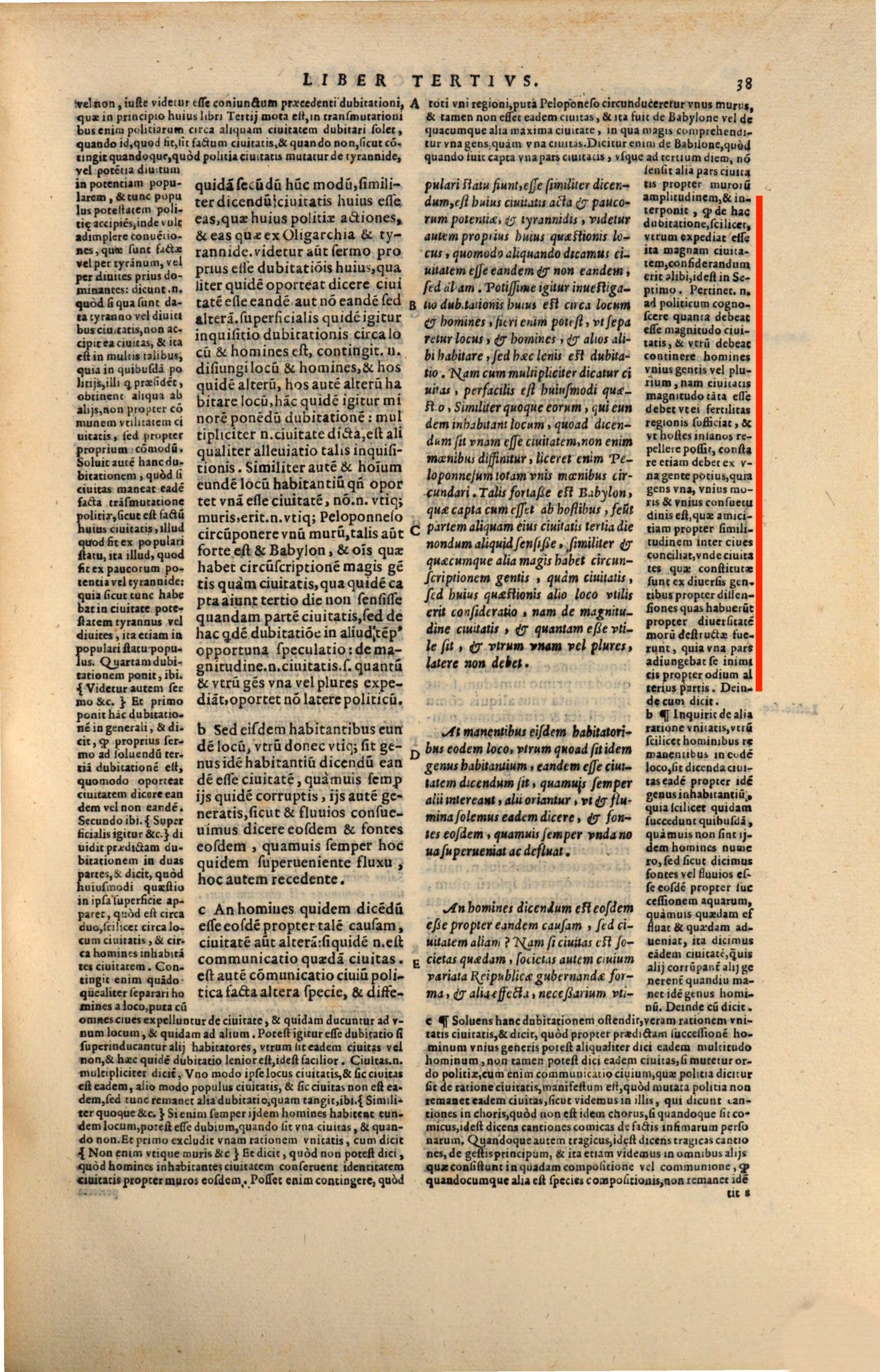
Polit., II c. 4 and 5.
Com. in Polit., 1. III, lect. 2.
Regarding the right to incite sedition against the established power of the state, see what Peter of Alvernia teaches, completing the commentary of St. Thomas on Aristotle’s Politics: “...for someone to incite sedition in the commonwealth, it is necessary that he have a just cause and power: but the virtuous, as is frequently the case, do not have power, nor do they think that they have a just cause: therefore they do not incite. But if these things were to concur, that they had a just cause and power, and there was no detriment to the common good, they would incite sedition reasonably, and would sin if they did not incite.” (Com. in Polit. 1. V, lect. 1).
Job, VII, 1.