

“For a moment, some intelligent people… seemed to admit that the Encyclical Immortale Dei supported Dupanloup’s position. The Encyclical Libertas shattered these illusions. No, no, no; Leo XIII never uttered a single word, not a single word, that the partisans of liberalism could rightfully claim as their own.”
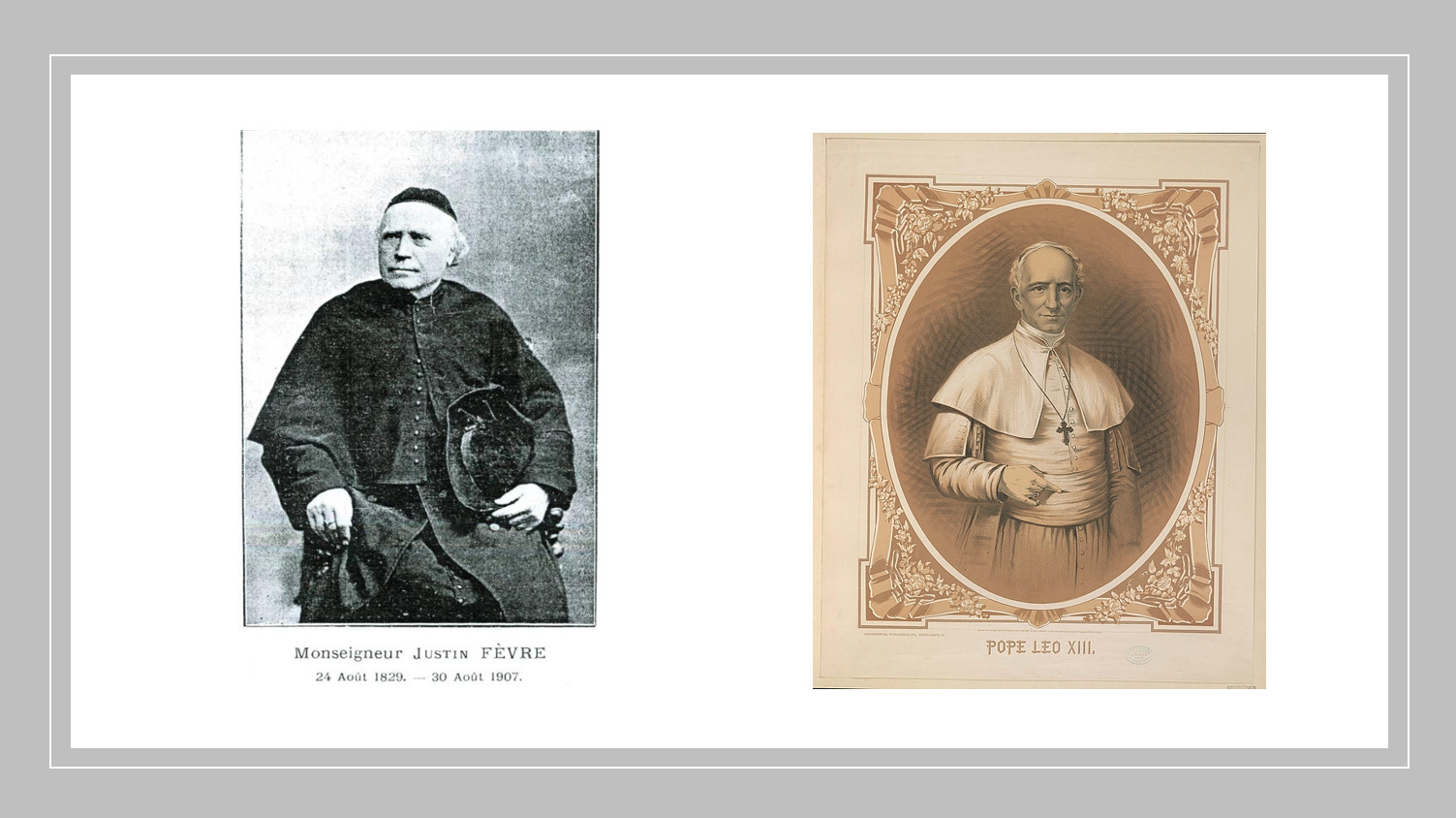
Leonine Revisionism
Those misguided persons today who, in earlier times would be branded with the name “liberal Catholics”, sometimes attempt to present Pope Leo XIII (reigning from February 20, 1878, until his death on July 20, 1903) as an agent of liberalism, which is an absurdity to anyone with even a cursory knowledge of his pontificate. Others, more intelligent but possibly lacking in integrity, concede that Leo XIII was thoroughly anti-liberal in his magisterium, his doctrinal pronouncements and in the exercise of the papacy, but attempt to represent the august pontiff as sympathetic to their cause in the practical order. The Ralliement “Rallying” to the French Republic is the most [in]famous example. That said, is there any merit to this latter view and, if yes, to what extent?
Rest assured, the facts of history do not bear this out,1 nor will the contemporary testimony of our featured author, Monsignor Justin Fèvre, confirm this. Rather, his 1907 analysis dispels any such notion of liberalism on the part of Pope Leo XIII, either in the theoretical order (of course, impossible in his divinely assisted magisterium), or in the practical order. Importantly, Monsignor Fèvre begins his treatment by distinguishing between a liberal, properly understood and characterized by the adherence to revolutionary, rationalist and individualistic ideas, from the liberal man who displays the true virtue of liberality. The latter case is legitimate and not really the thrust of the accusation as we will see.
Before providing a brief biography of Monsignor Fèvre in order to establish his ecclesiastical credentials and authority in judging this matter, we would like to review two key details about the anti-liberal bonafides of the Pope in question, namely Leo XIII. First, which may come as a surprise to many Catholics, it was then-Cardinal Joachim Pecci, himself, who conceived of the idea of a “Syllabus” to capture and refute the prevailing errors of the day. Needless to say, this was prior to his becoming Pope and, throughout his pontificate through many encyclicals (notably in Quod Apostolici Muneris, 1878; Diuturnum, 1881; Libertas, 1881; Immortale Dei, 1885) he would confirm and implement the timeless, all-important condemnations of the Syllabus of 1864 promulgated by his predecessor, Pope Pius IX. The history from the French Dictionnaire de théologie catholique “Dictionary of Catholic Theology” is as follows:
It was Cardinal Joachim Pecci, the future Leo XIII, who first conceived, without a doubt, the idea of an act in the style of the Syllabus. He was Bishop of Perugia and, in that capacity, participated in the work of the provincial council of Spoleto in 1849. On his initiative, the council addressed a petition to Pope Pius IX, asking him ‘to list, in the forms they have assumed in our time, all the errors against the Church, authority, and property, and to condemn them by assigning them a specific penalty’ (emphasis added).2
Turning now to the most contentious issue surrounding his pontificate, the aforementioned Ralliement, we find another vindication of Pope Leo XIII even though this policy of rapprochement ended up being a disaster—especially in hindsight.
However, we know that Pope Leo XIII proposed the “rallying” to the French Republic as a matter of practical policy, as an entirely strategic maneuver which aimed at re-installing authoritarian monarchy as the government of France. In other words, it was a call for loyal Catholics to defend the interests of the Church by way of constitutional means, without legitimizing the liberal and secular principles of the French Third Republic. In a private letter to Monsignor de Cabrières, who would later be elevated to the cardinalate by Pope St. Pius X in 1911, Pope Leo XIII expressed his sympathies for monarchical government and confirmed the strategic objective of the Ralliement:
If you follow my advice, you will have four hundred Catholic deputies in France, and you will establish the monarchy. I am a monarchist myself (emphasis added).3
For our readers who are interested in learning more about this complex situation in France and the history of the present crisis in the Catholic Church, we would recommend two, introductory videos from Mr. Theo Howard of The Two Cities Podcast:
Finally, at the end of this treatment from Monsignor Fèvre, the Ralliement will be discussed, offering further evidence of the strategic aim of Pope Leo XIII to overthrow the yoke of Freemasonry and liberal radicals in the Third Republic.
Fèvre’s Biography
Monsignor Justin Louis Pierre Fèvre was a French clergyman, teacher, writer, bibliophile and journalist. Born in Riaucourt in 1829, the son of a schoolteacher, he would begin his ecclesiastical education at seminary in Langres. During this time, he developed a strong foundation in theology and Catholic doctrine. At the age of twenty-three, Fèvre was ordained a priest and began his ministry with a focus on education and pastoral care. From the beginning, he was committed to ultramontane principles which would define his life’s work.4
Despite, or perhaps in consequence of his polemical disposition, Fèvre’s ecclesiastical career advanced within the Church earned him the title of apostolic protonotary (Monsignor) in 1878, followed by honorary positions as vicar general of Gap and Amiens. From 1889 until his death, he directed the “Revue du monde catholique,” using the publication as a platform to promote intransigent Catholicism and critique liberal influences within the Church and broader French society.5
A prolific writer, Monsignor Fèvre authored numerous works on Church history and papal authority. One of his most famous is the “Histoire critique du catholicisme libéral en France jusqu’au pontificat de Léon XIII.” Fèvre was always a staunch advocate for ultramontane ideas, emphasizing papal infallibility and opposition to modernist reforms. He left behind an influence on Catholic thought in France, Belgium and Canada. In 1907, Monsignor Fèvre died while in Saint Dizier6 and went to his eternal reward, leaving behind an impressive body of work.
Now, without further ado, The Journal of American Reform is pleased to present this invaluable 1907 analysis—translated for the first time into English—from Monsignor Fèvre on the alleged liberalism of Pope Leo XIII.
The Liberalism of Leo XIII — Was Leo XIII, as is often said, a liberal Pope?
I.
To answer this question clearly, we must first explain what is meant by this adjective.
According to simple reason, liberal has two main meanings: 1° it means generous in ideas, feelings, or works; 2° it means a supporter of the doctrine qualified by the word liberalism.
In the first sense of the word, everyone should be liberal, and, in a certain sense, everyone is, at least in some circumstances. However, to be distinguished by this epithet, an accidental or temporary generosity is not enough; one must be generous habitually, by turn of mind, inclination of feeling, dominant of works; a few acts of generosity, as there are in every life, would not be enough to be called liberal.
Was Leo XIII liberal in this sense? Yes, Leo XIII was liberal in the sense that there were, in his life and during his pontificate, many acts of remarkable generosity, acts dictated by his high position and which he could not fail to perform without losing his dignity. But was he liberal at heart, by natural inclination, by his very nature, by a graceful surrender of character? No, in this sense, he was not liberal; he was rather the opposite, having been, throughout his life, a man of thought and reserve, drawing his inspiration from his intellect and making decisions only according to the dictates of his wisdom. Generosity, like everything else, had its source there and flowed from it only according to the order of his counsel.
Was Leo XIII liberal in the narrower sense of financial extravagance? No, not yet; Leo XIII did not want debts, he kept his affairs in order, and, in the handling of funds, he was rather economical with money. And this should not be taken in a negative light; economy and restraint are also virtues that take precedence over generosity. A generosity that was neither economical nor wise would have another name.
Now, was Leo XIII, through his doctrines and actions, politically liberal in the sense given by the Charter of the Revolution; or only in the more restricted sense, expounded by Dupanloup in his book on Religious Pacification, published in 1845?
A Pope cannot be liberal in principle, in the sense of the Revolution, since the principles of the Revolution were condemned by Pius VI as contrary to the good of society and the Church; and condemned and proscribed more solemnly by Pius IX in the Syllabus, a synthesis of all liberal errors, whose condemnations Leo XIII himself authenticated more than once. — A Pope can be even less liberal in fact, in the revolutionary sense; for the acts of the Revolution, as such, are so many attacks against religion, against the Church, and against the Holy Apostolic See.
In the narrower sense, in Dupanloup’s sense, in the sense of reconciling the Church with modern society, Leo XIII, despite being urged to do so throughout his pontificate, was not liberal either. Read all his acts with keen eyes and an understanding mind; you will not find a single word that can be justified for the partisans of liberal Catholicism. For a moment, some intelligent people, like Emile Ollivier and Maurice d’Hulst, seemed to admit that the Encyclical Immortale Dei supported Dupanloup’s position. The Encyclical Libertas shattered these illusions. No, no, no; Leo XIII never uttered a single word, not a single word, that the partisans of liberalism could rightfully claim as their own.
To examine the question more closely, practically speaking, is Leo XIII not at least suspected of liberalism? — The answer depends on the meaning given to the word practically. Liberalism starts from the principle that truth is self-sufficient; that it is enough to speak it to assert its validity, and that its full and complete expression is sufficient for claiming one’s rights and fulfilling one’s duties. — Leo XIII, certainly, spoke the truth in its entirety; He said it to the extent that circumstances demanded it; he said it everywhere, always, at the right time and out of the right time, with no other concern than to honor the duties of his office. Whether he did so practically, in the spirit of liberalism, would require scrutinizing his intentions, and that is beyond anyone’s power. It is clear that he said everything that needed to be said, that he said it as it needed to be said, with all the desired accuracy and precision. But nothing proves that he intended it to be done for the benefit of liberalism.
The last refuge of the liberalism accusation against Leo XIII would consist in saying that this Pontiff, in all his papal acts, confined himself to expressing the truth, to stating right and duty, without commanding, by order, the respect of the one and the fulfillment of the other. But that, in fact, cannot be said; For Leo XIII knew how to give orders and issue prohibitions. The only thing that would remain in favor of the accusation is that Leo XIII, especially in his dealings with the French government, pursued a course of conciliation from the first to the last day of his pontificate. This conduct is not an act of doctrine, it is an act of government, an act of sovereignty. The Pope adhered to this resolution of condescension, to this course of delay, for reasons that seemed sound to him, the effect of which did not meet his expectations, the failure of which must have poisoned his soul, especially when, on the last day of his life, he could see that his forbearance, his kindness, his wisdom led to this wicked law of separation, which is, in its true name, nothing but a law of suppression by oppression, a solemn outrage, hurled not only at the Catholic religion and the Roman Church, but at all the facts of history.
II.
Pope Leo XIII was therefore, in no sense of the word, a liberal pope; was he more of a conciliatory pope?
Some writers divide the successors of Saint Peter into two categories: the intransigent popes and the conciliatory popes. Indeed, one can hardly deny, when considering the pontificates as a whole, that some seem more inclined toward conciliation, others toward intransigence. Popes are men; they have diverse temperaments and different minds; they are influenced more or less by the spectacle of events and by their interactions with people. The outcome of their pontificates can be wisely assessed, must allow for all shades of judgment, from the most demanding integrity to the most amiable conciliation; but, in our view, this is not the point of the question.
The question posed here is not a historical one, but a dogmatic one. The question is whether a Pope can be exclusively intransigent or exclusively conciliatory; to such an extent that he is entirely one and cannot be in any way the other. The question, posed thus, is meaningless. Let a Pope, as a man, be whatever he wishes, as soon as he becomes the successor of Saint Peter, the Vicar of Jesus Christ, he becomes, by his title and by the tradition of the Holy See, the custodian of the Gospel, the legal continuator of his successors, the man who must apply immutable dogmas and sacred laws to the governance of humanity. By virtue of his divine mandate, the successor of Saint Peter holds the place of Jesus Christ: he fulfills his function as Jesus Christ would have fulfilled it, had he not ascended to heaven With this difference, however, that Jesus Christ was both God and man; and that the Pope is only a man, but a vicar of God. As a man, he has the weaknesses and sinfulness of humanity; as vicar of the God-man, he has received the prerogatives of sovereignty, infallibility, and unity necessary for his anointing. As a man, he can be a conciliator as long as he wills it; as Vicar of Jesus Christ, he can only, in his public function, possess charity and intransigence. His infallibility does not entail his impeccability; it only implies that in matters of faith, morals, and general discipline, he cannot fall into error.
The doctrinal infallibility of the sovereign pontiff is less extensive than the sovereignty of his government. Infallibility has a very limited object: its exercise is, moreover, rare; it serves more to defend revealed truth against attacks than to extend it through dogmatic definitions. The Pope’s unique and sovereign government, on the contrary, is daily and constant. The Pope has the solicitude of all the churches; his authority applies, directly and immediately, to all the dioceses Through appeals, consultations, and the events and incidents of daily life, he is led to offer opinions, advice, and guidelines on every matter. In this daily practice, he has the assistance of Jesus Christ and the illuminations of the Holy Spirit; the intervention of miracles is commonplace, habitual in his life. Furthermore, he has the counsel of the cardinals, the aid of the congregations, and the support of the various dicasteries. In addition, he receives, through visits or correspondence, a wealth of information to receive or verify. The Vatican is the place in the world where one knows best what is happening in every corner of the universe. From his bedroom window, a Pope sees the whole world. Under these circumstances, the Pope possesses, along with the governance of souls and the administration of affairs, all the elements of singular wisdom. The marks of this wisdom are evident in all his responses. In practical terms, when one visually assesses the heaps of papers and affairs upon which the judgment of the Roman Pontiff must fall, one is astonished that a single man can recognize himself in them; and one invariably admires the admirable prudence that presides over all his advice.
But in this respect, the Pope is not infallible; he judges according to his wisdom; it is great, it is privileged, it excites the admiration of history throughout the ages. But ultimately, by the force of circumstances, by that element of uncertainty and obscurity inherent in human affairs, it may not always reach perfection and may have its flaws. There is perhaps no pope in whose life one cannot find omissions or gaps. This is the nature of human affairs; it would be a marvel if there were none; but if such omissions are found, they turn against neither the institution nor the man. This is so because it cannot be otherwise.
Hence the diverse judgments that historians, in good faith and with complete fairness, make about the Popes of different centuries. Historians, too, can err; they can, in their accounts, exaggerate things for better or for worse; but where they are not mistaken, in principle, is when they admit diverse perspectives and different assessments. If they can be mistaken about the details, they are not mistaken on the point of seeing things from different angles, of making diverse judgments, always approaching, like asymptotes, the line, without perhaps ever reaching it.
We are not raising the question of material error here. It is certain that any historian can be ignorant of something and deceive himself. We are only saying that if, in practice, in human affairs, there is no absolute good, one can only attain a relative perfection, which leaves room for desires, but without implying condemnation of a power whose perfection, certainly very great, cannot always reach the summit of perfection for everything.
The infallibility of the Pope does not entail the possibility of error; the government of the Pope cannot be without error, to a small degree, no doubt, but still to some degree. This flaw, inherent in human affairs, necessary, inevitable, does not touch the halo that encircles the brow of the Roman Pontiffs. The Roman Pontiffs are the demiurges of humanity; their status as vicars of Jesus Christ, proven by the infallibility of their decisions, is also proven by the unwavering prudence of their government. The mark of man is clearly visible there; the sign of God is even more clearly visible. What is human even highlights God’s share in a more vivid and brilliant splendor. — Those who deny this are the moles of history; they cannot see clearly and proclaim foolishly.
III.
These principles are undeniable; we must now examine them in practice; and, so as not to lose ourselves in vagueness, concretize them in a contemporary event.
“God,” says Leo XIII, in the Encyclical Immortale Dei, “divided human government between two powers: the ecclesiastical power and the civil power; the former being in charge of divine matters, this latter in charge of human affairs. Each of them, in its own way, is sovereign; each is enclosed within perfectly determined limits, drawn in accordance with reason and its specific purpose. There is, therefore, as it were, a circumscribed sphere, in which each power exercises its own right. Each has its sovereignty, and neither is bound to obey the other, within the limits in which each is confined by its constitution, for the management of the interests that fall within its competence.”
According to this teaching of the Pope, the distinction between the political and religious domains must be maintained; but at the same time, their necessary relations must be maintained, and, by reason of their distinct object and end, coordinated with one another in their relations. “If it is true,” says Abbot Barbier, “that politics is and can only be the application of morality to the government of the country, in Christian states, and if morality is essentially linked to religion, it clearly follows that the Church, the Pope, guardian of morality and religion, has, as such, a right to intervene in politics. The Church derives this right from the threefold power doctrinal, legislative, and judicial, inherent in its divine constitution. No Catholic can contest or evade it. — It was by exercising this right that the sovereign pontiff, Leo XIII, in his Letter to the French, reminded them of the obligation to accept the established government, to submit to the just laws emanating from it, and the duty of Catholics to rise above party divisions in order to concentrate their efforts on resisting the anti-religious conspiracy.”7
The morality of civic and political acts is directly subject to the Pope, but papal policy and its diplomatic directives only claim this authority insofar as they address and achieve the relationship between politics and morality and religion. Beyond that, they are in no way binding in conscience. “This policy,” says Abbé Barbier, “these directives, refer to questions of tactics; they vary with the times, places, circumstances, and individuals, and are subject to misinterpretations even among the most enlightened Popes.”
Outside of his own ministry, a Pope is constantly engaged in business and daily negotiations, matters within his purview, with all the governments of the world. As for Pope Leo XIII, after the intransigent reign of Pius IX, he inclined, as early as 1878, towards more consideration towards political powers and liberal opinion. In France, in particular, he advised rallying to the republican form of government. But he was careful to point out three things: 1° That he did not intend to overstep the limits set by his predecessors regarding the respective value of political forms; 2° that he did not want to disturb anyone’s conscience and, on the contrary, wished to respect the traditional convictions of the old families; and 3° that he distinguished between the constitution and legislation, and that, consequently, French Catholics, faithful and exemplary observers of the republican constitution, should employ all the resources of their genius, zeal, and courage to combat the anti-Christian legislation of the sectarians currently in power. — One can even say, without exaggeration, that, through his various interventions, the Pope wanted to facilitate the Catholics’ accession to power and, consequently, overthrow the Freemason sectarians.
It is impossible, without willful blindness and outright insult, to attribute to Pope Leo XIII even the most remote intention of favoring opportunistic or radical sectarians. The Republic, as they understand it, is not a form of democratic and popular government; for them, it is a dogma, an impious belief, insofar as it affirms its irreconcilable opposition not only to the ideas and sentiments of the Gospel, but also to the fundamental truths of natural religion and philosophy. Their Republic is a crude, atheistic, and materialistic symbol that Freemasonry imposes as the basis of our legislation. For far too long, this has been the form in which the Republic has presented itself. She wants to impose on a free and Christian nation a government for which power is nothing if it does not serve to maintain the intolerant domination of a sect, which takes no account of the religious convictions of man, which does not want to leave religion any place in individuals, in families, or in French society.
We cannot, I say, without insulting Leo XIII, suppose him capable of connivant, however slightly, with the actions of these base and wicked beings, whose reign is a continuous assault on the fundamental institutions of humankind. That, for fear of the worst and hope of the best, he failed to resist them as promptly, as completely, as radically, as he should have, is possible. But he was not mistaken about the perversity of their ideas, the enormity of their laws, or the little hope of their repentance. While he harbored the hope that a grassroots Catholic movement, a sudden shift in opinion, or some kind of reversal could change the course of events, it was an illusion that deceived his expectations; but the fault does not lie with the Pope.
The fault lies with all those political schemers who bravely claimed the Pope’s protection, and who, in France, under the pretext of following papal directives, constantly distorted and deflected them to secure the benefits of a national derailment. That a De Mun and a few others attempted, on the purely political front, reaction and counter-revolution, was their right and perhaps even their duty. Their failure proves nothing against the legality and probity of their initiative. But others were less loyal; without any intention of obeying the Pope, following his advice, or ensuring the success of his policies, they simply fabricated opinions based on common law and various centrist viewpoints, thereby, far from serving the Christian cause, they undermined it. We have seen this sorry game continue for years; I wonder if it isn’t still continuing under Pius X, while the sectarians finish demolishing the Church and losing France.
But to attribute such aberrations to the heroic Pius X and the temporizing Leo XIII, no, no, no. These actions are not their doing, and cannot be their fault. It is the fault and the crime of the right-wing sectarians for whom the republic and democracy are, in essence, little more than machinations of hell, but a hell more idiotic than wicked, perverse nonetheless. — We do not wish to personalize this debate.
JUSTIN FÈVRE, Apostolic Protonotary.
END.
CONSIDER SUPPORTING THE JOURNAL OF AMERICAN REFORM!
As I intend to devote more and more time to this political project, I want to continue to provide free, educational material, whether visual (graphics) or written (essays, translations and a forthcoming book) content. If you have benefited from my work in any way, kindly consider supporting The Journal financially. On a personal note, I am married and duty-bound to provide for my family, so any help, big or small, is appreciated. Subscribe or make a one-time donation.
Regardless, the production of free material will continue, hopefully with ever-increasing quality, and I will keep all my subscribers notified of my plans.
In addition to Substack, the home of The Journal, my work, graphics and commentary can be found on the following platforms:
X: @AmericanReform_
Telegram: @American_Reform
Fr. Francesco Ricossa, The painful wound of the ‘Ralliement’ by Catholics to the French Republic under Leo XIII (1890-1903), Sodalitium, (2021), No. 72, pp. 34-40.
Oscar L. Arnal, Why the French Christian Democrats Were Condemned, Church History, (1980), Vol. 49, No. 2, p. 201.
Bibliography of Justin Fèvre, Babelio.
Mgr JUSTIN FÈVRE par lui-même, Liberius, p. 26.
Bibliography of Justin Fèvre, Babelio.
Rome et Faction libérale populaire, p. 10.